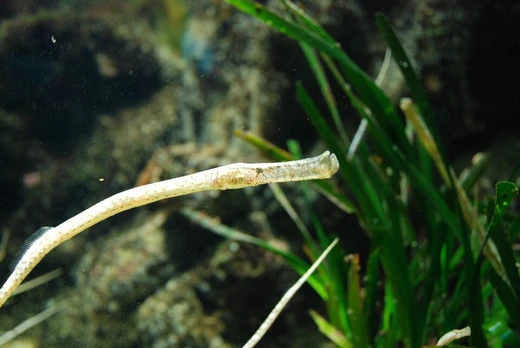
Alligator pipefish
A camouflaged pipefish that anchors with its prehensile tail.

The alligator pipefish, also known as the double-ended pipefish (Syngnathoides biaculeatus), is the sole member of the genus Syngnathoides within the Syngnathidae family. This fish lives in shallow tropical and subtropical waters across the Indo-Pacific, from East Africa to northern Australia. It makes its home among seagrass and seaweed, where it blends in by hanging vertically with its head pointing down, mimicking the surrounding plant stems. Its long, well-camouflaged body can reach up to 29 cm (11 in) in length. To feed, it simply sucks in its prey.
The head is narrow, with a pair of short tentacles at the tip of the snout. The body is elongated and tetrahedral in shape. It has a dorsal fin with 38 to 48 soft rays and an anal fin with 4 soft rays. The tail is long, tapering, and prehensile—it lacks a tail fin and is used to grip onto vegetation. Coloration usually matches the environment, typically green, brown, or grey. Females often have blotches and may display a white zigzag line along their belly.
This species is found in the tropical and subtropical Indian and Pacific Oceans, from South Africa, East Africa, and the Red Sea to India, Japan, Indonesia, the Philippines, New Guinea, Australia, and various Pacific islands. In Australia, its range stretches from Geraldton in Western Australia, around the Northern Territory and Queensland, down to Batemans Bay in New South Wales. It inhabits lagoons, reef flats, bays, estuaries, seagrass meadows, and floating algae mats, usually at depths less than 5 m (16 ft).
The alligator pipefish is a poor swimmer, moving by undulating its pectoral and dorsal fins. It eats zooplankton and small creatures, sucking them into its mouth. Its diet includes amphipods, mysids, shrimp, other benthic invertebrates, and small fish. Males are larger than females and reach maturity at about 180 mm (7 in). Breeding occurs in summer in Moreton Bay, Queensland, but can happen year-round in Papua New Guinea. Females produce 60 to 200 eggs, which the male carries in a brood pouch on his abdomen until they hatch. The pair appears monogamous, with all developing eggs at the same stage, likely from a single female.
This fish is dried and used in traditional Chinese medicine, where it is called "hailong." It is also sold for home aquariums and kept in public aquariums.
Quick Facts
- Taxon
- Syngnathoides biaculeatus
Facts from the source article.
Lore & Background
The alligator pipefish has an elongated, well-camouflaged body that can reach 29 cm (11 in) in length. Its narrow head has the snout tipped by a pair of short tentacles, and the body is tetrahedral. The tail is long, tapering, prehensile, and lacks a tail fin, being used to anchor the fish to vegetation. Colour tends to match its surroundings, usually some shade of green, brown, or grey; females are often blotched and may have a white zigzag line running along the abdomen.
It is an inefficient swimmer, moving by an undulating motion of its pectoral and dorsal fins. It feeds by sucking up prey, including zooplankton, amphipods, mysids, shrimps, other benthic invertebrates, and small fish. The species is sexually dimorphic, with males larger than females. Breeding takes place during summer in Moreton Bay, Queensland, but occurs at any time of year in Papua New Guinea. A female produces a batch of 60 to 200 eggs, which are retained by the male in a brood pouch on his abdomen until they hatch. The male and female seem to have a monogamous relationship, with all developing eggs at the same stage, presumably from a single female.
Reader's Guide
The alligator pipefish is notable as the only species in the monotypic genus Syngnathoides. It is dried and used in traditional Chinese medicine, where it is known as 'hailong'. The fish also appears in the pet trade for home aquarium owners and is kept and reared in public aquariums. No studies on the population trend for this species have been done, and the International Union for Conservation of Nature does not know where the traded fish are acquired; it is unclear whether these are wild-caught fish, whether there are dedicated fisheries for this species, whether the fish are caught as bycatch, or whether they are captive-reared. For these reasons, the IUCN considers it has insufficient information to assess the conservation status and has listed it as 'data deficient'. It is a listed marine species under the Australian Environment Protection and Biodiversity Conservation Act 1999. Its range extends from South Africa and the Red Sea to Japan, Australia, and various Pacific Islands, occurring in lagoons, reef flats, bays, estuaries, seagrass meadows, and floating masses of algae.
Did You Know?
- The alligator pipefish is the only species in the monotypic genus Syngnathoides.
- It hides by positioning itself vertically with its head down amidst vegetation.
- Males are larger than females and retain eggs in a brood pouch on the abdomen.
- It is known as 'hailong' when used in traditional Chinese medicine.
Physical Form and the Art of Slow Motion
The bay pipefish is a slender, ten-inch creature whose entire body plan is built around stillness rather than speed. Its elongated, sinuous frame is encased in bony plates that run the full length of its body, providing both structural support and a degree of armor against predators. The green coloration and undulating shape let it vanish among the swaying blades of eelgrass across the Eastern Pacific, from Southern Baja California up to the Gulf of Alaska. What makes its locomotion particularly striking is how limited it is: the dorsal and pectoral fins are small and weak, rendering the fish a genuinely poor swimmer. Instead of powerful fin beats, the pipefish orients its direction by steering with its head. A reduced caudal fin helps it hold a vertical posture against seagrass stems, while its prehensile tail allows it to wrap around blades and mimic the grass itself. This combination of traits means the pipefish is less a swimmer than a drifter, a creature that moves through its world with deliberate, unhurried precision.
Courtship, Pregnancy, and the Male's Burden
Reproduction in the bay pipefish follows a pattern that would seem reversed to most observers. During the breeding season, which spans at least six months, it is the female who takes the lead in courtship, displaying vivid coloration to attract a mate. Pairs typically come together in the morning. The female then deposits roughly two hundred eggs over the course of about two hours into a specialized brooding pouch located at the front of the male's underbelly. From that point forward, the male carries the developing embryos for one to two weeks, nourishing them through his bloodstream via a connection to his abdominal wall. During this period he appears visibly pregnant. Notably, the relationship is far from monogamous: females have been observed mating with multiple males, a strategy made possible by their essentially unlimited egg supply. Offspring that emerge from the pouch mature into reproductive adults in under a year, completing the cycle with remarkable speed.
The Patient Hunter and a Seasonal Menu
The bay pipefish is a sedentary predator that relies on stealth and patience rather than speed. It wraps its body around seagrass stems, using its reduced caudal fin to maintain a vertical position, and simply waits, swaying with the current like another blade of grass. When prey comes within range, the pipefish slowly detaches, creeps forward, and then darts into the open water column to strike. Its toothless, elongated mouth works by suction, drawing in small crustaceans such as isopods, copepods, and amphipods. The mouth is small enough that larger amphipods are out of reach, though the pipefish can target the fleshy skin of bigger crustaceans when the opportunity arises. Its diet also includes algae, which it grazes during daylight hours—a necessity driven by the fact that it lacks a stomach. Seasonal shifts in the abundance of other organisms influence what the pipefish eats, meaning its menu is as much a product of the surrounding environment as of its own preferences.
Life in the Eelgrass and a Fading Home
The bay pipefish is tightly bound to seagrass habitats, particularly eelgrass beds, which stretch along the Pacific coast from British Columbia down to Baja California. It occupies the intertidal zone and waters reaching depths of ten to twenty meters, favoring coastal wetlands and open shallow waters. Its seasonal movements are tied to the vegetation: in spring it drifts into shallow vegetative areas, and by late fall it retreats to deeper channel habitats. A small number of individuals remain in the grass beds through winter, but most follow the seasonal rhythm. The degree of mobility varies with anatomy—pipefish with reduced caudal fins and prehensile tails tend to stay put near eelgrass canopies, while those with more developed caudal fins and richer surrounding vegetation show greater range. Although the species carries a least-concern conservation status, the eelgrass beds it depends on are declining worldwide due to habitat fragmentation and other human pressures. The pipefish itself is not endangered, but the slow erosion of its seagrass world poses a quiet, long-term threat to its populations.
Frequently Asked Questions
What is the Alligator pipefish?
The alligator pipefish (Syngnathoides biaculeatus), sometimes called the double-ended pipefish, is the sole representative of its genus within the Syngnathidae family. It is a small, slender marine fish with a long, narrow body adapted for life among aquatic plants.
How does the Alligator pipefish hide from predators?
It suspends itself vertically with its head pointing down, draping its body along seagrass or seaweed stems so it resembles just another piece of vegetation. Its elongated shape and muted coloration make it nearly invisible against the surrounding plant material.
How big can an Alligator pipefish grow?
A typical adult measures around 20 cm (8 in), while the largest recorded individuals reach about 29 cm (11 in). Males are generally considered sexually mature once they approach 180 mm (7 in) in length.
Where does the Alligator pipefish live?
Its range spans shallow tropical and subtropical waters of the Indo-Pacific, stretching from the East African coast to northern Australia. Within that range it favors seagrass beds and dense seaweed patches where it can anchor itself with its prehensile tail.
How does the Alligator pipefish reproduce?
As with other syngnathids, the male is responsible for brooding the eggs, with a single clutch containing roughly 60 to 200 eggs. After the young are released they drift into the open water column to begin their independent lives.
More in Seahorses and Pipefish 1-24
Spotted an error? Know more?
Reader corrections go straight into our review queue. Suggest an edit · How this site is sourced