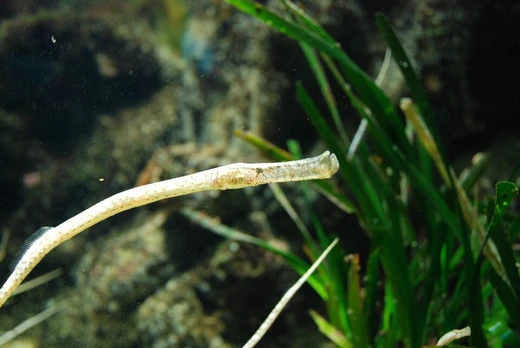
Entelurus
Largest European pipefish, expanded into Arctic waters in early 2000s.

Entelurus is a genus of pipefish within the family Syngnathidae, containing only the snake pipefish (*Entelurus aequoreus*). This species holds the record as the largest pipefish found in European waters, and its range pushed northward into Arctic regions during the early 2000s.
The snake pipefish has an extremely long, slender, and smooth body with a rounded cross-section. It stands out from other pipefish in the same area because its bony rings are almost absent. Its head is long, with a thin dark stripe along each side, a long concave snout, and a very small, protractile mouth. The dorsal fin is long-based and contains 37 to 47 short rays, while the caudal fin is tiny; there are no pectoral or anal fins. Coloration is pale brown or yellowish-green, with each of the 28 to 31 body rings marked by pale blue rings with dark edges. The gill opening is reduced to a pore above the opercle, and the gill membranes are fused to the body and the isthmus. Males reach total lengths of up to 40 cm (16 in), females up to 60 cm (24 in), though typical sizes are around 32 cm (13 in) for males and 45 cm (18 in) for females. Juveniles under 70 mm have membranous pectoral fins that vanish as they mature.
This species lives in the northeastern Atlantic, from Iceland and Norway south to the Azores, and into the Baltic Sea. It is absent from the Mediterranean. In the early 2000s, it expanded northward as far as Svalbard and the Barents Sea.
The snake pipefish inhabits more open and deeper water than other pipefish, at depths of 10 to 100 meters (33–328 ft). It lives among kelp, deep-water seaweeds, and seagrasses like *Zostera marina*, though both young and large adults have been caught in pelagic waters. Its color and pattern provide good camouflage in these settings. The spread of the invasive Japanese seaweed *Sargassum muticum* onto Wadden Sea sand flats has helped increase local snake pipefish numbers.
Breeding occurs in midsummer, when males and females pair up. The species is ovoviviparous: the female attaches over 1,000 fertilized eggs, each about 1.2 mm (0.047 in) across, to a sticky mucus layer in a groove on the male’s belly, where they stay until hatching. After birth, the fry are pelagic until they reach 12 mm (0.47 in) in length. Adults feed on small crustaceans and larval fish, sucking them into the mouth.
Quick Facts
- Genus
- Entelurus
- Species
- aequoreus
Facts from the source article.
Lore & Background
The snake pipefish has a very long, slender body with a smooth skin and rounded cross-section, distinguished from other sympatric pipefishes by the near lack of bony rings. It has a long head with a thin dark stripe on its sides, a long concave snout, and a very small protractile mouth. The dorsal fin has 37–47 short rays, the caudal fin is minute, and there are no pectoral or anal fins. Its coloration is pale brown or yellowish-green, with each of the 28–31 body rings marked by pale blue rings with dark margins. The gill opening is reduced to a pore above the opercle, and the gill membranes are fused to the body and isthmus. Juveniles under 70 mm have membranous pectoral fins that disappear as they mature.
It occurs in the northeastern Atlantic from Iceland and Norway to the Azores and into the Baltic Sea, but not in the Mediterranean. In the early 2000s it expanded northwards to Svalbard and the Barents Sea. It lives among kelp, deep-water seaweeds, and seagrass such as Zostera marina, at depths of 10–100 meters, and some individuals are caught in pelagic waters. Its color and patterning provide camouflage. The colonization of Wadden Sea sand flats by the invasive Japanese seaweed Sargassum muticum has facilitated an increase in snake pipefish there.
Breeding occurs in mid summer, with males and females pairing up. The species is ovoviviparous: the female attaches over 1,000 fertilized eggs (each about 1.2 mm in diameter) to a layer of sticky mucus in a groove on the male's belly, where they remain until hatching. Fry are pelagic until they reach 12 mm in length. Adults feed on small crustaceans and larval fish, caught by suction. When populations increased in the 2000s, some seabirds (auks and terns) fed on these pipefish due to a decline in sand-eels, but the pipefish had limited nutritional value and many chicks choked on their hard bodies.
Reader's Guide
The snake pipefish is significant as the largest pipefish species in European waters and for its notable northward range expansion into Arctic waters (Svalbard and the Barents Sea) in the early 2000s. Its biology includes a unique reproductive strategy where males brood over 1,000 eggs on their belly. The species' increase in the 2000s had ecological consequences: seabirds such as auks and terns turned to feeding on them when their usual prey, sand-eels, declined, but the pipefish's bony structure and low nutritional value caused chick mortality. Additionally, the invasive Japanese seaweed Sargassum muticum facilitated population growth in the Wadden Sea. The snake pipefish's morphology—smooth skin, near absence of bony rings, and lack of pectoral and anal fins in adults—distinguishes it from other pipefish. Its etymology reflects its long tail (Greek entelès 'complete' and oura 'tail') and marine habitat (Latin aequoreus 'marine'). The species is not found in the Mediterranean Sea.
Did You Know?
- The snake pipefish is the largest pipefish species recorded in European waters, with females reaching up to 60 cm.
- Males brood over 1,000 fertilized eggs attached to a groove on their belly.
Frequently Asked Questions
What is Entelurus?
Entelurus is a single-species genus in the pipefish family Syngnathidae, represented only by the snake pipefish (Entelurus aequoreus). It is recognized as the largest pipefish occurring in European waters.
How big does Entelurus aequoreus get?
Males commonly reach about 32 cm and females around 45 cm, though maximum recorded lengths push to 40 cm for males and 60 cm for females. That makes it noticeably larger than most other pipefish in the same region.
What does Entelurus look like compared to other pipefish?
It has an extremely elongated, smooth body with a rounded cross-section, a long concave snout, and a tiny protractile mouth. Unlike many regional pipefish, its bony rings are nearly absent, and a thin dark stripe runs along each side of its long head.
Where can you find Entelurus in the wild?
The snake pipefish lives at depths of roughly 10 to 100 meters in European seas. During the early 2000s its range also pushed northward into Arctic waters, a shift that drew attention from marine biologists.
Why is Entelurus considered notable among pipefish?
It holds the size record as the largest pipefish in European waters, and its early-2000s expansion into Arctic regions made it a frequently cited example of shifting marine species distributions.
More in Seahorses and Pipefish 1-24
Spotted an error? Know more?
Reader corrections go straight into our review queue. Suggest an edit · How this site is sourced