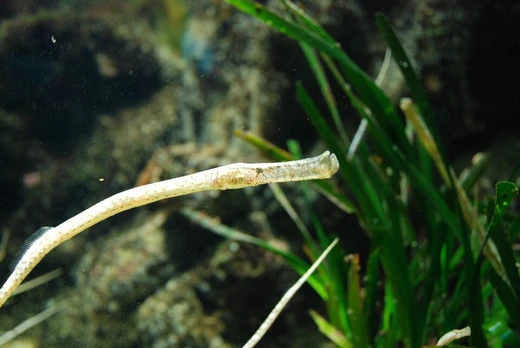
Flagtail pipefish
Colourful Indo-Pacific pipefish known for flashing patterned tails.

Flagtail pipefish is the common name for two genera in the Syngnathidae family: *Doryrhamphus* and *Dunckerocampus*. These fish live in warm, fairly shallow waters across the Indo-Pacific, except for one species, *D. paulus*, which is found in the eastern Pacific. Most are brightly colored and somewhat popular in saltwater aquariums, though they need special care and aren't suited for beginners. They get their name from the way they flash their patterned tails during courtship and other displays.
Adults are very territorial and usually stick to pairs. Their diet consists of tiny crustaceans and other small animals, and most *Doryrhamphus* species will sometimes act as cleaner fish.
*Doryrhamphus* species reach a maximum length of 14 cm (5.5 in) or less, with *D. janssi* being the only one that grows past 8.5 cm (3.3 in). Most have a horizontal blue line along the body, and all have a whitish-edged tail marked with black, red, or yellow. *Dunckerocampus* are more elongated, reaching 10 to 20 cm (3.9 to 7.9 in) in length, except *D. chapmani*, which stays under 15 cm (5.9 in). Their tail is red with a white edge, and some species have a white or yellow spot in the center. All but *D. baldwini* (and a similar, possibly undescribed species from the eastern Indian Ocean) have vertical red/brown and yellow/white stripes on the body.
Taxonomy of these genera is confusing because several species haven't been scientifically described yet, and some described ones are variable. German ichthyologist George Duncker first recognized the species now placed in *Dunckerocampus* as a separate genus, naming it *Acanthognathus* in 1912. But that name was already taken by a genus of ants, so the replacement name *Dunckerocampus* honors him. After a 1985 review, *Dunckerocampus* was generally treated as a subgenus of *Doryrhamphus*, but a 1998 recommendation put it back as a full genus, also adding the newly described *D. boylei*. When *D. naia* was described in 2004, it was placed in *Dunckerocampus* as well. Recent authorities usually recognize *Doryrhamphus* and *Dunckerocampus* as separate genera.
- Maximum length doryrhamphus
- 14 cm (5.5 in) or less
- Maximum length dunckerocampus
- 10 to 20 cm (3.9 to 7.9 in)
- Distribution
- Indo-Pacific, with one species (D. paulus) in the eastern Pacific
- Diet
- tiny crustaceans and other small animals
- Behavior
- adults are highly territorial and usually live in pairs; some Doryrhamphus species act as cleaners
Lore & Background
Considerable taxonomic confusion exists in these genera, both because a number of scientifically undescribed species remain and some already described species are variable. The first to recognise the species now placed in Dunckerocampus as worthy of a separate genus was the German ichthyologist George Duncker, who coined Acanthognathus in 1912. However, that name was preoccupied by a genus of ants, so the replacement name Dunckerocampus honours Duncker. Following a review in 1985, Dunckerocampus was generally considered a subgenus of Doryrhamphus, but in 1998 it was recommended that Dunckerocampus again should be a genus, and it should include the newly described D. boylei. When described in 2004, D. naia was also placed in this genus. Recent authorities generally recognise Doryrhamphus and Dunckerocampus as separate genera.
Reader's Guide
Flagtail pipefish are notable for their vivid colours and distinctive tail patterns, which they flash during courtship and other displays. They are fairly popular in the marine aquarium hobby, though they require special care and are not recommended for beginners. Adults are highly territorial and usually live in pairs. They feed on tiny crustaceans and other small animals, and most species from the genus Doryrhamphus will sometimes act as cleaners. The taxonomy of these genera has been subject to considerable confusion, with some species still scientifically undescribed and others variable. The genera were separated, then merged, then separated again, with recent authorities generally recognising Doryrhamphus and Dunckerocampus as distinct. The name Dunckerocampus honours German ichthyologist George Duncker, who first recognised the group as a separate genus. The species list includes several with disputed status, such as D. malus and D. melanopleura, which are treated as species by some authorities and as subspecies or synonyms by others.
Anatomy & Physical Form
The flagtail pipefish belongs to the subfamily Syngnathinae, whose name traces back to Ancient Greek words meaning "together" and "jaw," a nod to the fused jaw structure shared across the group. These small fishes resemble elongated, straight-bodied seahorses with a distinctive tubular snout that terminates in a tiny, upward-opening, toothless mouth. Their bodies and tails are long, thin, and serpentine, encased in a highly modified dermal skeleton that forms armored plating. Unlike most fish whose cross-section is round or oval, a vertical slice through a pipefish reveals an angular profile due to several longitudinal ridges running along the body. A dorsal fin is always present and serves as the primary or sole means of propulsion, while ventral fins are consistently absent. Most pipefish are weak swimmers, relying on rapid dorsal-fin movements to get through open water. The flagtail group, however, stands out with more developed caudal fins that grant them considerably stronger swimming ability compared to their seahorse relatives, which lack a caudal fin entirely.
Reproduction & Male Parental Care
In the world of pipefish, the male shoulders nearly all parental responsibility. After a female deposits her eggs into his brood pouch or onto a specialized patch of ventral skin, the male provides all postzygotic care, delivering nutrients and oxygen through a placenta-like connection. The brood pouch varies among species—some run along the entire underside, while others sit at the tail base. In the genus Syngnathus, a ventral seam can seal the pouch completely. Courtship is elaborate: in Syngnathus typhle, both sexes perform a conspicuous wriggling and shaking dance before copulation, a dramatic contrast to their otherwise secretive existence. Under predator threat, these displays diminish, copulation frequency drops, and females transfer more eggs per event. During the actual egg transfer, the pair rises through the water column, the male assumes an S-shaped posture, and fertilization occurs as they descend. Males with pouches release sperm directly inside and shake the pouch vigorously. The dual transfer of immune information—from mother via the egg and father via the pouch—gives offspring an additive immunological advantage not seen in other chordates.
Habitat & Conservation Pressures
Most pipefish are marine species thriving along tropical and temperate coastlines, typically reaching 35 to 40 centimeters in length. They favor sheltered environments such as coral reefs and seagrass beds, and only a handful of species inhabit freshwater. Their limited swimming capability confines them to shallow waters, making them particularly vulnerable to industrial runoff, recreational disturbance, and boat traffic that stirs up shoreline sediment. These pressures degrade the seagrasses and eelgrasses that form the backbone of pipefish habitat. Their narrow geographic distribution further compounds the risk, as they lack the capacity to relocate to new environments when conditions shift. Beyond habitat loss, pipefish face direct exploitation. In traditional Chinese medicine, they are prized over seahorses on the belief that their greater length confers higher potency, despite no evidence of efficacy beyond placebo. The aquarium trade has also intensified in recent years, adding another layer of pressure on already vulnerable populations.
Taxonomy & Evolutionary Context
The flagtail pipefish sits within the subfamily Syngnathinae, which, alongside seahorses and the two seadragon genera Phycodurus and Phyllopteryx, comprises the family Syngnathidae. The subfamily's name is a direct reference to a shared anatomical trait: a fused jaw, derived from the Ancient Greek sún ("together") and gnáthos ("jaw"). This grouping highlights a close evolutionary kinship among these unusual fishes, all of which share the elongated body plan and dermal armor that distinguish them from typical fish. The evolution of male brooding in pipefish is thought to have arisen because ancestral males that accepted and guarded eggs gained a reproductive advantage—protecting them from predation in a way that free-floating eggs could not. This strategy persists today in the form of brood pouches or ventral skin patches. A notable evolutionary twist is the dual-source immune transfer: unlike other chordates where only the mother passes immune information to offspring, pipefish receive it from both the egg and the brood pouch, creating an additive protective effect for developing young.
Frequently Asked Questions
What is a Flagtail pipefish?
It is the shared common name for two genera of pipefish, Doryrhamphus and Dunckerocampus, both members of the Syngnathidae family. These small, vividly coloured fish inhabit warm, shallow marine environments and are recognised for their striking tail patterns.
Where can I find Flagtail pipefish in the wild?
The vast majority of species inhabit warm, shallow waters throughout the Indo-Pacific. A single species, D. paulus, breaks the pattern by occurring in the eastern Pacific instead.
How large do Flagtail pipefish grow?
Doryrhamphus members generally cap out at around 14 cm (5.5 in), whereas Dunckerocampus species can reach anywhere from 10 to 20 cm (3.9 to 7.9 in).
Why is the name "flagtail" used for these pipefish?
The name refers to the distinctive way they wave or flash their ornately patterned tails during mating rituals and other social interactions, much like a small flag being displayed.
Can a beginner keep a Flagtail pipefish in a home aquarium?
Although their bright colours make them appealing to saltwater hobbyists, they demand specific husbandry and are not ideal for first-time keepers. Adults are strongly territorial and tend to form bonded pairs, so tank mates and space need to be carefully considered.
More in Seahorses and Pipefish 1-24
Spotted an error? Know more?
Reader corrections go straight into our review queue. Suggest an edit · How this site is sourced