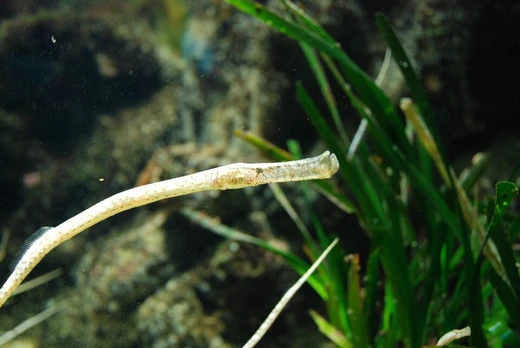
Corythoichthys flavofasciatus
A tropical pipefish with yellow and brown stripes.

The network pipefish, also called the reticulate pipefish or yellow-banded pipefish, is a marine fish belonging to the family Syngnathidae. Its range stretches from the Red Sea and Eastern Africa across to the Tuamotu Islands, the Ryukyu Islands, northern Australia, and the Austral Islands. It inhabits tropical lagoons and coral reefs, living from the low tide line down to depths of 25 meters.
Males of this species grow to about 12 centimeters (4.7 inches) in length. They have 26 to 36 dorsal soft rays. The body is marked with yellow and brown stripes, and the snout is red. Males develop orange stripes and bright light blue spots. The fish closely resembles *Corythoichthys conspicillatus*.
*Corythoichthys flavofasciatus* is ovoviviparous. It is likely monogamous and usually found in pairs. The male carries the eggs in a ventral pouch beneath the tail, and hatching takes about 10 to 12 days. Its diet consists of small invertebrates, primarily copepods, but also small isopods and ostracods. In French Polynesia, it is preyed upon by the honeycomb grouper (*Epinephelus merra*).
Some authorities consider *Corythoichthys flavofasciatus* to be restricted to the Red Sea, and that the fish found elsewhere in the Indo-Pacific is actually *Corythoichthys conspicillatus*.
Quick Facts
- Taxon
- Corythoichthys flavofasciatus
Facts from the source article.
Lore & Background
Corythoichthys flavofasciatus can be found from the Red Sea and Eastern Africa to the Tuamotu, the Ryukyu Islands, northern Australia, and the Austral Islands. It lives in tropical climates and is associated with lagoons and coral reefs at depths from the low tide line to 25 m. The body has yellow and brown stripes, while the snout is red; males develop orange stripes and brilliant light blue spots. This species is quite similar to Corythoichthys conspicillatus.
This species is ovoviviparous and probably monogamous, usually found in pairs. The male carries the eggs in a ventral pouch below the tail, with hatching time lasting 10–12 days. It feeds on small invertebrates, especially copepods, but also small isopods and ostracods. In French Polynesia, it is predated by Epinephelus merra.
Some authorities consider that Corythoichthys flavofasciatus is a species restricted to the Red Sea and that the species found in the remainder of the Indo-Pacific is Corythoichthys conspicillatus.
Reader's Guide
Corythoichthys flavofasciatus is significant as a representative of the family Syngnathidae, known for its unique reproductive strategy where the male carries the eggs in a ventral pouch. Its wide distribution from the Red Sea to the Austral Islands highlights its adaptability to tropical lagoons and coral reefs. The species is notable for its striking coloration—yellow and brown stripes with a red snout—and the brilliant light blue spots that develop in males. Its diet of small invertebrates like copepods, isopods, and ostracods places it within the reef food web, and it is preyed upon by the honeycomb grouper (Epinephelus merra) in French Polynesia. The taxonomic uncertainty regarding its distinction from Corythoichthys conspicillatus adds to its scientific interest, as some authorities restrict the true C. flavofasciatus to the Red Sea. This pipefish is also known by multiple common names, reflecting its recognition across different regions.
Taxonomic Identity & Classification
Corythoichthys flavofasciatus, commonly known as the Network pipefish, was first described by Rüppell back in 1838, making it one of the earlier documented members of its genus. It belongs to the family Syngnathidae, the broader group encompassing pipefishes and their close relatives. Within the genus Corythoichthys, it sits alongside eleven other currently recognized species, ranging from the Brown-banded pipefish to Waite's pipefish, whose inclusion remains debated. What makes the taxonomy of this group particularly interesting is that relationships among its members are still actively debated by ichthyologists. While twelve species are formally recognized, some researchers suggest the true count could reach at least twenty-three, implying that many of these pipefishes may not yet have been properly distinguished or described. The Network pipefish thus occupies a position at the center of an ongoing taxonomic conversation that continues to shape our understanding of reef fish diversity in the Indo-Pacific.
Habitat & Biogeographic Range
The Network pipefish inhabits the warm waters of the tropical Indian and Pacific Oceans, a vast biogeographic region that stretches across some of the world's most biodiverse marine environments. Like all members of the genus Corythoichthys, it is associated with reef habitats or rubble bottoms, the kind of structured, complex substrates that provide both shelter and foraging opportunities for small, slender-bodied fish. These environments are typically found in shallow coastal waters where coral formations and broken rock create a mosaic of microhabitats. The pipefish's elongated body and its network-like patterning, hinted at by its common name, would be well suited to blending into the intricate textures of living coral or scattered reef debris. Being a member of the Syngnathidae family, it shares its ecological niche with seahorses and other pipefishes, all of which rely on the structural complexity of reef systems for survival. Its presence across both the Indian and Pacific Oceans underscores the connectivity of tropical marine ecosystems along the equatorial belt.
Courtship Ritual & Male Parental Care
Reproduction in the Network pipefish follows a pattern characteristic of its genus, centered on seasonal pair bonding between males and females. Rather than forming permanent attachments, these pipefish come together during specific breeding periods, and individuals are most frequently observed as pairs hovering over reef substrates. The courtship ritual is a distinctive visual display: the male and female engage in a coordinated dance, circling and moving around one another above the seafloor in what appears to be a synchronized aerial performance. Once the pair has bonded for the season, the female deposits her eggs in a flat sheet and presses this sheet against the underside of her partner. The male then performs a remarkable physiological act, growing a layer of skin over the egg mass to enclose it in a protective brood pouch. Within a matter of weeks, tiny pipefish larvae emerge from this pouch, completing a reproductive cycle that places the entire burden of incubation squarely on the male.
Species Diversity & Ongoing Taxonomic Debate
The Network pipefish is one of twelve formally recognized species within the genus Corythoichthys, a group of pipefishes whose internal relationships remain a source of ongoing scientific discussion. The recognized roster includes species described across more than a century of ichthyological work, from Rüppell's 1838 description of the Network pipefish to Allen and Erdmann's 2008 identification of Benedetto's pipefish. Other members bear common names that hint at their distinctive markings, such as the Reticulate pipefish, the Ocellated pipefish, and the Black-breasted pipefish. Several species were described by C. E. Dawson in 1977, suggesting a period of intensive taxonomic revision. The genus is not without controversy: Waite's pipefish, described by Jordan and Seale in 1906, is listed as debated, and some researchers believe the true species count may extend to at least twenty-three. This taxonomic uncertainty means that the Network pipefish's precise evolutionary relationships to its close relatives are still being refined, keeping it a living subject of ongoing classification work.
Frequently Asked Questions
What is Corythoichthys flavofasciatus?
It is a small tropical pipefish in the Syngnathidae family, better known to hobbyists as the network pipefish, reticulate pipefish, or yellow-banded pipefish. Like its seahorse relatives, it is a fully marine species found throughout the Indo-Pacific.
Where does Corythoichthys flavofasciatus live?
Its range stretches from the Red Sea and East African coast eastward to the Tuamotu and Ryukyu Islands, northern Australia, and the Austral Islands. Within that zone it favors tropical lagoons and coral-reef habitats, ranging from the low tide line down to about 25 meters.
How big does a Corythoichthys flavofasciatus get?
Males reach roughly 12 centimeters (4.7 inches) at most. They also carry between 26 and 36 dorsal soft rays running along the back.
What does Corythoichthys flavofasciatus look like?
The body is decorated with a striking pattern of yellow and brown stripes, and the elongated snout is a vivid red. Males additionally develop orange coloration as they mature.
How long does Corythoichthys flavofasciatus take to hatch?
Eggs in the male's brood pouch typically take 10 to 12 days before the young emerge. This relatively short incubation suits its warm tropical lagoon and reef environment.
More in Seahorses and Pipefish 1-24
Spotted an error? Know more?
Reader corrections go straight into our review queue. Suggest an edit · How this site is sourced