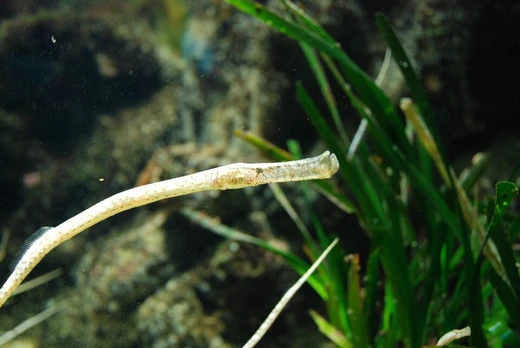
Haliichthys taeniophorus
A pipefish with a prehensile tail for vertical grasping.

The ribboned pipefish (Haliichthys taeniophorus), also known as the ribboned pipehorse or ribboned seadragon, is a species of pipefish found along the coast of northern Australia and New Guinea. It is notable as the only known member of its genus and for possessing a unique prehensile tail used for vertical grasping, a trait likely adapted for hanging on sea grasses.
Quick Facts
- Genus
- Haliichthys
- Species
- taeniophorus
Facts from the source article.
Lore & Background
The ribboned pipefish inhabits a range of environments along the coasts of northern Australia and New Guinea, from shallow weedy areas to deeper sandy bottoms down to 16.5 meters. It grows to a total length of 30 centimeters and displays colors from greenish yellow to brownish red. This species is the sole member of its genus, Haliichthys.
Its most distinctive trait is a prehensile tail used to grab things vertically, which likely evolved as an adaptation for hanging on sea grasses in a vertical orientation, contrasting with the typical horizontal hanging habits of other pipehorses on microalgae. The exact phylogenetic position of this species regarding the tail's evolution is uncertain, but it is hypothesized to be similar to other pipefish and seahorses such as the Southern little pipehorse and bastard seahorse due to shared intermediate skeletal morphology.
The ribboned pipefish possesses body plating on its ventral side similar to seahorses, and a rigid plate structure on its dorsal side like other pipefish. Because of this combination, it is often referred to not only as a pipefish, but also as a seahorse and seadragon.
Reader's Guide
The ribboned pipefish holds significance as the only known member of its genus, Haliichthys, and for its unique prehensile tail that allows vertical grasping—a trait likely developed for hanging on sea grasses. This adaptation sets it apart from other pipehorses, which typically hang horizontally on microalgae. The species' exact phylogenetic position regarding the tail's evolution remains uncertain, but it is hypothesized to share an intermediate skeletal morphology with other pipefish and seahorses, including the Southern little pipehorse and bastard seahorse. Its body combines seahorse-like ventral plating with pipefish-like dorsal rigid plates, leading to its common references as both a pipefish, seahorse, and seadragon. Found along the coasts of northern Australia and New Guinea in habitats from shallow weedy areas to deeper sandy bottoms down to 16.5 meters, it grows to 30 centimeters in length and displays colors ranging from greenish yellow to brownish red. The species' legacy lies in its evolutionary distinctiveness and the ongoing uncertainty about its phylogenetic relationships, which highlights the complexity of pipefish and seahorse evolution.
Did You Know?
- The ribboned pipefish is the only known member of its genus, Haliichthys.
- It possesses a prehensile tail used for vertical grasping, likely adapted for hanging on sea grasses.
- Its colors can range from greenish yellow to brownish red.
Range, Habitat, and Physical Profile
The ribboned pipefish occupies a broad stretch of Indo-Pacific coastline, spanning from Shark Bay in northwestern Australia all the way to the Torres Strait, and extending across both West New Guinea and Papua New Guinea. Within this range it is not confined to a single environment. Instead, it tolerates a wide spectrum of substrates and water conditions, from shallow, weed-choked shallows to deeper, sandy seafloors at depths reaching 16.5 metres (about 54 feet). Adults can grow to a total length of 30 centimetres (roughly 12 inches), making them a moderately sized member of the pipefish family. Their coloration is notably variable, shifting across a palette that runs from greenish yellow to brownish red, presumably offering camouflage against the diverse backgrounds they inhabit. This combination of wide geographic spread, depth flexibility, and color plasticity paints a picture of a species well adapted to the heterogeneous coastal environments of northern Australia and the New Guinea region.
The Prehensile Tail and Vertical Grasping
One of the most striking features of Haliichthys taeniophorus is its prehensile tail, a trait that sets it apart from most of its relatives. Rather than the typical pipehorse strategy of draping horizontally over microalgae, this species has evolved to grasp its surroundings vertically, wrapping its tail around upright structures such as sea grasses. This shift in orientation likely represents an adaptation to a specific ecological niche where vertical grasping conferred a survival advantage, perhaps in weedy habitats where upright vegetation offered better anchorage. The tail's evolution is described as exclusive to this species' own phylogenetic lineage, meaning no close relative shares the same mechanism. What makes the situation particularly fascinating is that, despite this unique adaptation, the exact phylogenetic placement of the species remains uncertain. The tail's origin and the precise evolutionary pathway that produced it are still subjects of hypothesis rather than settled fact, leaving researchers with an intriguing puzzle about how a single morphological innovation can reshape an animal's entire ecological strategy.
Skeletal Morphology and Phylogenetic Ambiguity
The ribboned pipefish occupies a genuinely ambiguous position within the broader family of pipefishes, seahorses, and seadragons. Its skeleton reveals a blend of features that bridge these groups. On the ventral side, the body plating closely resembles that of seahorses, while the dorsal side displays the rigid plate structure characteristic of other pipefish. This intermediate skeletal morphology is shared with species such as the Southern little pipehorse (I. australe) and the bastard seahorse (A. gracilissima), suggesting a common evolutionary thread that has not yet been fully resolved. Because of this morphological overlap, the species is frequently described under multiple common names—pipefish, seahorse, and seadragon—reflecting the difficulty of slotting it neatly into a single category. The uncertainty is compounded by the fact that the prehensile tail, its most distinctive trait, has no clear parallel in these close relatives, making it hard to determine whether the tail evolved independently or represents a modification of a shared ancestral structure. The result is a species that defies easy classification.
Taxonomic Singularity and the Puzzle of Common Names
Haliichthys taeniophorus stands alone as the only known member of its genus, a fact that underscores just how distinct this species is from anything else in the pipefish and seadragon radiation. This singular taxonomic status is mirrored in the confusion surrounding its common names. Depending on the source or the observer, it may be called the ribboned pipefish, the ribboned pipehorse, or the ribboned seadragon—three labels that each emphasize a different aspect of its morphology. The pipefish designation highlights its elongated body and rigid dorsal plating; the pipehorse nod acknowledges its seahorse-like ventral structure; and the seadragon label captures its overall sinuous, dragon-like appearance. None of these names is wrong, and all are in common use, which speaks to the species' position at the intersection of what humans have traditionally separated into distinct groups. For a taxonomist, this multiplicity of names is a small but telling reminder that the boundaries between pipefishes, seahorses, and seadragons are far more porous than the traditional classification scheme might suggest.
Frequently Asked Questions
What is Haliichthys taeniophorus?
The ribboned pipefish (also called the ribboned pipehorse or ribboned seadragon) is a small marine fish within the pipefish family. It is the sole representative of the genus Haliichthys, making it taxonomically one-of-a-kind among seahorses and pipefish.
What makes Haliichthys taeniophorus stand out from other pipefish?
Its most distinctive feature is a prehensile tail capable of vertical grasping, a trait thought to have evolved so the fish can cling to seagrass beds. No other pipefish or seahorse species shares this particular tail adaptation.
Where does Haliichthys taeniophorus live?
This species ranges along the northern Australian coast from Shark Bay up to the Torres Strait and across to both West New Guinea and Papua New Guinea. It inhabits shallow weedy areas as well as deeper sandy bottoms, with records down to about 16.5 metres (54 ft).
How large is Haliichthys taeniophorus and what does it look like?
Adults reach a maximum total length of roughly 30 cm (12 in), and their coloration shifts from greenish-yellow to brownish-red depending on the individual. The elongated, pipe-like body is typical of the family, but the grasping tail sets it apart visually.
Why is Haliichthys taeniophorus important to seahorse and pipefish fans?
As the only known species in its genus, it represents a unique evolutionary branch within the Syngnathidae family. Its specialized prehensile tail also offers a fascinating example of how pipefish can adapt locomotion strategies beyond the more familiar seahorse grip.
More in Seahorses and Pipefish 1-24
Spotted an error? Know more?
Reader corrections go straight into our review queue. Suggest an edit · How this site is sourced