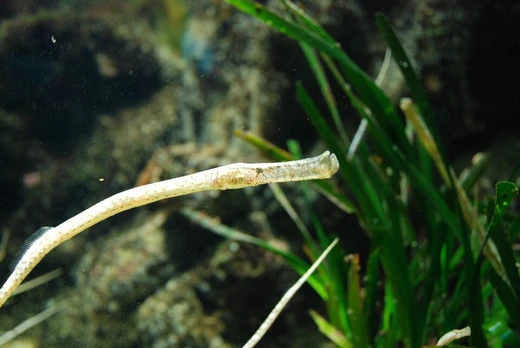
Syngnathidae
A fish family known for male pregnancy and fused jaws.

Syngnathidae is a fish family made up of seahorses, pipefishes, sea muppets (Australyichthys), and seadragons (Phycodurus and Phyllopteryx). The name comes from the Ancient Greek words for "together" and "jaw," a reference to the fused jaw that every member of the family shares.
These fish live in temperate and tropical seas around the world. Most stick to shallow, coastal waters, though a few are found in the open ocean, often hanging around sargassum mats. They have long snouts, fused jaws, no pelvic fins, and thick, bony plates covering their bodies. That armor makes them stiff, so they swim by flapping their fins rapidly. This makes them slower than many other fish, but they can move with great precision and even hover in place for a long time.
The most unusual thing about syngnathids is their reproduction. After the female lays her eggs, the male fertilizes them and carries them through incubation. How he does this varies: male seahorses have a special pouch on their belly, male sea dragons glue the eggs to their tails, and male pipefish might use either method depending on the species. The key difference between the family's lineages is where the male's brood pouch sits—on the tail (Urophori) or on the abdomen (Gastrophori). Pouch complexity also varies, from simple sticky patches to fully enclosed pouches. In species with more developed, closed pouches, males provide their young with nutrients and immunity to disease, and they can even abort a brood from a low-fitness female.
Mating behavior in Syngnathidae is diverse. For example, Hippocampus fuscus follows the usual pattern of males competing for females, while Corythoichthys haematopterus flips that completely, with females competing for males. Most species with conventional sex roles are monogamous, while those with reversed roles tend to be polygamous.
Seahorses and pipefish also have a unique feeding trick called elastic recoil feeding. Though the details aren't fully understood, they seem to store energy from contracting their epaxial muscles (used to lift the head), then release it all at once to snap their mouths forward at incredible speed toward prey.
Looking at evolution, the most recent common ancestor of all syngnathids probably didn't have a pouch. The related family Solenostomidae (ghost pipefish) has females that incubate eggs inside fused pelvic fins.
Quick Facts
- Taxon
- Syngnathidae
Facts from the source article.
Lore & Background
Syngnathids are found in temperate and tropical seas worldwide, mostly in shallow coastal waters, though a few inhabit the open ocean, especially near sargassum mats. They are characterized by elongated snouts, fused jaws, absence of pelvic fins, and thick bony armor plates. This armor gives them a rigid body, so they swim by rapidly fanning their fins, making them relatively slow but capable of precise movements, including hovering. Uniquely, after females lay eggs, males fertilize and carry them during incubation using various methods: seahorses have a ventral brood pouch, seadragons attach eggs to their tails, and pipefish may do either depending on species. The most fundamental difference between lineages is brood pouch location—on the tail (Urophori) or abdomen (Gastrophori). Pouch complexity varies from simple gluing areas to fully enclosed pouches; in more developed pouches, males provide nutrients and immunity to pathogens and can abort broods from low-fitness females. Mate choice and competition vary widely, with some species showing conventional sex roles and others being completely sex-role reversed. Most conventional-role syngnathids are monogamous, while sex-role reversed species are mostly polygamous. Their feeding mechanism, elastic recoil feeding, involves storing energy from epaxial muscle contraction to rapidly rotate the head toward prey.
Reader's Guide
The family Syngnathidae holds significant evolutionary interest due to its complex history of male pregnancy and brood pouch evolution. Phylogenetic analysis suggests the most recent common ancestor was likely pouchless, and evolutionary transitions from female to male care are practically nonexistent in teleosts. Genome sequencing reveals multiple independent origins of brood pouches across and within different types. The family was historically divided into Neophinae (trunk-brooders) and Syngnathinae (tail-brooders), but genetic studies show a parallel increase in pouch complexity in both lineages. Some species, such as pygmy seahorses, independently evolved trunk brooding despite being phylogenetically surrounded by tail brooders, likely due to selection for a prehensile tail and diminutive size. Viviparity and male pregnancy required co-evolution of behavioral, physiological, morphological, and immunological traits, driven by increased offspring fitness. This led to sex-role reversal in some species, with females competing for mates. The earliest syngnathid fossils are known from the Paleocene (Danian) of Egypt and the Eocene of Monte Bolca, Italy. Recent whole-genome sequencing has greatly improved understanding of their evolutionary history, though further research is needed into genetic mechanisms and selective motivations, which may provide insight into the evolution of pregnancy outside the female reproductive system.
Did You Know?
- The family name Syngnathidae means 'together jaw', referring to their fused jaws.
- Male syngnathids carry and incubate eggs; methods include a ventral brood pouch (seahorses), tail attachment (seadragons), or either method depending on pipefish species.
- Pygmy seahorses are trunk brooders about 1–2 cm tall, despite being phylogenetically surrounded by tail brooders.
- The earliest syngnathid fossils come from Paleocene strata in Egypt and Eocene strata in Italy.
Bony Armour, Fused Jaws, and the Art of Hovering
Syngnathids are among the most architecturally unusual fish on Earth. Their bodies are encased in thick plates of bony armour that render them rigid, and they lack the pelvic fins found in most other fish. Instead of undulating through the water like their relatives, they propel themselves by rapidly fanning their fins — a method that makes them comparatively slow but grants them extraordinary precision, including the ability to hover motionless for long stretches. Their elongated snouts and a single fused jaw (the very trait that gives the family its Greek-derived name, combining "together" and "jaw") are shared by every member. Perhaps most remarkably, seahorses and pipefish employ a feeding strategy called elastic recoil: they contract their epaxial muscles to rotate the head upward, storing mechanical energy that is then released in a snap, whipping the mouth forward toward prey at astonishing speed. The exact mechanics remain only partially understood, but the result is a hunting strike that belies the animal's otherwise languid cruising pace.
Pregnancy, Reversed: The Male Brood Pouch
In virtually every other fish family, the female bears the eggs. In Syngnathidae, the roles are flipped: the female deposits her eggs, and it is the male who fertilizes them and carries them through incubation. The method varies by lineage. Male seahorses tuck the eggs into a specialized ventral brood pouch; male seadragons glue them along the length of their tails; and male pipefish may use either strategy depending on the species. The degree of pouch development ranges enormously, from a simple adhesive patch on the belly to a fully enclosed, vascularized chamber. In the most advanced pouches, the father does far more than hold the eggs — he actively supplies nutrients and even confers immune protection against pathogens. He can even partially or wholly abort a clutch if the mother's fitness is judged insufficient. This system has driven a cascade of behavioural consequences: in some species, females compete aggressively for access to males, and mating systems shift from monogamy to polygamy depending on the lineage.
A Pouch Born Again and Again: Evolution in Repetition
The evolutionary story of syngnathid pregnancy is one of remarkable repetition. Phylogenetic and genomic evidence strongly suggests that the most recent common ancestor of the entire family possessed no brood pouch at all, and that egg-laying (oviparity) was the ancestral condition. Yet pouches — on the tail, on the trunk, in varying degrees of enclosure — have evolved independently multiple times across the family. A striking case of convergent evolution is found in the pygmy seahorses (Hippocampus bargibanti, H. denise, H. pontohi), tiny trunk-brooding species only one to two centimetres tall that are phylogenetically embedded among tail-brooding relatives. Their pouch likely migrated from the tail to the trunk under correlated selection for a prehensile tail and miniature body size. Fossil syngnathids are known from Paleocene deposits in Egypt and Eocene strata in Italy, anchoring the family's history in the early Cenozoic. Whole-genome sequencing continues to reveal that the traits enabling male pregnancy — morphological, physiological, immunological, and behavioural — co-evolved in tightly linked packages, each origin a separate evolutionary experiment.
Redrawing the Tree: From Seahorse Subfamily to Brood-Pouch Lineage
For much of the twentieth century, syngnathid taxonomy rested on a simple morphological split: the elongated, pipe-shaped Syngnathinae (pipefishes and seadragons) versus the coiled Hippocampinae (seahorses and close relatives). Modern genetic analyses have dismantled that arrangement, revealing both groups to be paraphyletic — seahorses are, in fact, deeply nested within the pipefish radiation rather than forming a separate branch. The family has therefore been re-circumscribed around a different, more fundamental divide: where the male brood pouch sits. The two principal subfamilies are now Nerophinae, the trunk-brooders, and Syngnathinae, the tail-brooders, with seahorses and seadragons both falling into the latter. The split between these two lineages is estimated to have occurred during the Paleocene. The closely related family Solenostomidae (ghost pipefish) occupies a parallel niche in the order Syngnathiformes, with females incubating embryos inside fused pelvic fins — a reminder that male pregnancy, while dominant in Syngnathidae, is not the only reproductive strategy in this radiation.
Frequently Asked Questions
Who is Syngnathidae?
Syngnathidae is the family name covering seahorses, pipefishes, seadragons, and the sea muppet (Australyichthys). Every species in the group shares a distinctive fused-jaw structure and a body encased in bony plates rather than typical scales.
What are Syngnathidae's powers/role?
The family is best known for male pregnancy, in which the father carries fertilized eggs in a specialized pouch until the young are ready to emerge. Their rigid, armored bodies make them sluggish swimmers, so they rely heavily on camouflage and slow, deliberate movement to avoid predators.
Why is Syngnathidae important?
As one of the very few vertebrate groups where males handle gestation, the family gives researchers a living model for studying reproductive biology and parental investment. Their presence in shallow coastal waters and sargassum mats also makes them useful indicators of ecosystem health in those habitats.
What's Syngnathidae's origin story (naming)?
The family name is built from two Ancient Greek roots meaning 'together' and 'jaw,' a direct nod to the single fused jaw structure shared by every member. The type genus, Syngnathus, was formally described by Linnaeus back in 1758.
More in Seahorses and Pipefish 1-24
Spotted an error? Know more?
Reader corrections go straight into our review queue. Suggest an edit · How this site is sourced