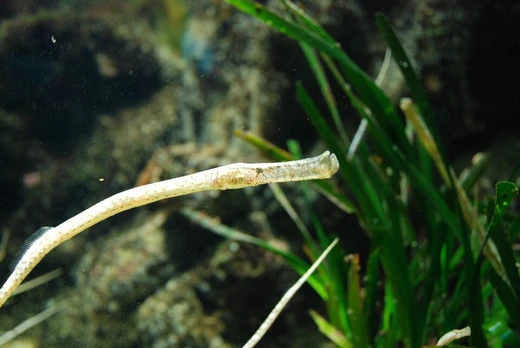
Haliichthys
A pipefish with a prehensile tail for vertical grasping.

Haliichthys is a genus of pipefish containing the single species Haliichthys taeniophorus, known as the ribboned pipefish, ribboned pipehorse, or ribboned seadragon. It is notable for being the only member of its genus and for possessing a prehensile tail used for vertical grasping, a trait that distinguishes it from related pipefish and seahorses.
Quick Facts
- Genus
- Haliichthys
- Species
- taeniophorus
Facts from the source article.
Lore & Background
The ribboned pipefish is found along the coast of northern Australia from Shark Bay to Torres Strait, and in New Guinea, including both West New Guinea and Papua New Guinea. It inhabits a range of environments from shallow, weedy areas to deeper, sandy bottoms down to depths of 16.5 meters. The species grows to a total length of 30 centimeters and displays colors ranging from greenish yellow to brownish red.
This species is the only known member of its genus Haliichthys. It possesses a unique prehensile tail used to grab things vertically, which was likely developed as an adaptation for hanging on sea grasses vertically, contrasting with the typical horizontal hanging habits of other pipehorses on microalgae. The exact phylogenetic position of this species is uncertain regarding the tail's evolution, but it is hypothesized to be similar to other pipefish and seahorses such as the Southern little pipehorse and bastard seahorse due to a shared intermediate skeletal morphology.
The ribboned pipefish has body plating on its ventral side similar to seahorses, and a rigid plate structure on its dorsal side like other pipefish. Because of this combination, it is often referred to not only as a pipefish, but also as a seahorse and seadragon.
Reader's Guide
The ribboned pipefish holds significance as the sole member of the genus Haliichthys, making it a distinct evolutionary lineage among pipefish. Its prehensile tail, used for vertical grasping, is a unique trait that likely evolved as an adaptation to hanging on sea grasses vertically, in contrast to the horizontal habits of other pipehorses. This feature underscores its ecological specialization. The species' intermediate skeletal morphology—with seahorse-like ventral plating and pipefish-like dorsal plating—places it in a debated phylogenetic position, linking it to both the Southern little pipehorse and the bastard seahorse. This morphological blend has led to its multiple common names, reflecting its ambiguous classification. The species' distribution along the coasts of northern Australia and New Guinea, in habitats ranging from shallow weedy areas to deeper sandy bottoms down to 16.5 meters, highlights its adaptability. Its legacy lies in its role as a key example of evolutionary convergence and divergence within the Syngnathidae family, illustrating how tail structure and body plating can vary across related groups.
Did You Know?
- It possesses a prehensile tail used for vertical grasping, unlike the horizontal habits of other pipehorses.
- Its colors range from greenish yellow to brownish red.
- It grows to a total length of 30 cm (12 in).
Frequently Asked Questions
What is Haliichthys?
Haliichthys is a monotypic genus of pipefish whose sole member is Haliichthys taeniophorus, a species more widely known as the ribboned pipefish, ribboned pipehorse, or ribboned seadragon.
What makes Haliichthys unique among pipefish and seahorses?
Its defining trait is a prehensile tail that allows it to grip onto structures vertically, a capability found in no other pipefish or seahorse. This single feature sets it apart from every other member of the family Syngnathidae.
Where does the ribboned pipefish live in the wild?
It is found along northern Australia's coastline, stretching from Shark Bay up to the Torres Strait, and also in West New Guinea and Papua New Guinea. Its habitat spans shallow weedy areas as well as deeper sandy bottoms reaching roughly 16.5 m (54 ft).
How large does Haliichthys taeniophorus grow, and what does it look like?
Adults can reach a maximum length of about 30 cm (12 in). Its body coloration ranges anywhere from greenish yellow to brownish red, giving it a varied appearance depending on the individual.
Why do fans and researchers single out Haliichthys?
As the only species in its genus it is already taxonomically distinctive, and its prehensile-tail adaptation adds a behavioral trait no other seahorse or pipefish possesses. Together, these features make it a go-to example whenever pipefish diversity is discussed.
More in Seahorses and Pipefish 1-24
Spotted an error? Know more?
Reader corrections go straight into our review queue. Suggest an edit · How this site is sourced