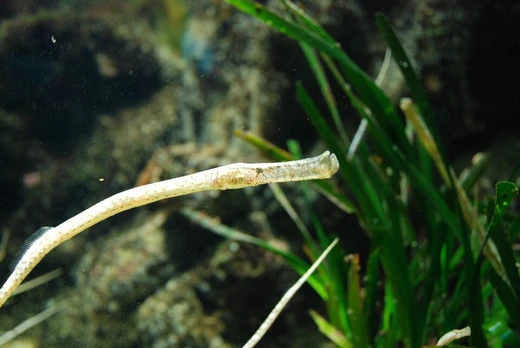
Hipposyngnathus
Extinct pipefish that convergently evolved seahorse-like morphology.

Hipposyngnathus is a prehistoric pipefish genus, now extinct, that ranged across the Northern Hemisphere between the Oligocene and Late Miocene. Its body plan independently resembled that of seahorses (the genus *Hippocampus*), featuring a well-developed trunk and prominent armored plates. Three species are recognized: *H. convexus* (Early Oligocene, North Caucasus), *H. imporcitor* (Late Miocene, California), and *H. neriticus* (Early Oligocene, Poland). Originally placed in its own subfamily, Eogastrophinae, more recent work suggests it may belong with modern trunk-brooding pipefishes in the subfamily Nerophinae. This is supported by a distinct abdominal ridge that could have held fertilized eggs, possibly as part of a brood pouch. However, some researchers argue that *Hipposyngnathus* lacked a pouch entirely, with eggs simply attached to the ridge’s surface until hatching—a method seen in some living trunk-brooders like *Maroubra*. The genus likely occupied varied habitats. Some fossils appear alongside sublittoral fish like *Trachinus*, indicating neritic environments. Others come from pelagic deposits mixed with *Sargassum* algae, seagrass, and swimming crabs, resembling modern floating-algae communities such as the Sargasso Sea. This suggests *Hipposyngnathus* may have lived among drifting *Sargassum* mats on the open ocean. Its relatively short snout points to a diet of slow-moving prey, probably small crustaceans.
Quick Facts
- Taxon
- Hipposyngnathus
Facts from the source article.
Lore & Background
Hipposyngnathus was initially described in its own subfamily, Eogastrophinae, due to its distinctive morphology. However, more recent studies suggest it may potentially belong to the modern trunk-brooding pipefishes in the subfamily Nerophinae. This is supported by the presence of a well-developed abdominal ridge on which fertilized eggs could be deposited, speculated to have supported a brood pouch. Other researchers hypothesize that Hipposyngnathus lacked a brood pouch entirely, with eggs attached to and completing development on the surface of the abdominal ledge, a trait seen in some modern trunk-brooding pipefish such as Maroubra.
Two species are known from the Paratethys of eastern Europe, and one late-surviving species is known from the Pacific Coast of North America. Some Hipposyngnathus populations appear to have inhabited neritic habitats, based on co-occurrence with fossils of sublittoral fish such as Trachinus. Other fossils are known from pelagic deposits, preserved together with fossils of Sargassum algae, seagrass, and swimming crabs, reminiscent of assemblages around floating algae in pelagic ecosystems such as the Sargasso Sea, suggesting Hipposyngnathus may have also inhabited floating Sargassum mats at the surface of the open ocean. It has a relatively short snout, indicating it likely fed on slow-moving prey such as small crustaceans.
Reader's Guide
Hipposyngnathus holds significance as an extinct genus that illustrates convergent evolution with seahorses, developing a similar trunk and armor despite being a pipefish. Its classification remains debated: originally placed in its own subfamily Eogastrophinae, it is now considered by some researchers to belong to the modern trunk-brooding pipefish subfamily Nerophinae. The presence of an abdominal ridge suggests a reproductive strategy involving egg attachment, though whether it had a brood pouch or eggs developed directly on the ridge is uncertain. Its fossil record spans the Northern Hemisphere from the Oligocene to Late Miocene, with species in eastern Europe and North America. The variety of depositional environments—neritic and pelagic—indicates ecological flexibility, possibly including life in floating Sargassum mats. Its short snout points to a diet of slow-moving prey like small crustaceans. These features make Hipposyngnathus a key example of morphological convergence and adaptive radiation in prehistoric syngnathids.
Did You Know?
- Hipposyngnathus convergently evolved a close morphology to seahorses, with a developed trunk region and prominent armor shields.
- It was initially placed in its own subfamily, Eogastrophinae, but recent studies suggest it may belong to the subfamily Nerophinae.
- Some fossils of Hipposyngnathus are preserved with Sargassum algae and swimming crabs, suggesting it may have inhabited floating Sargassum mats.
A Seahorse's Prehistoric Cousin
Hipposyngnathus stands as one of paleontology's most striking examples of convergent evolution. Though it belongs to the pipefish lineage rather than the seahorse branch, this extinct genus independently developed a body plan that closely mirrors modern Hippocampus species. Its most immediately recognizable features include a robustly built trunk section and a set of conspicuous bony plates that would have given it a heavily armored, almost plated appearance. The name itself hints at this seahorse-like resemblance, yet the creature occupied a distinct evolutionary position within the Syngnathidae. One of its more subtle but ecologically telling traits is its relatively short snout, a morphology that points toward a diet of sluggish, easy-to-capture prey such as small crustaceans rather than the more active hunting strategies seen in longer-snouted relatives. Together, these anatomical signatures paint a picture of a small, heavily armored, slow-feeding marine animal that looked deceptively like a seahorse but was, in fact, a pipefish wearing a very convincing disguise.
The Brood Pouch Debate
For decades, Hipposyngnathus occupied a taxonomic limbo. When first recognized, its unusual combination of features led paleontologists to carve out an entire subfamily for it alone, Eogastrophinae, essentially acknowledging that it fit neatly into no existing group. More recent phylogenetic work, however, has begun to pull it closer to the living trunk-brooding pipefishes of the subfamily Nerophinae. The evidence rests largely on a well-developed abdominal ridge visible in the fossil record, a structure that strongly suggests some form of reproductive investment. Yet even here, the picture remains contested. One camp of researchers argues that this ridge supported a true brood pouch in which fertilized eggs were deposited and carried to term. The opposing view holds that no enclosed pouch existed at all; instead, eggs were merely fixed to the exposed surface of the belly ledge, where they matured in place, a strategy still seen in the modern trunk-brooding pipefish Maroubra. Resolving this question would not only clarify Hipposyngnathus's exact position in the family tree but would also deepen our understanding of how reproductive strategies evolved across the Syngnathidae.
A Northern Hemisphere Wanderer
Spanning roughly thirty million years of Earth's history, from the Oligocene through the Late Miocene, Hipposyngnathus left its fossil imprint across the Northern Hemisphere. Two of its three known species come from the Paratethys basin of eastern Europe, a vast inland sea that once stretched across what is now the Russian steppe and Central Europe. The type species, H. convexus, was recovered from Early Oligocene deposits in the North Caucasus region of Russia, while H. neriticus is known from a contemporaneous formation in Poland. The third and chronologically latest survivor, H. imporcitor, pushes the genus's range dramatically westward and southward to the Pacific Coast of California, where it persisted into the Late Miocene. This geographic spread, combined with the genus's long temporal window, suggests a remarkable capacity to track shifting coastlines and oceanic conditions across millions of years. That a single small pipefish lineage could maintain a presence from the Black Sea region to the California current over such an extended period speaks to both its ecological flexibility and the repeated availability of suitable habitats across the Northern Hemisphere's warm, shallow seas.
Life Among the Floating Algae
The fossil assemblages in which Hipposyngnathus appears tell a surprisingly nuanced story about where it lived. Some populations are clearly neritic in character, found alongside fossils of sublittoral fish like Trachinus, indicating they inhabited shallow coastal waters. Other specimens, however, come from distinctly pelagic deposits, preserved in the company of Sargassum algae, seagrass, and swimming crabs. This particular combination of organisms closely mirrors the floating algal mats that still drift through the open ocean today, most famously in the Sargasso Sea. The implication is that at least some Hipposyngnathus populations were not confined to the continental shelf but instead lived at the surface of the open ocean, weaving through drifting Sargassum thickets. Their relatively short snout further supports a lifestyle of patient, low-energy foraging, picking off slow-moving small crustaceans that would have been abundant in such vegetated, low-current environments. In this light, Hipposyngnathus was not merely a seahorse look-alike on the seafloor but a versatile creature that could exploit both sheltered coastal niches and the open, floating gardens of the pelagic zone.
Frequently Asked Questions
What is Hipposyngnathus?
Hipposyngnathus is an extinct pipefish genus whose fossils span the Oligocene through the Late Miocene across the Northern Hemisphere. It is best known for independently evolving a robust, armored trunk that looks strikingly similar to the body of a modern seahorse, despite belonging to the pipefish lineage.
Is Hipposyngnathus actually a seahorse?
No. Although its trunk shape and bony plates closely mirror those of Hippocampus, Hipposyngnathus is a pipefish that converged on a seahorse-like silhouette through parallel evolution rather than shared descent. Its true relatives sit within the broader Syngnathidae pipefish group.
How many species of Hipposyngnathus are known?
Three species are currently recognized: the type species H. convexus from the Early Oligocene Pshekha Formation in the North Caucasus, H. neriticus from Early Oligocene strata in Poland, and H. imporcitor from Late Miocene deposits in California.
Where have Hipposyngnathus fossils been found?
Specimens come from three well-separated regions: the North Caucasus (Russia), Poland, and California (United States). This wide geographic spread indicates the genus occupied a broad swath of Northern Hemisphere marine environments over tens of millions of years.
How is Hipposyngnathus classified in modern taxonomy?
It was originally given its own subfamily, Eogastrophinae, to reflect its unusual seahorse-like build. More recent phylogenetic analyses, however, suggest it may instead belong among the living trunk-brooding pipefishes, collapsing that separate subfamily and linking it more tightly to extant Syngnathidae.
More in Seahorses and Pipefish 1-24
Spotted an error? Know more?
Reader corrections go straight into our review queue. Suggest an edit · How this site is sourced