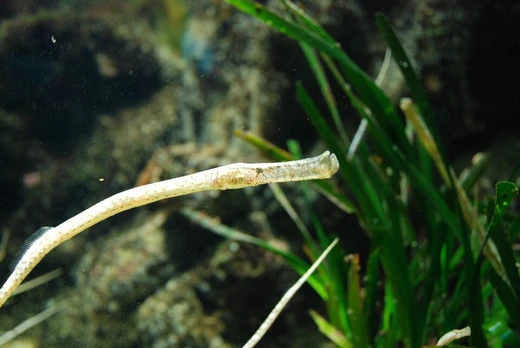
Australyichthys
A seahorse-like pipefish genus, known from only eight specimens, never observed alive.

Australyichthys is a genus of ray-finned fish in the family Syngnathidae, found only in the temperate mesophotic ecosystems off southern Australia. Named in 2026 by Short, Foster, Gomon, and colleagues, it contains three species: the type species A. minotaur, along with A. paradoxus and A. aegis. Every known specimen comes from structurally complex seafloor habitats at depths between about 50 and 124 metres (164–407 ft). These fish look much like true seahorses (genus Hippocampus): they have a head angled toward the underside, a fully enclosed brood pouch in males, and a prehensile tail. Because of this resemblance, A. minotaur and A. paradoxus were originally placed in Hippocampus. However, genetic phylogenetic analyses place Australyichthys within the tribe Haliichthyini (part of the pipefish subfamily Syngnathinae), which is distant from the seahorse tribe Hippocampini. Their seahorse-like body plan is thus a case of convergent evolution. Only eight specimens have ever been collected, all incidentally over nearly eighty years, with none in the last two decades, and the genus has never been seen alive. For this reason it is considered a "lost" taxon. A proposed common name is sea muppet, referring to the fish's enlarged, domed head and fleshy dermal lobes, which resemble features of certain characters from The Muppet Show.
The two earlier-described species were first classified in Hippocampus based on their external similarity to seahorses. Hippocampus minotaur was described by Gomon in 1997 from off Eden, New South Wales, and Hippocampus paradoxus by Foster and Gomon in 2010 from off Esperance, Western Australia. Both assignments relied mainly on external form and radiography, which could not reveal internal skeletal structure through the thick skin. A third specimen, preserved in ethanol, was later collected from the entrance to Spencer Gulf, South Australia. This specimen bridged the New South Wales and Western Australian records—separated by more than 2,500 km of coastline—and allowed re-examination of the lineage using high-resolution micro-computed tomography (CT) and genome-scale phylogenomic data.
Quick Facts
- Taxon
- Australyichthys
- Type Species
- Hippocampus minotaur
- Type Species Authority
- Gomon, 1997
Facts from the source article.
Lore & Background
The two earlier described species were originally assigned to Hippocampus on the basis of their external similarity to seahorses. Hippocampus minotaur was described by Gomon in 1997 from off Eden, New South Wales, and Hippocampus paradoxus by Foster and Gomon in 2010 from off Esperance, Western Australia. Both assignments relied chiefly on external morphology and radiography, which could not resolve internal skeletal structure through the thick integument. A third specimen, preserved in ethanol, was subsequently collected from the entrance to Spencer Gulf, South Australia. Bridging the New South Wales and Western Australian records across more than 2,500 km of coastline, it enabled re-examination of the lineage using high-resolution micro-computed tomography (CT) and genome-scale phylogenomic data. These analyses showed that the three species form a morphologically cohesive group defined by a ventral trunk skeleton unlike that of any other syngnathid, and that the group falls within the tribe Haliichthyini rather than among the seahorses (tribe Hippocampini). In 2026, the two Hippocampus species were accordingly transferred to the newly erected genus Australyichthys as A. minotaur comb. nov. and A. paradoxus comb. nov., and the Spencer Gulf specimen was described as A. aegis sp. nov.
Species of Australyichthys are small, ranging from approximately 34–65 millimetres (1.3–2.6 in) in standard length. The head is large and fleshy, with a short snout, and is angled ventrally relative to the trunk axis at approximately 90°, as in seahorses. The body is soft and externally unsegmented, the ring boundaries and spination typical of most syngnathids being obscured by a thick integument. A series of fleshy dermal lobes extends along the dorsal midline from the trunk onto the tail. These lobes lack bony support and thereby differ from the appendages of seadragons (Phycodurus and Phyllopteryx) and from the dorsolateral appendages of the ribboned pipehorse Haliichthys taeniophorus. The tail is prehensile and lacks a caudal fin, and males bear a fully enclosed brood pouch. The genus is diagnosed osteologically, on internal skeletal structure resolved by CT imaging rather than on external form. Its principal diagnostic character is a derived ventral trunk support complex that replaces the continuous ventral ridge present in other syngnathids. The complex comprises three components: paired or median anterior ventral elements (AVE) from the inferior trunk plates, paired posterior ventral elements (PVE) from the terminal trunk ring, and a single median anal pterygiophore (MAP) between them. In other syngnathids, including Hippocampus, the inferior and ventral plates meet at the ventral midline to form a rigid enclosure around the body cavity. In Australyichthys the ventral plates are absent, the inferior plates do not meet at the midline, and ventral support is provided entirely by the AVE–PVE–MAP complex. This configuration is unknown in any other syngnathid genus and is the primary basis for generic recognition.
As in seahorses, males brood the developing young in a fully enclosed pouch on the ventral surface of the posterior trunk. CT imaging of one male A. minotaur revealed approximately nine embryos within the pouch, positioned beneath the combined PVE–MAP complex. This was the first direct visualisation of male brooding in the genus. Females lack pouches. Hydrated oocytes are retained within the abdominal cavity between the AVE and PVE, one female A. paradoxus containing 11 such oocytes, each approximately 2 mm in diameter. Sexual dimorphism is best documented in A. minotaur, the only species known from both sexes. Males possess a more steeply inclined supraoccipital, four AVE units (versus two elongate units in females), and elongate, rod-like PVE that form a rigid support dorsal to the pouch, whereas females possess broader, spatulate PVE.
Reader's Guide
Australyichthys is notable as the first syngnathid genus known exclusively from the temperate mesophotic zone of southern Australia, a depth range (50–124 m) that is among the least-surveyed components of Australia's marine environment. Its discovery and description relied on high-resolution micro-CT and phylogenomic data, which revealed that its seahorse-like body plan is a result of convergent evolution, not shared ancestry with true seahorses. The genus is represented by only eight specimens collected incidentally over nearly eighty years, none within the last two decades, and has never been observed alive, leading to its classification as a 'lost' taxon. Its unique ventral trunk support complex—comprising anterior ventral elements, posterior ventral elements, and a single median anal pterygiophore—is unknown in any other syngnathid genus and forms the primary basis for its generic recognition. The proposed common name 'sea muppet' reflects its enlarged, domed head and fleshy dermal lobes. The three species span more than 2,500 km of southern Australian coastline, with A. aegis providing the ethanol-preserved specimen that enabled phylogenetic placement. The genus underscores the importance of mesophotic habitats as reservoirs of cryptic biodiversity and highlights how modern imaging and genetic techniques can resolve long-standing taxonomic puzzles.
Did You Know?
- Only eight specimens have ever been collected, none within the last two decades, and it has never been observed alive.
- The proposed common name 'sea muppet' refers to its enlarged, domed head and fleshy dermal lobes resembling characters from The Muppet Show.
Frequently Asked Questions
What is Australyichthys?
Australyichthys is a genus of syngnathid fish from the southern Australian coast, formally described in 2026 by Short, Foster, Gomon, and their collaborators. Although it closely mimics the body plan of true seahorses, it is classified as a pipefish relative rather than a member of Hippocampus.
How does Australyichthys differ from a true seahorse (Hippocampus)?
It shares the downward-angled head, prehensile tail, and male brood pouch that make Hippocampus instantly recognisable, yet it is placed in its own genus within the broader Syngnathidae family. Because only a handful of specimens exist, the precise anatomical and genetic distinctions from Hippocampus are still being clarified.
Where do Australyichthys species live and at what depth?
Every known specimen was recovered from structurally complex seafloor habitats in the temperate mesophotic zone off southern Australia, at depths between roughly 50 and 124 metres (about 164–407 ft). No living individual has ever been observed in the wild, so its natural behaviour remains entirely unknown.
What species are included in the genus Australyichthys?
Three species have been described: A. minotaur (the type species), A. paradoxus, and A. aegis. All three were delineated from the small pool of collected material during the 2026 taxonomic revision.
Why is Australyichthys a big deal for seahorse and pipefish enthusiasts?
With just eight specimens ever recorded and zero live sightings, it is one of the most elusive and least-understood syngnathid genera known. Its discovery in the deep mesophotic waters of southern Australia underscores how much of the seahorse–pipefish family tree is still waiting to be documented.
More in Seahorses and Pipefish 1-24
Spotted an error? Know more?
Reader corrections go straight into our review queue. Suggest an edit · How this site is sourced