Straightnose pipefish
A pipefish with worm-like appearance and male parental care.

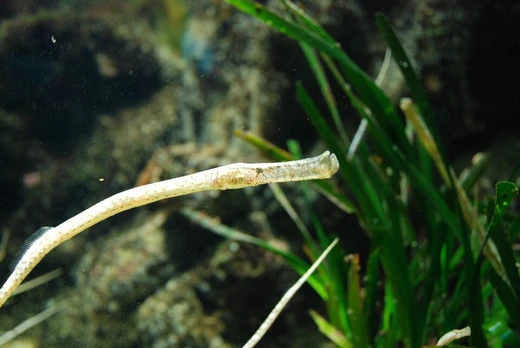
The straightnose pipefish (Nerophis ophidion) is a pipefish species that lives in brackish waters of the northeastern Atlantic, Baltic, Mediterranean, and Black Sea. At first glance, it looks like a worm, with a tiny head that resembles a seahorse’s—its close relative. Its body is round, its fins are very small, and it is green with a yellowish belly. The only fish it might be mistaken for is the broadnosed pipefish, but that species is sturdier and has a hexagonal body. Females have pale blue markings on the head and body, and both sexes become more colorful during breeding season, when the male’s snout turns yellow. They typically grow 15 to 20 cm, with a maximum of 30 cm.
This fish ranges from southern Norway to Morocco along Europe’s northeastern Atlantic coast, and also appears in the Baltic, Mediterranean, and Black Sea. It lives on sandy bottoms among fouling communities, at depths of 2 to 15 meters.
The straightnose pipefish dwells among eelgrass and seaweed, wrapping its tail around vegetation and holding its head up. Well-camouflaged there, it feeds on zooplankton and copepods by sucking them in. Scientists use this species to study mate choice and sex role-reversal. Like other pipefish and seahorses, males care for the young, so a female’s reproductive success depends on her ability to court and mate with a suitable male. This has led to female-female competition and male mate choice, resulting in female-specific coloration, ornamental skin folds, and more active courtship by females.
Quick Facts
- Taxon
- Nerophis ophidion
Facts from the source article.
Lore & Background
The straightnose pipefish initially gives the impression of being a worm. Its head is tiny and resembles that of a seahorse, to which it is closely related. The body is round in cross-section and the fins are tiny. It can be confused with the broadnosed pipefish (Syngnathus typhle), but that species is more robust and has a hexagonal cross-section. The general colour is green with a yellowish belly; the female has pale blue markings on the head and body. Both sexes become more colourful at breeding time, when the male's snout turns yellow. The average size is about 15 to 20 cm, with a maximum of 30 cm.
This fish is found in the northeastern Atlantic along the coasts of Europe, from southern Norway to Morocco, and also in the Baltic, Mediterranean, and Black Sea. It inhabits sandy bottoms and is part of the fouling community, at depths from 2 to 15 m. It lives among eelgrass and seaweed, with its tail wrapped around vegetation and its head elevated, where it is well-camouflaged. It feeds on zooplankton and copepods by sucking them in.
This species is used as a model to study mate choice and sex role-reversal. Like other pipefish and seahorses, it exhibits male parental care, meaning female reproductive success is limited by her ability to court and mate with a suitable male. In the straightnose pipefish, female-female competition and mate choice by males has resulted in female-specific coloration, female ornamental skin folds, and more active courtship in females.
Reader's Guide
The straightnose pipefish holds significance as a model organism for studying mate choice and sex role-reversal. The article describes that, like other pipefish and seahorses, it exhibits male parental care, which shifts the reproductive dynamic: female reproductive success is limited by her ability to court and mate with a suitable male. This has led to observable evolutionary outcomes, including female-specific coloration, female ornamental skin folds, and more active courtship in females. These traits arise from female-female competition and mate choice by males. The species' presence across a wide geographic range—from southern Norway to Morocco, and in the Baltic, Mediterranean, and Black Sea—underscores its adaptability to brackish and marine environments. Its habitat among eelgrass and seaweed, where it uses its tail to anchor and its camouflage to feed on zooplankton and copepods, highlights its ecological role in shallow coastal communities. The straightnose pipefish's legacy lies in its contribution to understanding sexual selection and parental investment, providing a clear example of reversed sex roles in a vertebrate.
More in Seahorses and Pipefish 1-24
Spotted an error? Know more?
Reader corrections go straight into our review queue. Suggest an edit · How this site is sourced