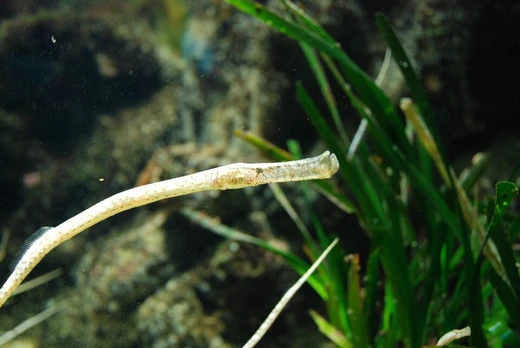
Stigmatopora harastii
A red pipefish named for David Harasti, found in central New South Wales.

The red wide-bodied pipefish, *Stigmatopora harastii*, is a ray-finned fish belonging to the Syngnathidae family, which includes pipefish and seahorses. Its scientific name honors David Harasti, who helped identify it as a distinct species, acknowledging his conservation work for Syngnathidae in Australia and his deep knowledge of the genus *Stigmatopora*. Proposed common names for this fish are Harasti's pipefish and red wide-bodied pipefish.
This species has a distinct, low ridge along the top of its head and the first trunk ring, starting from the back of the forehead and extending over the skull to the neck plates. The gill cover ridge is prominent, complete, and not angled upward. Another low, distinct ridge runs between the gill cover and the base of the pectoral fin. The dorsal fin begins on the sixth or seventh trunk ring, with 19 to 20 rings under the fin (12 trunk rings plus 7 or 8 tail rings), and the side ridge of the trunk ends on the first tail ring. The snout’s upper side is red with large, irregular pale white spots. The sides of the head and front trunk rings have similar pale white spots or a diffuse pale white stripe. In males, the underside of the first trunk ring shows distinct red elongated spots in a row, nearly forming a stripe along the midline. The underside of the front trunk rings is pale red, with a large cluster of red spots extending backward from the second trunk ring in males, while females have only a few scattered small red spots.
The red wide-bodied pipefish is currently known from only three locations in central New South Wales, Australia: Botany Bay, Shellharbour, and Jervis Bay. It lives in semi-exposed bay entrances and ocean embayments where the seafloor has sandy areas mixed with boulders and hard, flat reefs. Individuals and pairs have been seen closely associated with a species of finger sponge from the family Callyspongiidae, as well as several red algae species from the family Gracilariaceae, in the genera *Crassiphycus* and *Gracilaria*.
Quick Facts
- Genus
- Stigmatopora
- Species
- harastii
Facts from the source article.
Lore & Background
The species Stigmatopora harastii was named after David Harasti, who was one of the first to recognize it as a new species. The naming also honors his conservation efforts for Syngnathidae in Australia and his status as an aficionado of the genus Stigmatopora. Proposed common names include Harasti's pipefish and red wide-bodied pipefish.
In terms of physical description, the species has a distinct, low median ridge on the dorsum of the head and first trunk ring, a prominent and complete opercular ridge, and a distinct lateromedial ridge between the opercle and pectoral fin base. Its dorsal-fin origin is on the 6th–7th trunk rings, with subdorsal rings numbering 19–20. The lateral trunk ridge ends on the first tail ring. Coloration includes a red background on the dorsum of the snout with large irregular pale white spots, and similar spots or a diffuse pale white stripe on the sides of the head and anterior trunk rings. Males have distinct red elongated spots in a longitudinal row on the venter of the first trunk ring, and a large cluster of red spots extending from the second trunk ring; females have few scattered small red spots.
Stigmatopora harastii is currently known from only three localities in central New South Wales, Australia: Botany Bay, Shellharbour, and Jervis Bay. It inhabits semi-exposed bay entrances and ocean embayments with sandy areas interspersed with boulders and hard flat reefs. Individuals and pairs were observed in close association with a species of finger sponge (family Callyspongiidae) and several species of red algae (family Gracilariaceae, genera Crassiphycus and Gracilaria).
Reader's Guide
The significance of Stigmatopora harastii lies in its recognition as a distinct species within the Syngnathidae family, named to honor David Harasti for his role in identifying the species and his broader conservation work for pipefish and seahorses in Australia. The species is currently known from only three localities in central New South Wales, indicating a restricted distribution. Its association with specific sponge and algae species suggests a specialized habitat preference, which may inform future conservation efforts. The detailed description of its physical features, including distinct ridges and coloration patterns, provides a basis for distinguishing it from related species. The naming itself underscores the importance of local expertise and conservation advocacy in the study of Syngnathidae. The species' limited known range and habitat specificity highlight the need for continued monitoring of its populations in the documented localities.
Did You Know?
- Stigmatopora harastii is named after David Harasti, who was among the first to recognize it as a new species.
- Males have a distinct longitudinal row of red spots on the venter of the first trunk ring, while females have few scattered small red spots.
- Individuals and pairs were observed in close association with a finger sponge (family Callyspongiidae) and red algae (family Gracilariaceae).
More in Seahorses and Pipefish 1-24
Spotted an error? Know more?
Reader corrections go straight into our review queue. Suggest an edit · How this site is sourced