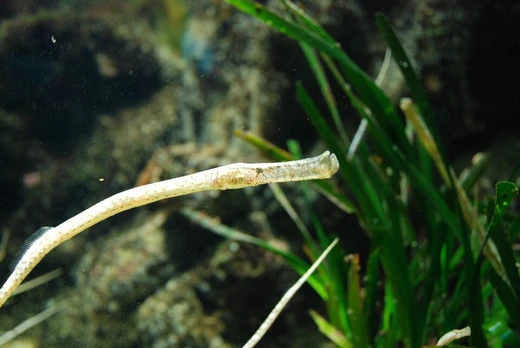
Schultz's pipefish
A cryptic pipefish of Indo-Pacific coral reefs.

Schultz's pipefish (*Corythoichthys schultzi*) belongs to the Syngnathidae family. Its genus name comes from Greek words for "helmet" and "fish," while its species name honors Leonard Peter Schultz, an American ichthyologist at the Smithsonian Institution. Males can grow up to 16 centimeters long. The body is long, cylindrical, and has a cryptic pattern—whitish with small black, brown, and reddish dashes and yellowish rings—that makes it hard for both prey and predators to spot. The eyes stick out, and the snout is long, slightly flattened, and narrower than the body. A small tail fin is present. Adults sometimes gather in small groups. This species is ovoviviparous: the male carries eggs and developing young in a brood pouch under his tail. It lives across the Indo-Pacific, from the Red Sea and East Africa to Tonga, Micronesia, northern Australia, and New Caledonia. A benthic fish, it stays around coral reefs in lagoons and seaward reefs, at depths of 2 to 30 meters. Adults form pairs or small groups when out in the open and find safe spots to spend the night.
Quick Facts
- Taxon
- Corythoichthys schultzi
Facts from the source article.
Lore & Background
The genus name *Corythoichthys* derives from the Greek words *coris* meaning 'helmet' and *ichthus* meaning 'fish'. The specific name *schultzi* honors Leonard Peter Schultz, an American ichthyologist of the Smithsonian Institution in Washington. The body is cylindrical and very elongated, with a whitish base color marked by small black, brown, and reddish dashes and yellowish rings. The eyes are protruding, and the snout is long, slightly compressed, and thinner than the body. The caudal fin is present but quite small. Adults may form small aggregations. The species is ovoviviparous: the male carries the eggs in a brood pouch under the tail, where the developing young are also carried.
Reader's Guide
Schultz's pipefish is a benthic species associated with coral reefs, typically found in lagoon and seaward reefs at depths between 2 and 30 meters. Adults live in pairs or small groups when out in the open and find safe places to spend the night. Its cryptic coloration makes it difficult to detect by both prey and predators. The species is widespread throughout the Indo-Pacific Oceans, from the Red Sea and East Africa to Tonga, Micronesia, northern Australia, and New Caledonia. Its reproductive strategy, with the male brooding eggs in a pouch under the tail, is characteristic of syngnathids and contributes to its biological significance.
Did You Know?
- The specific name *schultzi* honors American ichthyologist Leonard Peter Schultz of the Smithsonian Institution.
- Males can reach a length of up to 16 cm (6.3 in).
More in Seahorses and Pipefish 1-24
Spotted an error? Know more?
Reader corrections go straight into our review queue. Suggest an edit · How this site is sourced