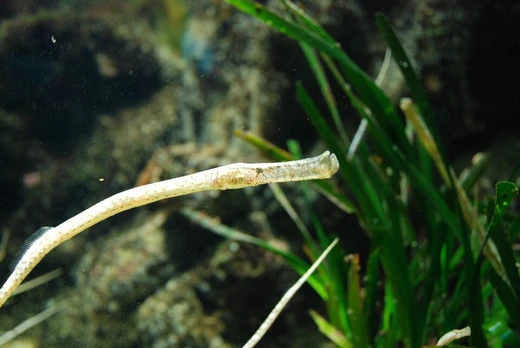
Ragged-tail pipefish
A freshwater pipefish with three genetically distinct lineages.

The ragged-tail pipefish (Microphis retzii) is a species of freshwater pipefish in the family Syngnathidae, distributed across Southeast Asia and parts of the western Pacific. It is notable for inhabiting tropical freshwater river systems and for being part of a species complex revealed by recent genetic analyses, which indicate that what was once considered a single widespread species actually comprises three distinct lineages.
Quick Facts
- Genus
- Microphis
- Species
- retzii
Facts from the source article.
Lore & Background
Microphis retzii was first described from Manado in Sulawesi, Indonesia, and later reassigned to the genus Microphis under the subgenus Lophocampus following taxonomic revision of Indo-Pacific freshwater pipefishes. The species is a slender pipefish with an elongated, armored body composed of bony rings, an angular cross section, and coloration ranging from pale to dark brown, often with a dark lateral stripe on the head and diffuse darker bars or stripes along the trunk. Juveniles may have elongated caudal-fin rays, while adults generally possess a rounded caudal fin.
The species occurs in freshwater habitats across Indonesia, the Philippines, Papua New Guinea, and islands extending to Pohnpei, Samoa, Fiji, the Solomon Islands, Tonga, and further north in eastern China, Taiwan, and Japan. In Japan, it is recorded from the Yaeyama Islands, with sporadic records from Wakayama and Shizuoka prefectures. Recent study shows an apparent increase in records along the path of the Kuroshio Current, suggesting a possible northward range expansion. The Yaeyama Islands are considered the northern limit of the species' breeding range.
Recent genetic analyses have revealed that M. retzii is actually a species complex consisting of three distinct lineages, separated for about 1.8 million years: one in East Indonesia (Sulawesi, Maluku, Papua), one in West Indonesia (Sunda Shelf islands), and one in the North Pacific (China and Taiwan). These lineages do not share genetic markers, indicating long-term isolation. The separation may have been influenced by historical changes in sea levels, ocean currents, and the species' ability to move between freshwater and marine environments during early life stages.
Reader's Guide
The ragged-tail pipefish is significant as a freshwater pipefish species whose taxonomy has been reshaped by modern genetic analysis. The discovery that Microphis retzii is a species complex—comprising three genetically distinct lineages associated with East Indonesia, West Indonesia, and the North Pacific—highlights the importance of molecular methods in revealing hidden biodiversity. This finding suggests that what was long considered a single widespread species actually represents multiple evolutionarily distinct groups that have been isolated for approximately 1.8 million years. The species' distribution across a broad geographic range, from Indonesia to Japan and the western Pacific islands, and its apparent northward expansion along the Kuroshio Current, indicate ongoing ecological and evolutionary dynamics. Its ability to inhabit freshwater rivers and streams, and evidence of possible amphidromous movement between freshwater and marine or estuarine environments, further underscore its ecological flexibility. The species also exhibits male parental care, with males carrying fertilized eggs in a brood pouch and releasing fully formed juveniles. A formal taxonomic revision is needed to clarify the classification of the three lineages, making M. retzii a subject of ongoing scientific interest.
Did You Know?
- The ragged-tail pipefish was first described from Manado in Sulawesi, Indonesia.
- Recent genetic analyses show that Microphis retzii consists of three distinct lineages separated for about 1.8 million years.
- Males carry fertilized eggs in a brood pouch and release fully formed juveniles, with broods typically containing approximately 100 eggs.
- The species has been recorded in Japan as far north as Wakayama and Shizuoka prefectures, with the Yaeyama Islands considered the northern limit of its breeding range.
More in Seahorses and Pipefish 1-24
Spotted an error? Know more?
Reader corrections go straight into our review queue. Suggest an edit · How this site is sourced