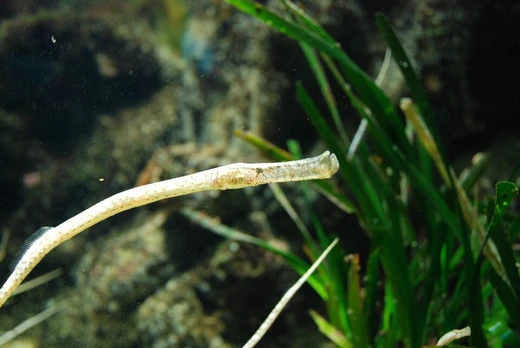
Notiocampus ruber
A sparsely recorded pipefish endemic to southern Australian waters.

Notiocampus ruber, the red pipefish, lives only in the temperate waters off southern Australia, including Tasmania. It is the sole species in its genus and was poorly known for decades—fewer than a dozen sightings were recorded across the country before 2021.
This pipefish is found on the continental shelf at depths between 5 and 20 meters. Its range stretches from New South Wales to Western Australia, with records also from Tasmania. Most observations come from reef crevices and hard seafloor, but in Gamay (Botany Bay, New South Wales), individuals were seen at about 12 meters depth on sand and low-relief hard structures, often among feathery red macroalgae. The first known photograph of a live red pipefish was taken on the Fleurieu Peninsula, South Australia, in 2007–2008. Fish are usually seen alone or in pairs, though groups have been noted. At least one individual showed short-term site fidelity, staying in the same spot for six months.
The body is long and worm-like, typically uniform red, though some fish have distinct markings on the head and snout plus scattered white speckles—whether these are sex-specific is unknown. It lacks pectoral fins entirely and has low, smooth body ridges, unlike the spiny ridges of many related pipefish. Unlike the northeastern Atlantic genera *Nerophis* and *Entelurus*, which it otherwise resembles, *Notiocampus* keeps a caudal fin and has its dorsal fin starting on the tail rather than the trunk.
Reproduction involves trunk brooding: a 2026 photograph showed a male carrying eggs attached directly to the underside of his trunk, just in front of the anus. The eggs are arranged in at least two parallel rows, large and exposed, without enclosing folds. This simple brooding pattern matches that of *Nerophis* and *Entelurus*.
Originally described as *Nannocampus ruber* by Ramsay and Ogilby in 1886, the species was moved to its own genus, *Notiocampus*, by C. E. Dawson in 1979. For decades, it was left out of molecular studies because no genetic material was available, so its place in the family tree remained uncertain. The 2026 confirmation of ventral trunk brooding places it in the subfamily Nerophinae, the earliest branch of Syngnathidae. This makes *Notiocampus* one of four southern Australian trunk-brooding pipefish genera, alongside *Heraldia*, *Maroubra*, and *Leptoichthys*.
Quick Facts
- Taxon
- Notiocampus ruber
Facts from the source article.
Lore & Background
Notiocampus ruber was originally described as Nannocampus ruber by E. P. Ramsay and J. D. Ogilby in 1886, and the genus Notiocampus was erected for the species by C. E. Dawson in 1979. Its reproductive morphology and phylogenetic placement remained unresolved for more than four decades after the genus was described. The first known photograph of a living specimen was taken on the Fleurieu Peninsula, South Australia, in 2007–2008. The species has a broad but sparsely recorded distribution across temperate southern Australia, ranging from New South Wales to Western Australia and including Tasmania. Records are primarily from reef crevices and hard substrates at depths of 5 to 20 m. Observations from Gamay (Botany Bay), New South Wales, between 2017 and 2021 documented individuals at approximately 12 m depth in mixed habitats comprising sand substrates and low-relief hard structures, frequently among feathery red macroalgae. Individuals are typically observed alone or in pairs, though aggregations have been recorded, and at least one individual exhibited short-term site fidelity over a six-month period.
Reader's Guide
Notiocampus ruber is notable as the only member of its genus and as a historically understudied species, with fewer than 12 records nationally prior to 2021. Its reproductive morphology and phylogenetic placement remained unresolved for more than four decades after the genus was described by C. E. Dawson in 1979. The 2026 confirmation of ventral trunk brooding—where eggs are attached directly to the ventral trunk surface without enclosing folds—supported its placement within the subfamily Nerophinae, the earliest-diverging clade within Syngnathidae. This makes Notiocampus one of four endemic southern Australian trunk-brooding pipefish genera, alongside Heraldia, Maroubra, and Leptoichthys. The species shares with the northeastern Atlantic genera Nerophis and Entelurus a suite of derived characters including complete loss of pectoral fins, low entire body ridges, an elongate vermiform body, and exposed eggs attached directly to the trunk integument. These shared characters suggest a possible closer affinity with the tribe Nerophini, though the geographically disjunct distribution may reflect either historical connectivity among early nerophine lineages with ancient Tethyan distributions or convergent evolution under ecological conditions favouring a cryptic, benthic lifestyle. The species is listed as Least Concern on the IUCN Red List, although it remains sparsely documented across its range.
Did You Know?
- Notiocampus ruber is the only known member of its genus.
- The species is a trunk-brooding pipefish, with eggs attached directly to the ventral trunk surface.
More in Seahorses and Pipefish 1-24
Spotted an error? Know more?
Reader corrections go straight into our review queue. Suggest an edit · How this site is sourced