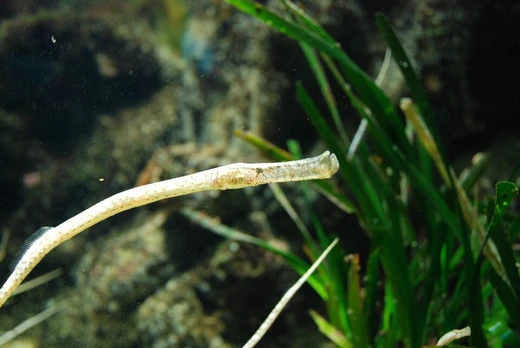
Microphis lineatus
A West Atlantic pipefish with distinctive breeding colors and uncertain taxonomy.

The opossum pipefish (*Microphis lineatus*) is a member of the Syngnathidae family found across a range of water types—fresh, brackish, and marine—in the West Atlantic. Its distribution spans from New Jersey (United States) south to São Paulo (Brazil), including the Caribbean Sea and Gulf of Mexico. It commonly inhabits rivers, areas among water hyacinth roots, mangroves, and *Sargassum* seaweed. Once classified as a subspecies of the Asian and Oceanian *Microphis brachyurus*, it is now considered a distinct species by FishBase and the Catalog of Fishes. However, some fully freshwater populations currently grouped under this species may actually represent a separate, unrecognized species.
Adults reach a maximum standard length of 19.4 cm (7.6 in). Their coloration is particularly striking in breeding individuals: the upper snout and rear half of the head and body are sienna brown, marked with a series of dark red blotches on each lateral trunk ring that form a red stripe between the lateral and superior trunk ridges. A silver stripe runs along the mid-side between the lateral and inferior trunk ridges, and the inferior trunk ridge has a silver edge. The lower half of the snout is bright red with a variable number of black vertical bars, while the caudal fin is also red with a central dark stripe. Spawning occurs in low-salinity areas of estuaries.
Little is known about annual population fluctuations, but declines in habitat quality have likely caused a drastic reduction in numbers. Major threats include habitat destruction, water control structures, declining water quality, and increased disease—all documented within the species’ primary ecosystems. Due to taxonomic uncertainty and vulnerability to habitat loss, the IUCN lists it as data deficient. In the United States, the National Marine Fisheries Service considers it a species of concern, the American Fisheries Society lists it as threatened, and it is designated a Species of Greatest Conservation Need in Florida, Louisiana, and Texas.
Quick Facts
- Genus
- Microphis
- Species
- lineatus
Facts from the source article.
Lore & Background
The opossum pipefish was historically considered a subspecies of Microphis brachyurus, which is native to Asia and Oceania, but is now treated as a distinct species by FishBase and Catalog of Fishes. However, it is possible that full-freshwater populations currently included in Microphis lineatus represent a separate species, reflecting ongoing taxonomic uncertainty. The species spawns in low salinity areas of estuaries.
Breeding adults exhibit a distinctive coloration: the upper snout and back half of the head and body are sienna brown with a series of dark red blotches on each lateral trunk ring forming a red stripe between the lateral and superior trunk ridges; a silver stripe appears on the mid-side between the lateral and inferior trunk ridges, with a silver edge on the inferior trunk ridge; the lower half of the snout is bright red with a variable number of black vertical bars, and the caudal fin is red with a central dark stripe.
Nothing is known about annual variation in population size, but a decline in habitat quality has likely led to a drastic decrease in population size. Major threats include habitat destruction, water control structures, declining water quality, and an increase in disease, all documented within the primary ecosystems occupied by the species.
Reader's Guide
The opossum pipefish is significant as a species whose taxonomic status has shifted from a subspecies to a full species, yet remains uncertain due to the possibility that freshwater populations may represent a separate species. This taxonomic ambiguity, combined with documented threats such as habitat destruction, water control structures, declining water quality, and increased disease, has led to its designation as Data Deficient by the IUCN and as a Species of Concern by the U.S. National Marine Fisheries Service. The American Fisheries Society lists it as Threatened, and it is a Species of Greatest Conservation Need in Florida, Louisiana, and Texas. Its distinctive breeding coloration—featuring sienna brown, red blotches, silver stripes, and a red caudal fin with a dark stripe—makes it visually notable among pipefish. The lack of data on annual population variation and the likely drastic population decline underscore the need for further research and conservation attention. Its presence across fresh, brackish, and marine habitats in the West Atlantic, from New Jersey to Brazil, highlights its broad but vulnerable distribution.
Did You Know?
- The opossum pipefish reaches up to 19.4 cm (7.6 in) in standard length.
- Breeding adults have a bright red lower snout with variable black vertical bars and a red caudal fin with a central dark stripe.
More in Seahorses and Pipefish 1-24
Spotted an error? Know more?
Reader corrections go straight into our review queue. Suggest an edit · How this site is sourced