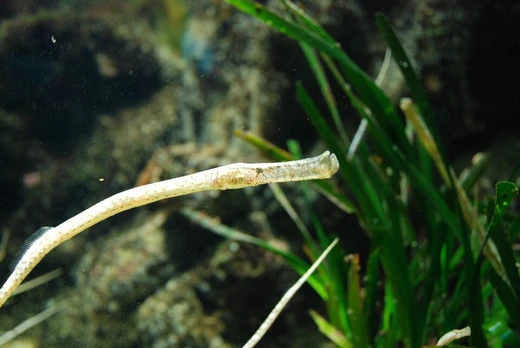
Messmate pipefish
A biofluorescent pipefish of Indo-Pacific reefs.

The messmate pipefish (Corythoichthys haematopterus) is a marine fish belonging to the Syngnathidae family. It lives across the tropical Indo-Pacific, ranging from East Africa to the Vanuatu Islands. Sometimes sold in the aquarium trade, it goes by the name dragonfaced pipefish, as well as bloodspot pipefish, reef pipefish, reeftop pipefish, and yellow-streaked pipefish. This fish can glow—under blue or ultraviolet light, it re-emits the light as yellow, a trait called biofluorescence. This glow may help with communication between its own kind and with camouflage.
Adults have a long, narrow body and snout, a soft-rayed dorsal fin, and a caudal fin. They measure between 9 and 18 centimeters, averaging 13 centimeters. Their color varies, but most have a pale body, a striped or net-like head, faint brown horizontal stripes along the trunk and tail, and a dorsal fin without pale spots. Females show less visible bands and have dark blotches on the underside of their front trunk rings. Males may have bright blue bars across the belly of the front trunk. Males also have a brood pouch on the underside near the tail, where eggs are held under fleshy folds instead of protective plates. Juveniles lack color patterns but have spiny, serrated ridges on the trunk and tail, plus a membranous fin fold along the tail. As they grow to about 4 centimeters, their colors appear, and the ridges become mostly smooth in adults. Fish from the Seychelles have very few markings, and any present are light brown and irregular. In contrast, those from Sri Lanka and the Pacific are well-patterned, with a strongly net-like head pattern. This species can be told apart from other *Corythoichthys* pipefish by its 17 trunk rings. It has 48 to 54 rings total, 16 rays on the pectoral fins, and about 29 dorsal fin rays.
Messmate pipefish live in shallow seawater, from the surface down to about 19.8 meters deep. They stay near sandy bottoms in reefs, seagrass, coral, and rocky areas. They cannot handle changes in salinity and prefer warm water. Their population size and abundance are unknown.
The larval stage lasts about one month, during which the fish drift with ocean currents. This long larval phase lets them cross deep ocean straits that other marine animals with shorter larval periods cannot. Adults are secretive and rarely swim up into the water column except to find a mate.
Quick Facts
- Taxon
- Corythoichthys haematopterus
Facts from the source article.
Lore & Background
Messmate pipefish have an elongated body with a long, narrow snout, soft-rayed dorsal fin, and caudal fin. Coloration is variable: most have a pale body, striped or reticulate head, poorly defined brown horizontal stripes on trunk and tail, and a dorsal fin without pale spots. Females have less visible bands and dark splotches on the underside of anterior trunk rings; males may have bright blue transverse bars on the ventral side of the anterior trunk. The male’s brood pouch is located ventrally near the tail, and eggs are covered by fleshy folds rather than protective plates. Juveniles lack color patterns but have spiny, serrated trunk/tail ridges and post-larval membranous dorsal fin folds; ridges become mostly smooth in adults. Messmate pipefish from the Seychelles have minimal markings, while those from Sri Lanka and the Pacific are well patterned with a strongly reticulate head.
Reader's Guide
The messmate pipefish is notable for its biofluorescence, re-emitting blue or ultraviolet light as yellow, with red fluorescent light strongly in the fins used for signaling with conspecifics. These fluorescent pigments are found in cells similar to melanophores, possibly originating from microorganisms. The species is strictly monogamous, with females competing for mates—a case of sex role reversal. Males provide all parental care, protecting, aerating, and osmoregulating the clutch. Pairs mate around eight times per breeding season (April to October), with brooding periods lasting 9 to 19 days. Daily morning greetings, lasting 1–3 minutes, maintain reproductive synchronization and pair bonds. The species is cryptic, rarely swimming into the water column except to search for a mate, and anchors to coral to feed on planktonic crustaceans, especially harpacticoid and calanoid copepods. Listed as Least Concern on the IUCN Red List, it may be affected by habitat loss from human activity and climate change due to sensitivity to water temperature and salinity.
Did You Know?
- Females are the primary competitors for mates, a reversal of traditional sex roles.
- Males cannot carry more than one clutch of eggs at a time; any second clutch falls off within a day.
- Daily morning greetings between paired adults last 1–3 minutes and help synchronize reproduction.
More in Seahorses and Pipefish 1-24
Spotted an error? Know more?
Reader corrections go straight into our review queue. Suggest an edit · How this site is sourced