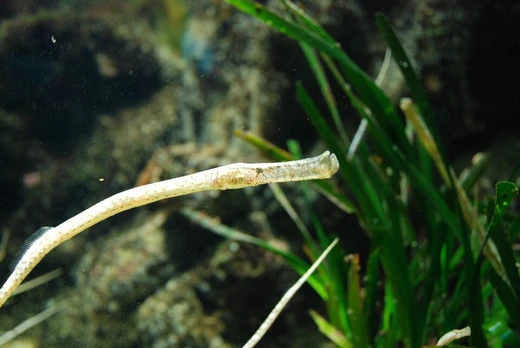
Leafy seadragon
A master of camouflage, the leafy seadragon resembles floating seaweed.

The leafy seadragon (Phycodurus eques), also known as Glauert's seadragon, is a marine fish and the only member of the genus Phycodurus in the family Syngnathidae, which includes seadragons, pipefish, and seahorses. It is found along the southern and western coasts of Australia and is popularly known as 'leafies'. It is the marine emblem of the state of South Australia and a focus for local marine conservation.
Quick Facts
- Genus
- Phycodurus
- Species
- eques
Facts from the source article.
Lore & Background
The name 'leafy seadragon' is derived from its appearance, with long leaf-like protrusions coming from all over the body. These protrusions are not used for propulsion; they serve only as camouflage. The creature propels itself using a pair of pectoral fins on the sides of its neck and a dorsal fin on its back, which are almost completely transparent and undulate minutely to complete the illusion of floating seaweed. It can also change colour to blend in, depending on diet, age, location, and stress level.
Much like the seahorse, the leafy seadragon's name is derived from its resemblance to another creature (in this case, the mythical dragon). It differs from the seahorse in appearance, form of locomotion, and its inability to coil or grasp things with its tail. A related species is the weedy seadragon, which is multicoloured and grows weed-like fins but is smaller. Another unique feature is the small, circular gill openings covering tufted gills, unlike the crescent-shaped gill openings of most fish.
The generic name Phycodurus comes from Ancient Greek words for 'seaweed' and 'skin', while the species name eques is from Latin meaning 'horse'. Leafy seadragons are found only in southern Australian waters, from Wilson's Promontory in Victoria to Jurien Bay in Western Australia, mostly over sand patches around kelp-covered rocks and seagrass. They usually live a solitary lifestyle, and males care for the eggs, which are deposited onto the male's tail and attach to a brood patch.
Reader's Guide
The leafy seadragon is notable as the marine emblem of South Australia and is celebrated through a biennial Leafy Sea Dragon Festival held within the District Council of Yankalilla, which attracted over 7,000 participants in its inaugural event. It has also been featured in an animated short film, 'The Amazing Adventures of Gavin, a Leafy Seadragon', made for marine conservation education. The species is subject to many threats, including collection for the aquarium trade, pollution, and industrial runoff. It has been totally protected in South Australia since 1987, Victoria since at least 1995, and Western Australia since 1991, and its welfare must be considered in development projects under Australian federal law. Despite protection, obtaining seadragons for captivity is expensive and difficult, and attempts to breed them in captivity have so far been unsuccessful. They are displayed in numerous public aquaria worldwide, including in Australia, Canada, Singapore, the United States, and Europe. The species is not used in alternative medicine, unlike other syngnathid fish.
Did You Know?
- The leafy seadragon is the only member of the genus Phycodurus.
- Its leaf-like protrusions are used only for camouflage, not for propulsion.
- The male cares for the eggs, which are deposited onto his tail and hatch after about 9 weeks.
- Only about 5% of the eggs survive to become independent young.
More in Seahorses and Pipefish 1-24
Spotted an error? Know more?
Reader corrections go straight into our review queue. Suggest an edit · How this site is sourced