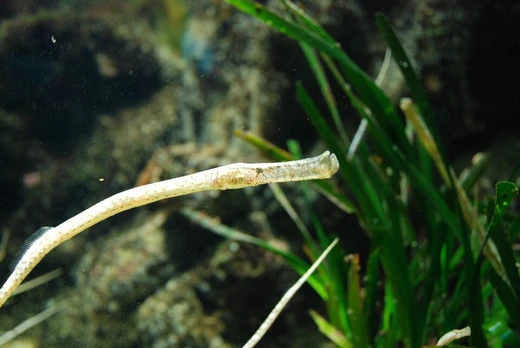
Kyonemichthys rumengani
A tiny pipefish, sole member of its genus, found across the Indo-Pacific.

The thread pipefish (Kyonemichthys rumengani), called Hari-youji in Japanese, is a tiny pipefish reaching just 2.68 cm (1.06 in) in length. It is the sole species in its genus and lives in the Pacific Ocean around Indonesia, at depths between 15 and 20 m (49 to 66 ft).
First described in 2007 from a female specimen collected in the Lembeh Strait off Sulawesi, it was initially grouped with the pygmy pipehorse genera *Acentronura* and *Idiotropiscis* based on body shape. However, mitochondrial DNA studies later showed that *Kyonemichthys* is actually a close relative of *Urocampus*, forming a branch separate from *Acentronura*, *Idiotropiscis*, and *Siokunichthys*.
Though first found in Indonesia, this species appears widespread across the Indo-Pacific. It has been recorded in the Red Sea near Egypt, the Ryukyu Islands, the Philippines, Fiji, the Mariana Islands, and Papua New Guinea. It inhabits shallow coastal reefs with mixed cover, often using bryozoans, hydroids, or debris as holdfasts to anchor itself.
Quick Facts
- Taxon
- Kyonemichthys rumengani
Facts from the source article.
Lore & Background
Kyonemichthys rumengani was originally described in 2007 based on an adult female specimen collected in the Lembeh Strait, Sulawesi. Initially thought to be related to the pygmy pipehorse genera Acentronura and Idiotropiscis based on morphological similarities, mitochondrial genetic analyses later found that Kyonemichthys is instead a sister taxon to Urocampus, forming a clade that excludes Acentronura, Idiotropiscis, and Siokunichthys. This species grows to a length of 2.68 cm (1.06 in) and is the only known member of its genus.
Reader's Guide
The thread pipefish is significant as the sole representative of its genus, Kyonemichthys, highlighting a distinct evolutionary lineage within pipefishes. Its discovery in 2007 from a single female specimen in the Lembeh Strait, Sulawesi, initially led to misclassification based on morphology, but genetic analysis clarified its relationship as a sister taxon to Urocampus. This underscores the importance of molecular data in resolving phylogenetic uncertainties. The species is widespread throughout the Indo-Pacific, recorded from the Red Sea off Egypt to the Ryukyu Islands, Philippines, Fiji, Mariana Islands, and Papua New Guinea, indicating a broad distribution despite its small size. It inhabits shallow coastal reefs at depths of 15 to 20 m, where it uses bryozoans, hydroids, and debris as holdfasts for orientation. Its small size and cryptic habits make it a notable subject for studies of reef biodiversity and evolutionary biology.
Did You Know?
- It grows to a maximum length of only 2.68 cm (1.06 in).
- It was originally described in 2007 from a single adult female specimen collected in the Lembeh Strait, Sulawesi.
- Genetic analysis shows it is a sister taxon to Urocampus, not closely related to pygmy pipehorses as first thought.
More in Seahorses and Pipefish 1-24
Spotted an error? Know more?
Reader corrections go straight into our review queue. Suggest an edit · How this site is sourced