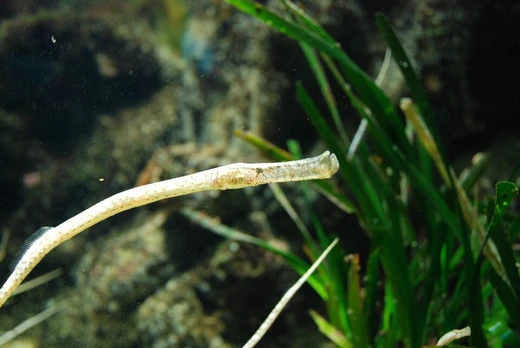
Kaupus
Monotypic genus of pipefish endemic to southern Australia.

Kaupus is a monotypic genus of pipefish, containing only the species Kaupus costatus, known as the deepbody pipefish. It is endemic to the southern coast of Australia. The genus is named in honor of the ichthyologist Johann Jakob Kaup.
Quick Facts
- Taxon
- Kaupus costatus
Facts from the source article.
Lore & Background
The deepbody pipefish has a very elongated, laterally flattened body, with adult females being much deeper than males. The snout is of moderate length, comprising 32-40% of the head length, and has a depth of 32-56% of its length. A ridge runs along the middle of the snout and merges with the supraorbital ridges. The opercular ridges are straight and cross at least half the opercule in subadults and adults. The upper trunk and tail ridges break near the dorsal fin base, while the lower ridges are continuous; the flank ridge on the trunk is not confluent with the tail ridges. The tail is not prehensile. The dorsal fin is nearer the head than the tail tip, the anal fin is very small, and the caudal fin is small and rounded. The fish is red or reddish-brown with very small blue, yellow, or white spots on the back, and undulating fine markings of the same colors on the head and tail. Adult males and subadults occasionally have a narrow, blackish midlateral stripe on the tail near the body. Adult females have bluish streaks, lines, and small spots above the lateral trunk ridge, with an obvious blue patch on each trunk ring below the lateral ridge.
Reader's Guide
Kaupus costatus is endemic to the coastal waters of southern Australia, occurring in Victoria, South Australia, Tasmania, the Bass Strait, and the Great Australian Bight. It inhabits seagrass and algal beds, mangroves, and estuaries at depths of 0–50 meters, preferring silty environments with relatively clear water. Its diet is thought to consist of small planktonic and possibly benthic crustaceans, as in other Australian pipefishes. The species is ovoviviparous, with males brooding fertilized eggs beneath their tail and giving live birth to fry. Broods are relatively small, containing 3 to 25 eggs, and newly hatched larvae measure 15 mm. The species is listed as a marine species under the Australian Environment Protection and Biodiversity Conservation Act 1999 and is protected by state fisheries management acts. Its preferred habitat of undisturbed seagrass beds, especially Zostera beds, is threatened by decline.
Did You Know?
- Kaupus is a monotypic genus named after ichthyologist Johann Jakob Kaup.
- The deepbody pipefish grows to a maximum length of 12.9 cm.
- Adult females are much deeper-bodied than males.
- Males brood 3 to 25 eggs beneath their tail and give live birth.
Frequently Asked Questions
What is Kaupus?
Kaupus is a monotypic genus of pipefish that contains just a single species, Kaupus costatus, commonly called the deepbody pipefish. Because it holds only one species, the genus and the species essentially refer to the same animal.
Why is the genus named Kaupus?
The name honors Johann Jakob Kaup (1803–1873), a German ichthyologist whose work on fish classification helped shape modern taxonomy. Taxonomists gave him the posthumous tribute by attaching his surname as the genus epithet.
Where does Kaupus costatus live in the wild?
The deepbody pipefish is endemic to the southern coastline of Australia, meaning you will not find it naturally anywhere else in the world. Its range is restricted to that stretch of temperate Australian waters.
How large can a deepbody pipefish grow?
Adults reach a maximum standard length of about 12.9 cm (roughly 5.1 inches). That places Kaupus costatus in the smaller-to-mid range among pipefish species.
What are the fin-ray counts for Kaupus costatus?
The dorsal fin carries between 30 and 36 rays, the anal fin has 3 to 4 rays, and each pectoral fin shows 9 to 11 rays. These counts are one of the key features ichthyologists use to separate Kaupus from other Syngnathidae genera.
More in Seahorses and Pipefish 1-24
Spotted an error? Know more?
Reader corrections go straight into our review queue. Suggest an edit · How this site is sourced