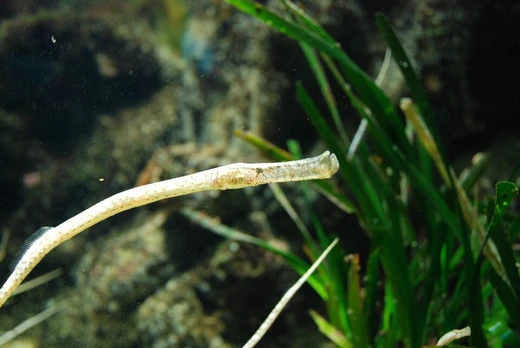
Hippichthys cyanospilos
A small Indo-Pacific pipefish with a male brood pouch.

Hippichthys cyanospilos, called the blue spotted pipefish or bluespeckled pipefish, is a marine species in the Syngnathidae family. It lives in the Indo-Pacific region.
This pipefish stays small, reaching up to 16 cm long. Its head flows smoothly into its body, with a medium-length, tapered snout. The body looks somewhat angular because of four broken lengthwise ridges along the top and bottom. Its caudal fin is small and narrow. Body color ranges from yellow to light brown, sometimes nearly black, and can be plain, spotted, or mottled with white, yellow, or light blue. The dorsal fin is usually whitish, with three to four small brownish spots on each of its 20 to 28 rays.
The species is widespread across tropical, subtropical, and temperate waters of the Indo-Pacific, from the east coast of Africa (including the Red Sea) to Fiji and the Philippines, and from southern Japan to northern Australia. It prefers shallow waters in estuaries, small coastal rivers, and mangrove areas.
It feeds on planktonic crustaceans. The fish is ovoviviparous: the male carries the eggs in a ventral brood pouch. This pouch has villi rich in capillaries that surround each fertilized egg, forming a kind of placenta to supply the embryos. Once fully developed, the young are released from the pouch and live independently.
Quick Facts
- Taxon
- Hippichthys cyanospilos
Facts from the source article.
Lore & Background
The blue-spotted pipefish is a small-sized fish reaching a maximum length of 16 cm. Its head is in continuity with the body, and its snout is tapered and of medium length. The body has a somewhat angular appearance due to four discontinuous longitudinal ridges on the dorsal and ventral sides. The caudal fin is small and narrow. Body coloration ranges from yellow to light brown through almost black, and can be plain, spotted, or mottled with white, yellow, or light blue. The dorsal fin is usually whitish with 3-4 small brownish spots on each of its 20-28 rays.
This species is widespread throughout tropical, subtropical, and temperate waters of the Indo-Pacific, from the eastern coast of Africa (including the Red Sea) to Fiji and the Philippines, and from southern Japan to the northern coast of Australia. It inhabits shallow waters of estuaries from small coastal rivers and mangrove areas.
The bluespeckled pipefish feeds on planktonic crustaceans. It is ovoviviparous, with the male brooding the eggs in its ventral brood pouch. The pouch contains villi rich in capillaries that surround each fertilized egg, creating a sort of placenta that supplies the embryos. When fully grown, the pups are expelled from the pouch and evolve in complete autonomy.
Reader's Guide
Hippichthys cyanospilos is a representative of the family Syngnathidae, a group known for male pregnancy. Its significance lies in its reproductive biology: the male broods the eggs in a ventral brood pouch with villi rich in capillaries that form a placenta-like structure to supply the embryos. This adaptation is a key characteristic of pipefishes and seahorses. The species is also notable for its variable coloration, ranging from yellow to light brown through almost black, often with white, yellow, or light blue spots or mottling. Its distribution across the Indo-Pacific, from the eastern coast of Africa to Fiji and from Japan to Australia, highlights its adaptability to tropical, subtropical, and temperate waters. The blue-spotted pipefish occupies shallow estuarine and mangrove habitats, feeding on planktonic crustaceans. Its legacy is tied to its role in understanding syngnathid evolution and parental care, as described in the source article.
Did You Know?
- The blue-spotted pipefish can reach a maximum length of 16 cm.
- Its dorsal fin usually has 20-28 rays, each with 3-4 small brownish spots.
- The male broods the eggs in a ventral brood pouch with capillary-rich villi that form a placenta-like structure.
More in Seahorses and Pipefish 1-24
Spotted an error? Know more?
Reader corrections go straight into our review queue. Suggest an edit · How this site is sourced