Halicampus
A pipefish genus closest to seahorses, with 12 species.

Halicampus is a genus of pipefish in the family Syngnathidae, with 12 recognized species. The name comes from Greek: *hali* (sea or salt, from *háls*) combined with *campe* (a bend or curve). Although they look like other pipefish, a 2022 genetic study showed that Halicampus is the closest relative of seahorses (genus *Hippocampus*), and both are placed in the tribe Hippocampini.
The 12 species are: *Halicampus boothae* (Booth's pipefish), *H. brocki* (Brock's pipefish), *H. dunckeri* (Duncker's pipefish), *H. edmondsoni* (Edmondson's pipefish), *H. grayi* (Gray's pipefish), *H. macrorhynchus* (ornate pipefish), *H. marquesensis*, *H. mataafae* (Samoan pipefish), *H. nitidus* (glittering pipefish), *H. punctatus* (starry pipefish), *H. spinirostris* (spinysnout pipefish), and *H. zavorensis* (Zavora pipefish).
These pipefish live mainly in shallow tropical or subtropical waters of the Pacific, Indian, and southeastern Atlantic Oceans. Adults range from 50 to 200 mm in length. They are secretive and well camouflaged, so although rarely seen, some species may be common. For example, *H. zavorensis* is known from only three specimens in the northwestern Indian Ocean, but it is unclear whether this reflects true rarity or behavior (such as hiding in weed), mimesis (resembling algae), or crypsis (mottled brown coloring blending in). Adults usually stay in water less than 100 m deep, but juveniles are pelagic and may be found deeper.
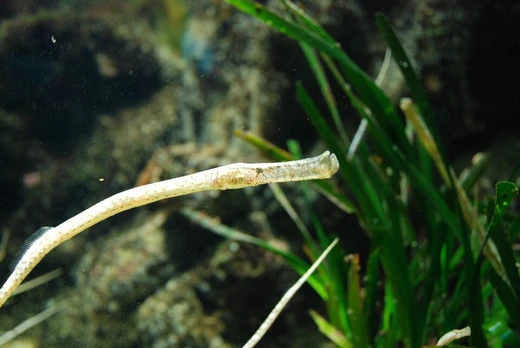
Adults typically inhabit sheltered areas like coral reefs, seagrass beds, or macroalgae. Some species are found on or in coral rubble, sand, or mud. Like other Syngnathidae, they have bony armor plates covering their bodies, which limits flexibility and makes them sluggish swimmers that rely on rapid fin movements. Their jaws are fused. Where known, their diet consists of small planktonic crustaceans, which they snap up with their small mouths at the tip of the snout. Their head—with a slim snout, large eyes, and raised rear skull—resembles a seahorse, contrasting with their long, slim body. Many species have projections sticking out from the body and head at intervals.
Halicampus species are ovoviviparous, giving birth to live young. Like seahorses, males receive eggs during mating into a brood pouch on the underside, extending from just behind the anus to about halfway along the tail.
Quick Facts
- Taxon
- Halicampus
- Type Species
- Halicampus grayi
- Type Species Authority
- Kaup, 1856
Facts from the source article.
Lore & Background
The name Halicampus is derived from Greek: hali, meaning sea or salt, combined with campus, from campe, meaning a bend, turn, or curve. The genus includes 12 recognized species such as Halicampus boothae (Booth's pipefish), Halicampus brocki (Brock's pipefish), and Halicampus grayi (Gray's pipefish). These pipefishes are mainly found in shallow tropical or subtropical waters of the Pacific, Indian and South-east Atlantic Oceans, varying from 50 to 200 mm in length when fully grown.
Reader's Guide
Halicampus species are notable for being the closest relatives to seahorses (Hippocampus) according to a 2022 phylogenetic study, which placed both genera in the tribe Hippocampini. They are generally secretive and often well camouflaged, so although quite rarely seen, some species may be quite common. For example, Halicampus zavorensis is known only from three specimens from the North-west Indian Ocean, but it is not known if this reflects rarity or is the result of behaviour, mimesis, or crypsis. Adults mainly live in sheltered areas such as coral reefs, seagrass beds, or among macroalgae. They have protective bony armor plates that limit flexibility, leading to sluggish swimming using rapid fin movements. Their diet consists of small planktonic crustacea snapped up by the small mouth at the tip of the snout. The head is reminiscent of a seahorse, with a slim snout, relatively large eyes, and raised rear part of the skull, contrasting with the long, slim body. Reproduction is ovoviviparous: eggs are transferred into a brood pouch on the ventral surface of the male, incubated within individual skin cells, and released as the yolk sac is exhausted. New-born fish become free-swimming pelagic members of the plankton until about half-grown, then settle into their preferred adult habitat.
Did You Know?
- Halicampus is the closest relative to seahorses (Hippocampus) according to a 2022 phylogenetic study.
- The name Halicampus combines Greek words for 'sea' and 'bend' or 'curve'.
- Adults are usually found in less than 100 m of water, but juveniles are pelagic and may be found deeper.
More in Seahorses and Pipefish 1-24
Spotted an error? Know more?
Reader corrections go straight into our review queue. Suggest an edit · How this site is sourced