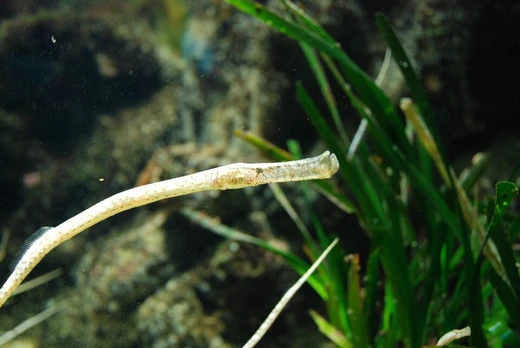
Halicampus macrorhynchus
A small, camouflaged pipefish with skin growths on back and snout.

Halicampus macrorhynchus, also called the ornate pipefish, whiskered pipefish, or winged pipefish, belongs to the family Syngnathidae. This small fish reaches a maximum length of 18 cm. Its body is thin and elongated, with reduced fins that are hard to see. The color changes to match its surroundings, improving camouflage, and ranges from reddish to brownish, greenish, or yellowish. On the back, there are small skin growths that form about eight pairs of fin-like structures, along with small, irregular whitish or pinkish spots. The head is small and blends into the body, featuring a long snout that may have skin growths at its tip.
The ornate pipefish is widespread across tropical and subtropical waters of the Indo-West Pacific, from the eastern coast of Africa (including the Red Sea) to the Solomon Islands, and from southern Japan to the Queensland area of Australia. It stays close to the bottom, from the surface down to 25 meters deep, preferring reefs, sandy bottoms, or coral rubble with algae or debris where it can hide easily.
Like many other pipefish, this species has a benthic lifestyle and is ovoviviparous. During courtship, the female transfers her eggs into skin folds on the male’s ventral surface, forming a protective pouch. The male fertilizes the eggs and guards them through incubation. The ornate pipefish is a carnivore, feeding on small crustaceans and other invertebrates, which it sucks in through its tubular snout.
Quick Facts
- Taxon
- Halicampus macrorhynchus
Facts from the source article.
Lore & Background
The ornate pipefish has a thin, elongate body with reduced fins that are difficult to observe. Its body color varies with its environment to improve camouflage, ranging from reddish to brownish through greenish and yellowish. The backside of its body has small skin growths forming pairs of fin-like structures, generally eight in number, and also small irregular whitish or pinkish spots. The head is small and does not stand out from the body, with a long snout whose extremity can be covered with skin growths.
This species is widespread throughout tropical and subtropical waters of the Indo-West Pacific, from the eastern coast of Africa (including the Red Sea) to the Solomon Islands, and from southern Japan to the Queensland area in Australia. It is found close to the bottom between the surface and 25 meters deep, preferring areas such as reefs, sandy bottoms, or coral rubble with algae or debris in which it can easily hide.
Like many pipefishes, the ornate pipefish has a benthic lifestyle and is ovoviviparous. Reproduction occurs during a courtship where the female transfers her eggs to the ventral surface of the male, between skin folds forming a protective pouch; the male fertilizes the eggs and protects them during incubation. It is a carnivore, feeding on small crustaceans and other invertebrates, which it aspires through its tubular snout.
Reader's Guide
The ornate pipefish is significant as a representative of the family Syngnathidae, demonstrating typical pipefish traits such as a benthic lifestyle, ovoviviparous reproduction with male brooding, and a carnivorous diet of small invertebrates. Its ability to change body color to match its environment highlights its adaptation for camouflage in reef, sandy, and rubble habitats. The species' distribution across the Indo-West Pacific, from eastern Africa to the Solomon Islands and from Japan to Australia, indicates a broad ecological range in tropical and subtropical waters. The presence of skin growths on the back and snout, along with its small size (up to 18 cm), distinguishes it from other pipefishes. Its legacy lies in its role as a cryptic, bottom-dwelling predator that relies on camouflage and a tubular snout for feeding, contributing to the biodiversity of shallow marine ecosystems.
Did You Know?
- The ornate pipefish can reach a maximum length of 18 cm.
- The male protects the eggs in a pouch formed by skin folds on its ventral surface.
More in Seahorses and Pipefish 1-24
Spotted an error? Know more?
Reader corrections go straight into our review queue. Suggest an edit · How this site is sourced