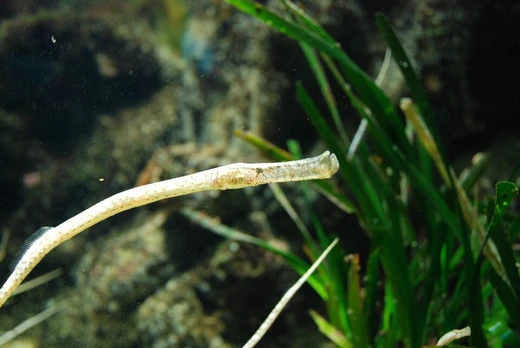
Halicampus dunckeri
A small, variable-colored pipefish of the Indo-West Pacific.

Halicampus dunckeri, known as Duncker's pipefish or ridgenose pipefish, belongs to the Syngnathidae family. This small fish reaches up to 15 centimeters in length, with a thin, elongated body and reduced fins that are hard to see. Its color varies widely between individuals, ranging from creamy white to dark brown, reddish, or yellowish. The upper body is covered in small whitish skin growths and irregular pale bars. The head is small with large eyes, and the snout is short with a distinctive whitish tip.
The ridgenose pipefish is found across the tropical and subtropical Indo-West Pacific, from the eastern coast of Africa and the Red Sea to the Solomon Islands, and from southern Japan to the Great Barrier Reef. It lives close to the bottom, from the surface down to 25 meters deep, preferring reefs, sandy bottoms, or coral rubble with algae or debris for hiding.
Like many pipefishes, this species has a benthic lifestyle and is ovoviviparous. During courtship, the female transfers her eggs into skin folds on the male's underside, forming a protective pouch where he fertilizes and guards them through incubation. It is carnivorous, feeding on small crustaceans and other invertebrates, which it sucks up through its tubular snout.
The fish is named after ichthyologist Georg Duncker (1870–1953), who revised the pipefish family in 1915 while at the Zoological Museum Hamburg.
Quick Facts
- Taxon
- Halicampus dunckeri
Facts from the source article.
Lore & Background
The Duncker's pipefish is a small fish reaching a maximum length of 15 cm, with a thin, elongate body and reduced fins that are difficult to observe. Its body color is highly variable, ranging from creamy white to dark brown, including reddish and yellowish tones. The dorsal part of the body is covered with small whitish skin growths and irregular pale bars. Its head is rather small with large eyes, and its snout is short with a characteristic whitish tip.
This species is widespread throughout the tropical and subtropical waters of the Indo-West Pacific, from the eastern coast of Africa (including the Red Sea) to the Solomon Islands, and from southern Japan to the Great Barrier Reef. It is found close to the bottom between the surface and 25 meters deep, preferring areas such as reefs, sandy bottoms, or coral rubble with algae or debris in which it can easily hide.
Like many pipefishes, the Duncker's pipefish has a benthic lifestyle and is ovoviviparous. During courtship, the female transfers her eggs to the ventral surface of the male, where they are fertilized and protected in a pouch formed by skin folds until hatching. It is a carnivore, feeding on small crustaceans and other invertebrates, which it aspirates through its tubular snout.
Reader's Guide
The Duncker's pipefish, named in honor of ichthyologist Georg Duncker, who revised the pipefish family in 1915, represents a typical example of the Syngnathidae family's reproductive strategy, with males carrying and protecting the eggs. Its highly variable coloration and preference for hiding among algae and debris make it well adapted to its benthic habitat. The species is found across a broad geographic range, from the eastern coast of Africa to the Solomon Islands and from Japan to the Great Barrier Reef, indicating its adaptability to tropical and subtropical waters. Its diet of small crustaceans and invertebrates, captured via its tubular snout, underscores its role as a predator of small benthic organisms. The fish's small size and cryptic appearance contribute to its ability to avoid predators and thrive in shallow, structured environments such as reefs and rubble zones.
Did You Know?
- The Duncker's pipefish can reach a maximum length of 15 cm.
- The male incubates the eggs in a protective pouch formed by skin folds on its ventral surface.
More in Seahorses and Pipefish 1-24
Spotted an error? Know more?
Reader corrections go straight into our review queue. Suggest an edit · How this site is sourced