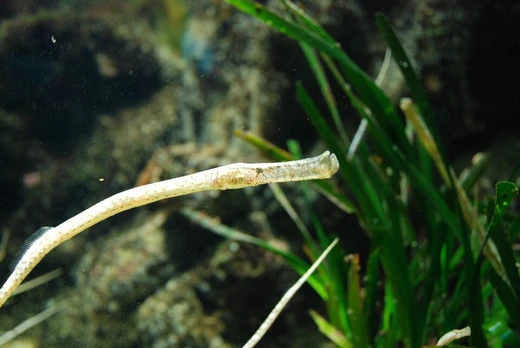
Festucalex cinctus
A secretive pipefish endemic to eastern Australian coastal waters.

Festucalex cinctus, commonly known as the girdled pipefish or orange-cheek pipefish, is a species of marine fish in the pipefish family Syngnathidae. It is endemic to the waters off eastern Australia, where it inhabits sheltered coastal bays and estuaries.
Quick Facts
- Taxon
- Festucalex cinctus
Facts from the source article.
Lore & Background
The girdled pipefish is recognized by its broad head, slender snout, and leafy appendages on its dorsal ridges. Its colour varies from dark grey to orange-brown with pale bars along the back and an orange blotch on the lower gill cover; occasional pale or black individuals have been sighted. It can grow to lengths of 16 centimetres.
This species is demersal and is expected to feed on small crustaceans, similar to other pipefish. It is ovoviviparous, with males carrying eggs and giving birth to live young. The males bear the fertilised eggs in a semi-enclosed pouch on the ventral side of the trunk; this pouch has distinct protective plates and its folds barely meet on the midline when full of eggs.
Festucalex cinctus is secretive, living on patches of coral rubble, sand, or in areas with sparse growth of seagrass, algae, and sponges. It has also been recorded in small numbers in open water near pilings of piers in harbours. Specimens from the tropical part of its distribution, in northern Queensland and the Northern Territory, appear to be different from specimens in New South Wales and may represent a different species.
Reader's Guide
Festucalex cinctus is notable as a secretive, endemic pipefish of eastern Australia, restricted to sheltered coastal bays and estuaries. Its distinctive features include a broad head, slender snout, and leafy dorsal appendages, with colour variation from dark grey to orange-brown and an orange cheek blotch. The species is ovoviviparous, with males carrying eggs in a semi-enclosed pouch with protective plates. It is listed under the Australian Environment Protection and Biodiversity Conservation Act 1999 and protected under the New South Wales Fisheries Management Act. A taxonomic uncertainty exists: specimens from northern Queensland and the Northern Territory may represent a different species from those in New South Wales, highlighting the need for further study. Its demersal lifestyle and expected diet of small crustaceans align with typical pipefish biology.
Did You Know?
- The girdled pipefish can grow to lengths of 16 centimetres.
- It is found at depths of 8–31 metres off Queensland and New South Wales.
More in Seahorses and Pipefish 1-24
Spotted an error? Know more?
Reader corrections go straight into our review queue. Suggest an edit · How this site is sourced