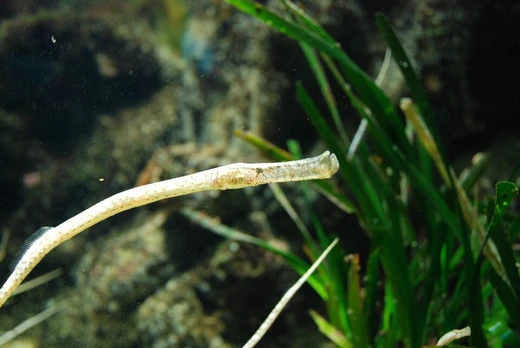
Doryrhamphus
Flagtail pipefishes popular in the aquarium trade.

Doryrhamphus is a genus of pipefish. Along with one other genus, its members are commonly called flagtail pipefish. They are a popular choice for home aquariums. These fish are found in the Indian and Pacific Oceans, living in reef habitats. All species in this genus reach a maximum length of 14 centimeters (5.5 inches) or less; only D. janssi grows longer than 8.5 centimeters (3.3 inches). Most species have a horizontal blue stripe along the body, and every species has a tail with a whitish edge that is set off by a contrasting patch of black, red, or yellow.
- Maximum length
- 14 cm (5.5 in) or less
- Species count
- 6 recognized species
- Notable species
- Doryrhamphus janssi (only species surpassing 8.5 cm)
- Distribution
- Indian and Pacific Oceans
- Habitat
- reef environments
Lore & Background
The members of Doryrhamphus are native to the Indian and Pacific Oceans, where they inhabit reef environments. Most species have a horizontal blue line along their body, and all have a whitish-edged tail that is marked contrastingly with black, red or yellow. The species in this genus have a maximum length of 14 centimetres (5.5 in) or less, with Doryrhamphus janssi being the only species that surpasses 8.5 centimetres (3.3 in).
Reader's Guide
Doryrhamphus is notable as one of the two genera colloquially known as flagtail pipefishes, a group popular in the aquarium trade. The genus comprises six recognized species, all native to the Indian and Pacific Oceans and restricted to reef environments. Their distinctive appearance includes a horizontal blue line along the body in most species and a whitish-edged tail marked contrastingly with black, red or yellow. The genus includes Doryrhamphus janssi, the only species exceeding 8.5 cm in length, though all species remain at or below 14 cm. The species list includes several subspecies, such as Doryrhamphus excisus abbreviatus and Doryrhamphus negrosensis malus, reflecting taxonomic subdivisions within the genus. The genus has been reviewed in the Ichthyological Bulletin, indicating scientific interest in its classification and diversity.
Did You Know?
- Doryrhamphus janssi is the only species in the genus that surpasses 8.5 cm in length.
- The genus contains six recognized species, including subspecies such as Doryrhamphus excisus abbreviatus.
More in Seahorses and Pipefish 1-24
Spotted an error? Know more?
Reader corrections go straight into our review queue. Suggest an edit · How this site is sourced