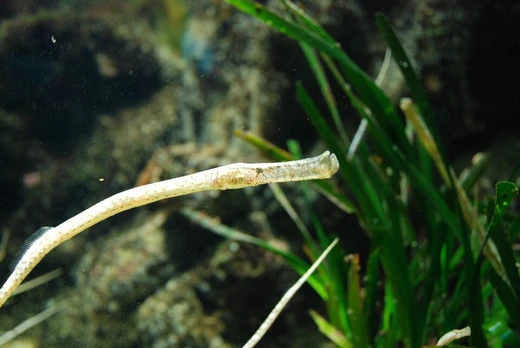
Doryrhamphus excisus
A cleaner pipefish with a blue stripe and fan-like tail.

Doryrhamphus excisus is a species of flagtail pipefish from the genus Doryrhamphus, commonly known as the blue-striped pipefish or blue-and-orange cleaner pipefish. It is notable for its wide distribution across the Indo-Pacific and tropical East Pacific, and for its symbiotic cleaning behavior with larger fish.
Quick Facts
- Genus
- Doryrhamphus
- Species
- excisus
Facts from the source article.
Lore & Background
The species was named by Kaup in 1856, with D. melanopleaura named by Bleeker as a synonym. It was later split into subspecies based on distribution: D. excisus abbreviatus, named by Dawson in 1981 and restricted to the Red Sea; D. excisus excisus, named by Kaup; and D. excisus paulus, named by Fritzsche in 1980 and restricted to the Revillagigedo Islands in Mexico. The fish is distinguished by a bluish mid-lateral stripe contrasting an orange or reddish body, a fan-like tail, a rounded caudal fin with a white outline and mostly black inside, and an elongated snout. Males and females grow to an average of 7 cm; males have a series of bumps and hooks on the upper surface of the snout, while females have a smooth snout. Males mature around lengths of 31 mm. The species has a wide distribution from the Persian Gulf to the coasts of Central America and South America, inhabiting reef crevices and tidepools.
Reader's Guide
Doryrhamphus excisus holds significance as a widespread cleaner pipefish in the Indo-Pacific and tropical East Pacific. Its behavior of inspecting larger fish for parasites, including moray eels, establishes a symbiotic relationship. The species frequently hovers in pairs, swimming in an undulating motion and bobbing up and down above the substrate to advertise cleaning services. During mating, females deposit eggs into the male's brooding pouch on its underside, which supplies oxygen and nutrients. Its diet includes zooplankton, benthic invertebrates, and parasites from other fishes, captured by rapidly taking in water through its tube-like snout. In captivity, the species is considered peaceful, especially in pairs, and has been reported to breed in tanks. Aquarium hobbyists have successfully fed it frozen brine shrimp and mysis shrimp, and it may be found in shady areas during daytime. The species' taxonomic history includes subspecies defined by distribution, with D. excisus abbreviatus limited to the Red Sea and D. excisus paulus to the Revillagigedo Islands.
Did You Know?
- Males have bumps and hooks on the upper surface of their snout, while females have a smooth snout.
- The species has been observed picking parasites off moray eels.
- Males mature at around 31 mm in length.
- The subspecies D. excisus paulus is restricted to the Revillagigedo Islands in Mexico.
More in Seahorses and Pipefish 1-24
Spotted an error? Know more?
Reader corrections go straight into our review queue. Suggest an edit · How this site is sourced