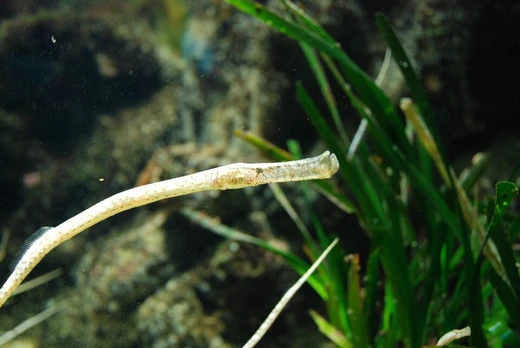
Corythoichthys amplexus
A small, monogamous pipefish with male brooding.

The brown-banded pipefish (*Corythoichthys amplexus*) is a small marine fish belonging to the family Syngnathidae. It reaches a maximum length of 10 centimetres (3.9 inches). Its base colour is light tan, with broad reddish-brown bands across the sides and back, each three to four rings wide. These bands sometimes split into two closely set bands, and may be indistinct on the rear third of the tail. The head lacks prominent stripes behind the eye. Males have dark brown blotches on the underside of the front trunk rings, while females often have small paired spots there.
Adults form monogamous pairs. The species is ovoviviparous: males brood the fertilised eggs in a pouch under the tail. This pouch protects the top and sides of the egg mass, leaving the underside exposed. Males can begin brooding once they reach a total length of 57 millimetres (2.2 inches). The egg mass contains two to 17 transverse rows within a gelatinous matrix.
The brown-banded pipefish is widespread across the tropical Indo-West Pacific, from the eastern coast of Africa to the western Pacific, north to the Ryukyu Islands and south to the Great Barrier Reef. Records from South Africa and Madagascar need confirmation. It is a secretive species found in coral reefs, lagoons, harbours, open sandy flats, rubble along reef edges, and small reef patches surrounded by sand. It occurs at depths up to 10 metres (33 feet) and feeds on small crustaceans.
Humans trade this pipefish for the aquarium trade. Like other pipefishes and seahorses, it may also be dried and sold for traditional medicine or as curios.
Quick Facts
- Taxon
- Corythoichthys amplexus
Facts from the source article.
Lore & Background
The brown-banded pipefish has a base color of light tan with broad reddish-brown bands on the body, each 3–4 rings wide, lying across the side and dorsal surfaces. Occasionally these bands are divided to form two closely set bands, and sometimes they are indistinct on the posterior third of the tail. The head lacks prominent stripes behind the eye, and the ventral surface of anterior trunk rings is blotched with dark brown in males, while often being marked with small paired spots in females.
Adult males and females form monogamous pairs. The species is ovoviviparous, with males brooding fertilised eggs in a brood pouch situated under his tail. The brood pouch protects the dorsal surface and side of the egg mass, leaving the ventral surface exposed. Males are capable of brooding once they attain a total length of 57 millimetres (2.2 in). The egg mass consists of 2–17 transverse rows within a gelatinous matrix.
The brown-banded pipefish is widespread throughout the tropical waters of the Indo-West Pacific region, from the eastern coast of Africa to the western Pacific north to the Ryukyu Islands to south the Great Barrier Reef. Records from South Africa and Madagascar require verification. It is a secretive species which occurs in coral reefs, lagoons, harbours, and open sandy-flats, as well as in rubble along edges of reefs and in small patches of reef surrounded by sandy flats. It occurs to a depth of 10 metres (33 ft) and feeds on small crustaceans.
Reader's Guide
The brown-banded pipefish is traded for the aquarium trade. Like other pipefishes and seahorses, it may be dried and traded for traditional medicine and for sale as curios. Its secretive nature and specific habitat preferences—coral reefs, lagoons, harbours, open sandy-flats, and rubble along reef edges—make it a species of interest for marine biodiversity. The species' monogamous pairing and male brooding behavior are notable reproductive traits within the Syngnathidae family. The uncertainty regarding records from South Africa and Madagascar highlights gaps in distribution knowledge. Its small size (maximum 10 cm) and distinctive reddish-brown bands aid in identification. The species' role in the aquarium trade and traditional medicine underscores its economic significance, though the article does not quantify trade volumes or conservation status.
Did You Know?
- Males brood fertilised eggs in a brood pouch under the tail, leaving the ventral surface exposed.
- The egg mass contains 2–17 transverse rows within a gelatinous matrix.
- It feeds on small crustaceans.
More in Seahorses and Pipefish 1-24
Spotted an error? Know more?
Reader corrections go straight into our review queue. Suggest an edit · How this site is sourced