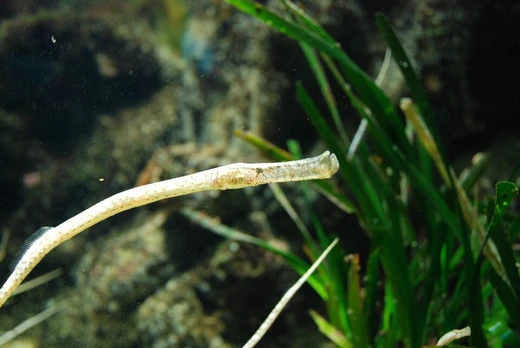
Common seadragon
A slow-moving, seaweed-mimicking fish endemic to southern Australian waters.

The common seadragon, also called the weedy seadragon (Phyllopteryx taeniolatus), belongs to the order Syngnathiformes, a group that includes pipefishes, seahorses, and trumpetfishes. This fish serves as the marine emblem for the Australian state of Victoria. Its range is limited to Australian and nearby island coastal waters in the eastern Indian Ocean, the northern part of the Southern Ocean, and the southwestern Pacific Ocean.
Adults display a reddish body with yellow and purple striped markings. They possess small, leaf-like appendages that mimic kelp or seaweed fronds for camouflage, along with several short spines for defense. Like seahorses and other syngnathids, they have a tubular snout and a fused, toothless jaw that snaps up small invertebrate prey very quickly. Males are narrower and darker than females. A long dorsal fin runs along the back, and small pectoral fins on each side of the neck help with balance. These fish can grow up to 45 cm (18 in) long.
Common seadragons live in coastal waters at depths from about 10 m (33 ft) to 30 m (98 ft). They are found around rocky reefs, seaweed beds, seagrass meadows, and structures covered with seaweed. They are slow-moving and, like most relatives, rely heavily on camouflage—specifically mimicking seaweed—to avoid predators. Unlike many seahorses and pipefishes, they lack a prehensile tail for grasping; instead, they drift among kelp and seaweed masses, blending in with their leafy appendages. Individuals are seen alone or in pairs, feeding on tiny crustaceans and other zooplankton by sucking them into their toothless mouths.
As with most other syngnathids, males care for the developing eggs. Females lay about 120 eggs onto a brood patch on the underside of the male’s tail. The male fertilizes and carries the eggs for roughly a month before the young hatch. Hatchlings are independent from birth and start eating soon after. They take about 28 months to reach sexual maturity and may live up to six years. Mating in captivity is rare because researchers have not yet identified the biological or environmental triggers for reproduction. Survival rates for young are low in the wild but around 60% in captivity.
Quick Facts
- Taxon
- Phyllopteryx taeniolatus
Facts from the source article.
Lore & Background
Adult common seadragons are reddish with yellow and purple striped markings, and have small, leaf-like appendages that resemble kelp or seaweed fronds, providing camouflage, as well as short spines for protection. They have a tubular snout and a fused, toothless jaw to capture small invertebrate prey at lightning speed. Males have narrower bodies and are darker than females. They have a long dorsal fin along the back and small pectoral fins on either side of the neck for balance.
Seadragons are slow-moving and rely on excellent camouflage as defense. They lack the prehensile tail of many seahorses and pipefishes, instead drifting among kelp and seaweed masses. Individuals are observed alone or in pairs, feeding on tiny crustaceans and other zooplankton. Males care for the developing eggs: females lay around 120 eggs onto the brood patch on the underside of the male's tail, which he fertilises and carries for about a month before hatchlings emerge. Young are independent at birth and begin eating shortly after.
Mating in captivity is rare because researchers have yet to understand the biological or environmental triggers. The survival rate for young is low in the wild but about 60% in captivity. Several aquariums have successfully bred common seadragons, including the Aquarium of the Pacific, Tennessee Aquarium, Melbourne Aquarium, Georgia Aquarium, Monterey Bay Aquarium, and Birch Aquarium. Aquarium keepers must adjust water, food, tank setup, and procedures, as seadragons are prone to diseases such as scuticociliatosis, myxozoanosis, fungal infections, intestinal coccidiosis, neoplasia, and swim bladder issues.
Reader's Guide
The common seadragon is classified as Vulnerable on the IUCN Red List. While it is desired in the international aquarium trade, the volume of wild-caught individuals is small and not currently a major threat. Instead, habitat loss and degradation due to human activities and pollution pose the greatest threats. The loss of seagrass beds and canopy seaweed from inshore rock reefs, combined with the species' poor dispersal ability, put populations at risk. It is not currently a victim of bycatch or targeted in traditional Chinese medicine.
Climate change-induced marine heatwaves on the Great Southern Reef may make the species more endangered than currently assumed. Edgar et al. (2023) suggest citizen science data reflects a 59% population decline between 2011 and 2021, which would classify it as Endangered. However, Schlögl and Booth (2025) argue that the data are too sparse to draw meaningful conclusions about population trends.
It is illegal to take or export these species in most states where they occur. A database called 'Dragon Search' encourages divers to report sightings, supported by the Marine Life Society of South Australia Inc., the Marine and Coastal Community Network, the Threatened Species Network, and the Australian Marine Conservation Society. Monitoring may indicate local water quality, and seadragons could become a flagship species for Australia's south coast. Captive breeding programs are in place, led by Sea Life Melbourne Aquarium. In December 2015, the Melbourne aquarium hatched eggs, and by March 2016, 45 fry had a 95% survival rate.
Did You Know?
- The common seadragon is the marine emblem of the Australian state of Victoria.
- Males carry the fertilized eggs on a brood patch under their tail for about a month.
- The species can reach 45 cm (18 in) in length.
- A 2023 study suggested a 59% population decline from 2011 to 2021, but a 2025 study disputed the data's sufficiency.
More in Seahorses and Pipefish 1-24
Spotted an error? Know more?
Reader corrections go straight into our review queue. Suggest an edit · How this site is sourced