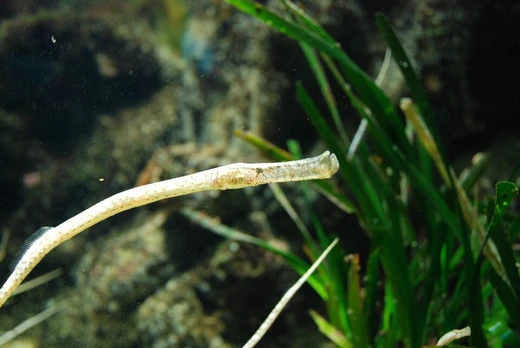
Choeroichthys sculptus
A small, secretive pipefish with keeled scutella and a short snout.

Choeroichthys sculptus, commonly known as the sculptured pipefish, is a marine fish belonging to the family Syngnathidae. This small, secretive species has a short snout and a body and tail that are roughly the same length. Its coloration is dark brown, with two to three rows of white spots bordered in black along the sides, larger white spots along the back, and dark spots on the lower part and sides of the head. The trunk and tail rings are notched between them, and each ring bears a conspicuous scutellum with a projecting ridge or keel. Adults can reach up to 8.5 centimeters (3.3 inches) in length.
The species is widely distributed across the Indo-Pacific, ranging from the South China Sea, southern Japan, and the Northern Mariana Islands to Samoa. In Australia, it is known only from northern Western Australia and the Great Barrier Reef.
Choeroichthys sculptus is thought to feed mainly on small crustaceans. It is solitary, with separate sexes. Males brood the eggs in an enclosed brood pouch on the underside of the body; this is an ovoviviparous species, meaning the eggs hatch inside the pouch and the male gives birth to live young. The female typically deposits the eggs in a single layer of two parallel rows within the pouch. Males may begin brooding at a length of 4.5 centimeters (1.8 inches). The larvae have not been described. This pipefish inhabits coral reef flats, mangroves, and seagrass beds.
The genus name *Choeroichthys* comes from the Greek *choiros* ("pig") and *ichthys* ("fish"), while the species name *sculptus* is Latin for "to carve," referring to the prominent keeled scutella.
Quick Facts
- Taxon
- Choeroichthys sculptus
Facts from the source article.
Lore & Background
Choeroichthys sculptus is a small secretive species with a short snout, and with body and tail sections which are approximately equal in length. It is dark brown in colour with 2–3 rows of black-margined white spots along its sides, larger white spots along its back, and dark spots situated on the lower part of and on either side of the head. The trunk and tail rings show notches between the rings with conspicuous scutella, each of which has a projecting ridge or keel. They can grow to lengths of 8.5 centimetres (3.3 in).
The species is widely distributed in the Indo-Pacific from the South China Sea, southern Japan, the Northern Mariana Islands, to Samoa. In Australia it is known only from northern Western Australia and the Great Barrier Reef. It inhabits coral reef flats, mangroves, and seagrass beds.
Choeroichthys sculptus is thought to feed mainly on small crustaceans. They are solitary, the sexes are separate, and males brood the eggs in an enclosed brood pouch on the underside of his body—this species is ovoviviparous, eventually the eggs hatch and the male gives birth to live young. The female usually lays the eggs in a single layer of two parallel rows within the brood pouch. The males may be brooding at 4.5 centimetres (1.8 in) in length. The larvae are undescribed.
Reader's Guide
Choeroichthys sculptus, the sculptured pipefish, is a small marine fish of the family Syngnathidae. Its significance lies in its distinctive morphology, particularly the conspicuous keeled scutella on the trunk and tail rings, which give the species its name—'sculptus' meaning 'to carve' in Latin. The species is widely distributed across the Indo-Pacific, from the South China Sea to Samoa, and in Australia is known only from northern Western Australia and the Great Barrier Reef. It occupies diverse habitats including coral reef flats, mangroves, and seagrass beds. The species exhibits typical syngnathid reproductive biology: males brood the eggs in an enclosed brood pouch and give birth to live young, with females laying eggs in a single layer of two parallel rows. Males may begin brooding at a length of 4.5 cm. The larvae remain undescribed. The generic name 'Choeroichthys' is derived from Greek 'choiros' meaning 'pig' and 'ichthys' meaning 'fish'. The species is thought to feed mainly on small crustaceans and is solitary in nature. Its secretive habits and specific habitat preferences contribute to its ecological role in Indo-Pacific reef and seagrass ecosystems.
Did You Know?
- Choeroichthys sculptus can grow to lengths of 8.5 cm (3.3 in).
- The species is ovoviviparous: males brood eggs in an enclosed pouch and give birth to live young.
- Its trunk and tail rings have conspicuous scutella with projecting ridges or keels.
- The specific name 'sculptus' means 'to carve' in Latin, referring to the keeled scutella.
More in Seahorses and Pipefish 1-24
Spotted an error? Know more?
Reader corrections go straight into our review queue. Suggest an edit · How this site is sourced