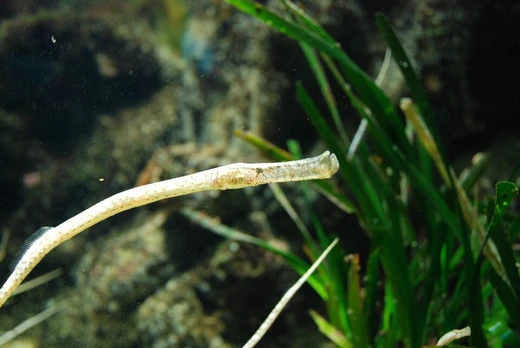
Choeroichthys latispinosus
A rare pipefish known from only three localities in Western Australia.

Choeroichthys latispinosus, called the Muiron Island pipefish or Muiron pipefish, lives only along the western coast of Western Australia. Its name comes from a sighting on South Murion Island. The species was first described in 1978 by Charles Dawson, who worked from a single specimen. Since then, scientists have found it at just three locations, and only a handful of specimens exist.
The holotype, a female, was 27.5 mm long (standard length). Its body is dark brown with pale white blotches and mottling. The dorsal fin has a narrow black or brown edge. The snout features a protruding, spiny ridge on each side; the species name *latispinosus* combines the Latin words for "side" and "thorny." The dorsal fin has 22 rays, the pectoral fin 20, the anal fin 4, and the caudal fin 10. There are 19 trunk rings and 20 tail rings. Adults reach a total length of 50 mm.
This pipefish is endemic to coastal waters from Port Denison to Brecknock Island in the eastern Kimberley region. It lives on coral reefs. Like other members of its genus, males brood the young in a simple pouch under their trunk or midsection. Females transfer eggs to the male, who keeps them until they hatch and then gives birth to live young. Its diet likely consists of small planktonic crustaceans such as copepods and isopods, as seen in better-known syngnathid fishes.
The IUCN lists *C. latispinosus* as Data Deficient. The main threat is loss and degradation of its coral reef habitat. More research is needed on its full range, ecology, abundance, and population trends. It is also listed as a marine species under Australia's Environment Protection and Biodiversity Conservation Act 1999.
Quick Facts
- Taxon
- Choeroichthys latispinosus
Facts from the source article.
Lore & Background
Choeroichthys latispinosus was described by Charles Dawson in 1978 based on a single female specimen measuring 27.5 mm SL. Its specific name latispinosus is derived from Latin latus (side) and spinosus (thorny), referring to the protruding, spinous lateral ridge on its snout. The holotype has a dark brown ground colour with pale white blotches and mottling, and its dorsal fin is narrowly edged with black or brown. The species grows to a total length of 50 mm and has 19 trunk rings and 20 tail rings.
The species is endemic to the coastal waters of Western Australia, thought to inhabit the area from Port Denison to Brecknock Island in the eastern Kimberley region. It is still known from only three localities and very few specimens. The species inhabits coastal coral reefs and is thought to feed on small planktonic crustaceans such as copepods and isopods, as exhibited by other more well-known syngnathid fishes.
Like other members of its genus, males of this species brood the young in a simple pouch beneath their trunk or midsection. Females transfer eggs to the male, who broods them until they hatch and then gives birth to live young.
Reader's Guide
Choeroichthys latispinosus is significant as a poorly known, data-deficient species endemic to Western Australia. Its description in 1978 from a single specimen highlights how little is understood about its distribution and ecology. The species is listed as Data Deficient on the IUCN Red List, with the major threat being loss and degradation of its coral reef habitat. It is also a listed marine species under Australia's Environment Protection and Biodiversity Conservation Act 1999. The fact that it is known from only three localities and very few specimens underscores the need for further research to understand its full range, ecology, abundance, and population trends. Its restricted range along the western coast of Western Australia, from Port Denison to Brecknock Island, makes it particularly vulnerable to habitat loss. The species' reproductive strategy, with males brooding young in a simple pouch, is typical of syngnathid fishes but remains poorly documented for this specific species. Its conservation status reflects the broader challenges facing many marine species with limited distributions and insufficient data.
Did You Know?
- Its specific name latispinosus means 'side thorny' in Latin, referring to a spinous ridge on its snout.
- The holotype is a female measuring 27.5 mm SL, described by Charles Dawson in 1978.
More in Seahorses and Pipefish 1-24
Spotted an error? Know more?
Reader corrections go straight into our review queue. Suggest an edit · How this site is sourced