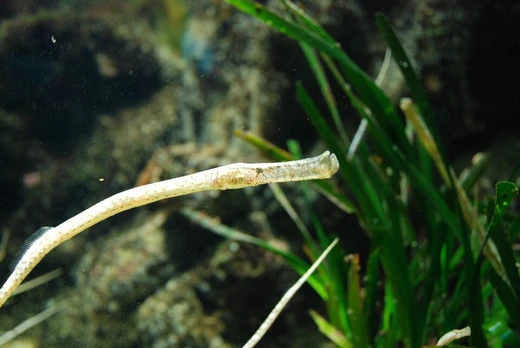
Banded pipefish
A widespread Indo-Pacific pipefish with a straight, banded body.

The banded pipefish, also known as the ringed pipefish (scientific name *Dunckerocampus dactyliophorus*), belongs to the Syngnathidae family, the same group that includes seahorses and other pipefish. This species is found across a wide area of the tropical Indo-Pacific, including the Red Sea. Its range stretches from Australia and Indonesia to Japan, the Philippines, and French Polynesia, as well as locations like South Africa, Fiji, and the Solomon Islands. It lives in tide pools, lagoons, and outer reef slopes in tropical climates.
The fish has a straight, elongated body that can grow up to 19 centimeters (7.4 inches) long. Fleshy streamers trail back from its head, which are believed to help camouflage it while hiding among reeds.
Reproduction follows the pattern seen in other seahorses and pipefish: the male has a specialized brood pouch. The female deposits her eggs into this pouch, where they develop, and the male later gives birth to the young.
Quick Facts
- Taxon
- Dunckerocampus dactyliophorus
Facts from the source article.
Lore & Background
The banded pipefish has a straight, elongated body reaching a maximum length of 19 cm. It possesses fleshy streams coming back from its head, which are thought to be mechanisms of camouflage while hiding in reeds. The species inhabits tide pools, lagoons, and outer reef slopes in tropical climates throughout the Indo-Pacific region, including the Red Sea. Its range extends from Australia and South Africa to French Polynesia and Japan. Like other seahorses and pipefishes, the male banded pipefish has a specialised brood pouch. The female deposits her eggs into this pouch, where they develop, and the male later gives birth.
Reader's Guide
The banded pipefish is significant as a representative of the Syngnathidae family, illustrating the unique reproductive strategy where males brood and give birth. Its widespread distribution across the Indo-Pacific, from the Red Sea to French Polynesia, highlights its adaptability to various tropical reef habitats, including tide pools, lagoons, and outer reef slopes. The species' fleshy head streams, thought to aid camouflage, demonstrate an evolutionary adaptation for concealment among reeds. The banded pipefish's maximum length of 19 cm and its straight, elongated body are characteristic features. Its presence in numerous countries and island nations underscores its ecological role in tropical marine ecosystems. The species is documented in taxonomic databases and photographic collections, contributing to scientific understanding of pipefish diversity and distribution.
Did You Know?
- The banded pipefish reaches a maximum length of 19 cm.
- It has fleshy streams coming back from its head, thought to aid camouflage.
- Its range includes the Red Sea and extends from South Africa to French Polynesia.
More in Seahorses and Pipefish 1-24
Spotted an error? Know more?
Reader corrections go straight into our review queue. Suggest an edit · How this site is sourced