Zosteraceae
A family of marine flowering seagrasses with filamentous pollen.

Zosteraceae is one of the four seagrass families, comprising marine perennial flowering plants found in temperate and subtropical coastal waters. The family is notable for having the highest diversity located around Korea and Japan, and for being a conserved name in botanical nomenclature.
Quick Facts
- Taxon
- Zosteraceae
Facts from the source article.
Lore & Background
Zosteraceae has long been accepted by taxonomists as monophyletic. The APG II system of 2003 recognizes this family and places it in the monocot order Alismatales. The family contains approximately twenty-two species divided between two genera, Phyllospadix and Zostera, with Zostera containing three subgenera: Heterozostera (formerly considered a separate genus), Zostera, and Zosterella. Zosteraceae is closely related to Potamogetonaceae, a family of freshwater aquatics.
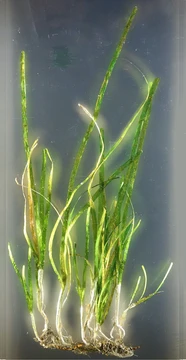
Most seagrasses complete their entire life cycle under water, having filamentous pollen especially adapted to dispersion in an aquatic environment and ribbon-like leaves that lack stomata. Seagrasses are herbaceous and have prominent creeping rhizomes. A distinctive characteristic of the family is the presence of characteristic retinacules, which are present in all species except members of Zostera subgenus Zostera.
The family is one of four marine grass families, alongside Cymodoceaceae, Ruppiaceae, and Posidoniaceae. Related families include Potamogetonaceae and sometimes Zannichelliaceae.
Reader's Guide
Zosteraceae is significant as one of the four seagrass families, representing marine perennial flowering plants that have adapted to complete their entire life cycle underwater. Its filamentous pollen and ribbon-like leaves without stomata are key adaptations to aquatic environments. The family's highest diversity around Korea and Japan highlights a biogeographic center of seagrass evolution. The presence of retinacules in most species serves as a distinctive taxonomic feature, with the exception of Zostera subgenus Zostera. The family's monophyletic status and placement in Alismatales under the APG II system of 2003 reflect its accepted phylogenetic position. Its close relationship to Potamogetonaceae, a freshwater family, provides insight into the evolutionary transition from freshwater to marine habitats. The conservation of the name Zosteraceae ensures nomenclatural stability. With approximately 22 species across two genera, the family contributes to coastal biodiversity and ecosystem function in temperate and subtropical waters worldwide.
The Great Return to the Sea
Seagrasses represent one of evolution's most dramatic reversals: flowering plants that once conquered dry land made the journey back into the ocean. This remarkable recolonization occurred roughly 70 to 100 million years ago, when a single lineage of monocotyledonous flowering plants gave rise to three independent marine lineages—Hydrocharitaceae, the Cymodoceaceae complex, and Zosteraceae. What makes this achievement even more extraordinary is that the transition happened in parallel three to four separate times, producing a paraphyletic assemblage of marine angiosperms. Despite their modest species count of around sixty, these plants have spread across the continental shelves of every continent except Antarctica, a colonization success that rivals more diverse marine plant groups like mangroves and salt marsh species. Recent genomic sequencing of Zostera marina and Zostera muelleri has illuminated the molecular story behind this return, revealing that certain genes were lost entirely—such as those governing stomata—while others were reduced or even regained, painting a picture of a plant family that rewrote its own blueprint to thrive beneath the waves.
Anatomy of an Underwater Plant
They are the sole group of embryophytes—what we commonly call land plants—that have made a permanent home in the ocean, and their anatomy reflects a radical departure from terrestrial ancestors. Their leaves carry a reduced cuticle and an epidermis completely devoid of stomata, with that same epidermis serving as the primary photosynthetic tissue. Rather than relying on aerial structures, these plants anchor themselves through robust rhizomes, while their roots operate in anoxic sediment, depending on oxygen shuttled down from the leaves and rhizomes above. The cell walls tell an equally fascinating story: alongside the familiar cellulose found in angiosperms, some seagrass species produce sulfated polysaccharides, a trait long associated with red, brown, and green macroalgae. Researchers proposed in 2005 that marine angiosperms independently regained the capacity to synthesize these sulfated compounds. The result is a cell wall architecture that blends ancestral land-plant features with marine-algae-like elements and entirely new structural components, shaped by the dual pressures of high salinity and novel grazers and bacterial communities.
Love in the Blue
Reproduction in seagrasses is a process that unfolds entirely beneath the surface, and for a long time scientists assumed it was a purely passive affair—pollen simply drifting on ocean currents. That assumption has been overturned, at least for Thalassia testudinum, which employs a mixed biotic-abiotic pollination strategy. Instead of offering nectar the way terrestrial flowers do, this seagrass produces nutritious mucigenous clumps of pollen designed to stick to passing animals. Crustaceans, including crabs from the family Majidae and the zoeal larvae of Thalassinidea, as well as syllid polychaete worm larvae, have all been discovered carrying pollen grains on their bodies. These tiny hitchhikers effectively serve as underwater pollinators, ferrying reproductive material between plants in a system that mirrors, in its own submerged way, the insect-pollinated flowers of the land. Seeds, once formed, are dispersed by both living organisms and physical forces, completing a life cycle that never breaks the water's surface.
Guardians of the Coast
Seagrass meadows rank among the most productive ecosystems on Earth, functioning as vital carbon sinks while supporting a diversity of marine life that rivals coral reefs. These dense underwater grasslands, spread across shallow and sheltered coastal waters anchored in sand or mud, serve as breeding and nursery grounds for countless organisms and underpin commercial fisheries that human communities depend upon. Yet this ecological wealth is under serious threat. Global studies indicate that seagrass habitat is declining worldwide, and ten of the roughly sixty seagrass species—about fourteen percent of the total—face elevated extinction risk, with three formally qualifying as endangered. The loss of these meadows would ripple far beyond the plants themselves, undermining the marine biodiversity and the ecosystem services that coastal populations rely on for food and protection. The worldwide endangering of these sea meadows has prompted a growing call for both deeper scientific understanding and more robust conservation efforts, recognizing that protecting seagrasses means safeguarding an entire web of life and the livelihoods intertwined with it.
Frequently Asked Questions
What is Zosteraceae?
Zosteraceae is one of the four recognized seagrass families, grouping marine perennial flowering plants that live in temperate and subtropical coastal waters. It encompasses roughly 22 species organized under just two genera, Phyllospadix and Zostera.
What are Zosteraceae's key genera and internal structure?
The family rests on two genera—Phyllospadix and Zostera—with Zostera itself split into three subgenera: Heterozostera, Zostera, and Zosterella. This layered taxonomy is what gives the family its notable internal diversity.
Where is Zosteraceae most diverse in the world?
The coastal waters around Korea and Japan host the highest concentration of Zosteraceae species, making that region the family's global diversity hotspot.
What makes Zosteraceae's pollen unusual?
Members of this family produce filamentous pollen, a distinctive trait that sets them apart from most other flowering plants. This adaptation is closely tied to their fully marine lifestyle within the order Alismatales.
What is Zosteraceae's standing in botanical nomenclature?
Under the APG II system (2003), Zosteraceae is classified in the order Alismatales and carries the status of a conserved name, meaning its identity is locked in and will not be displaced by competing synonyms.
More in Seagrasses 1-24
Spotted an error? Know more?
Reader corrections go straight into our review queue. Suggest an edit · How this site is sourced