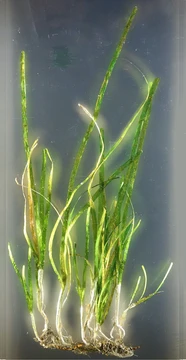
Zostera novazelandica
A disputed seagrass species endemic to New Zealand shores.

National Museum of Natural History · CC0
**Zostera novazelandica** is a marine flowering plant from the Zosteraceae family that grows along New Zealand’s shores. Some experts treat it as its own species, while others consider it the same as *Zostera muelleri*. In Māori, it is called karepō, nana, rehia, or rimurehia.
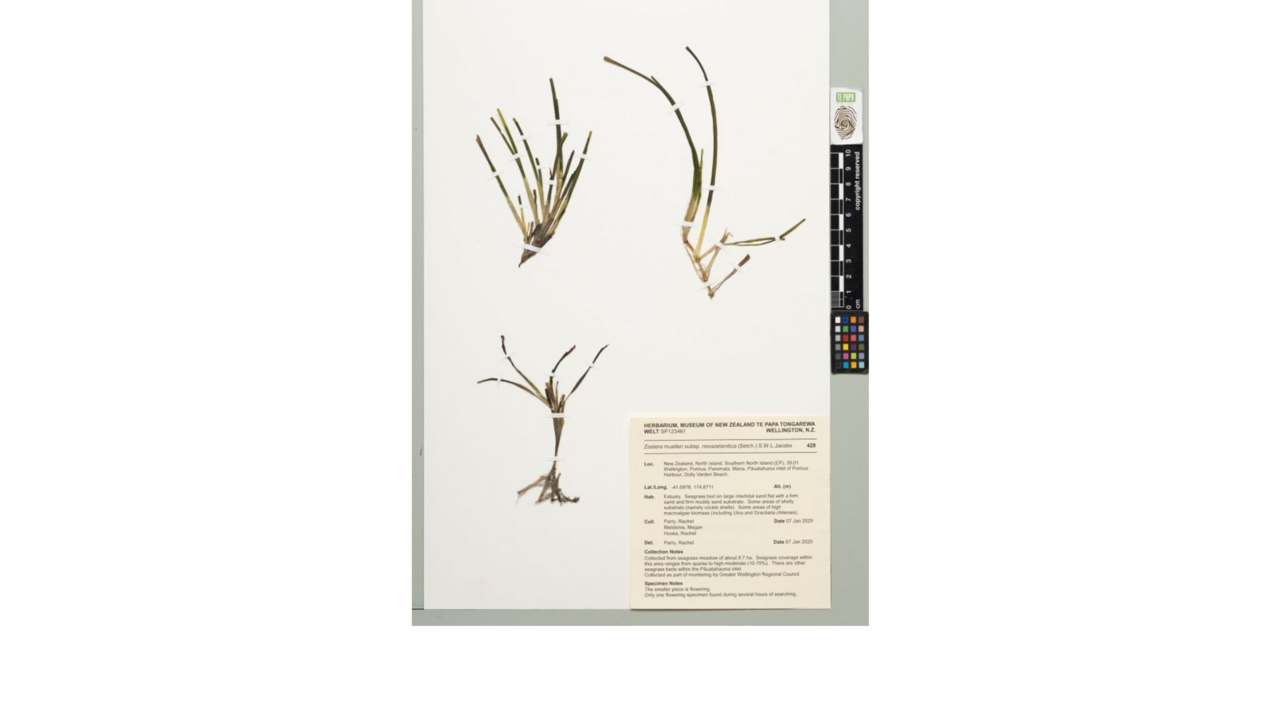
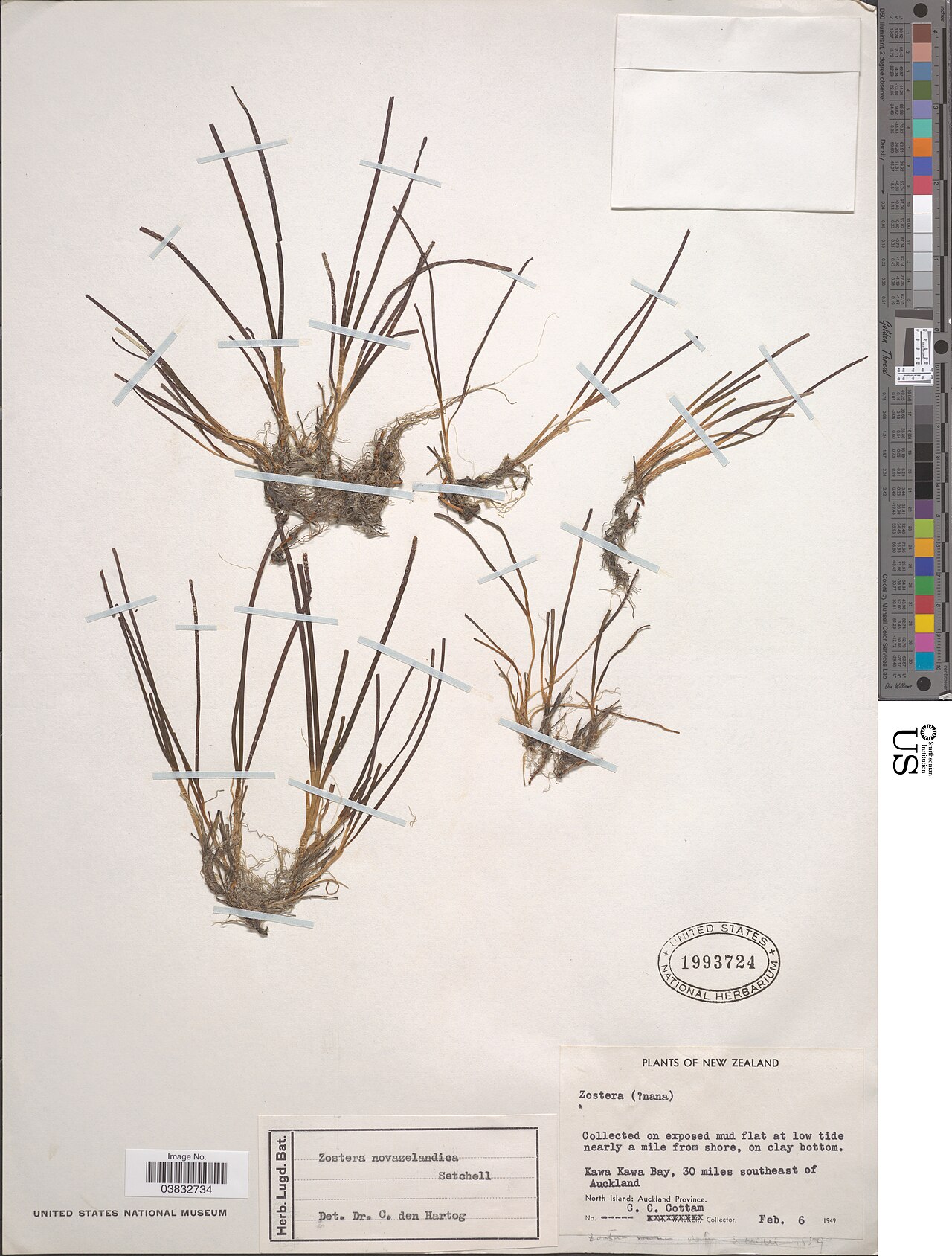
The plant has long, narrow, olive-green leaves that can reach 50 cm in length and are only 0.75 to 1.75 mm wide, with three lengthwise veins. It spreads via rhizomes buried in the sediment. The flowers and fruits are small and easy to miss, sitting among the leaf blades. Each flowering shoot has one or more branches, and each flower cluster is nearly wrapped by a leaf sheath. The plant is monoecious, meaning both male and female flowers appear on the same individual. Inside the flower, the carpels and stamens are packed tightly together, with fewer than six carpels and about twelve anther-sacs, all tilting inward and upward. The fruit is a smooth, yellow, oval achene about 2.5 mm by 1.0 mm, containing brown, ellipsoidal seeds that are roughly 2 mm long. There are at least two spathes (sheathing bracts) around each flower cluster, and each spadix holds four to eight male and female flowers.
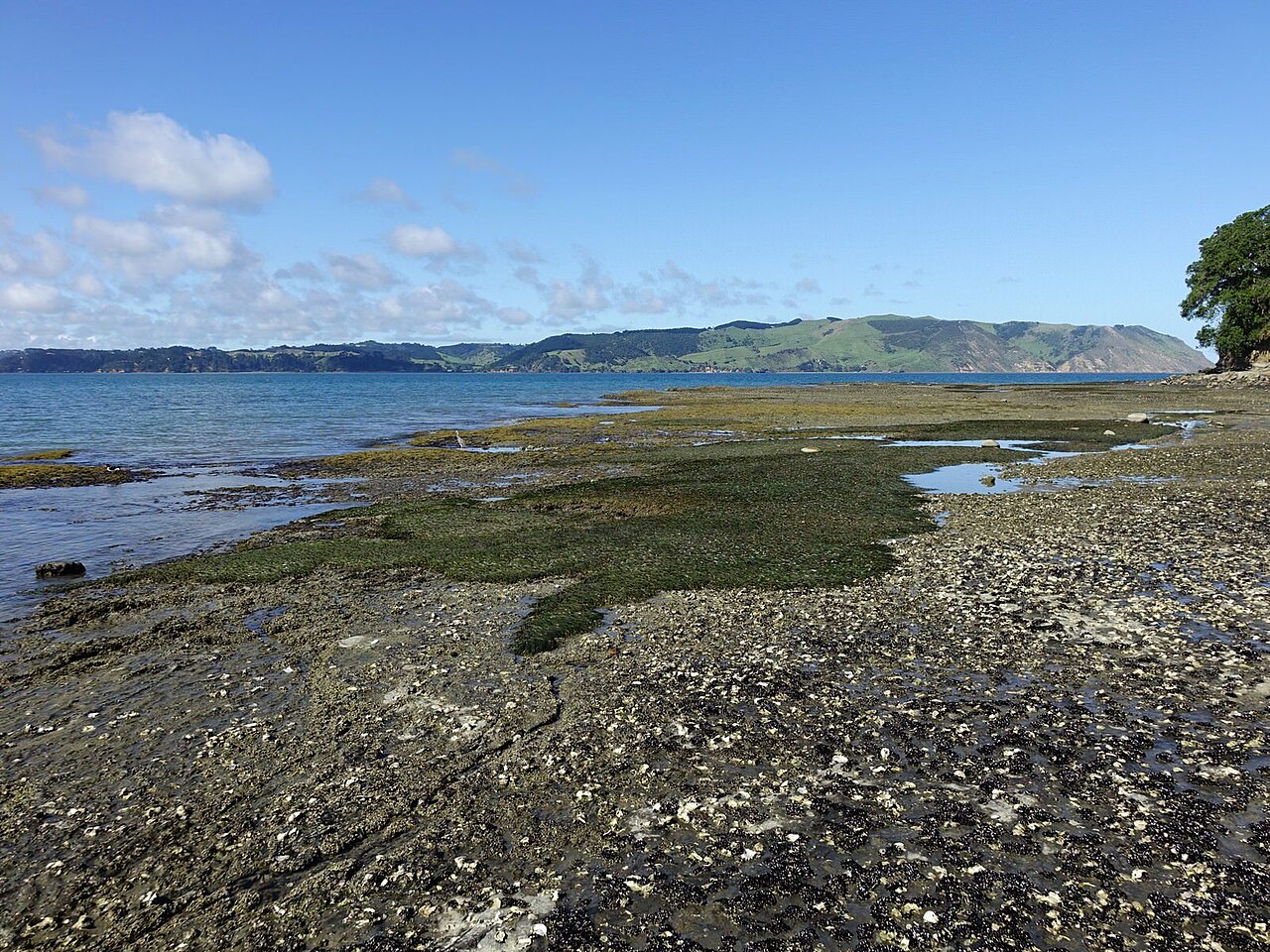
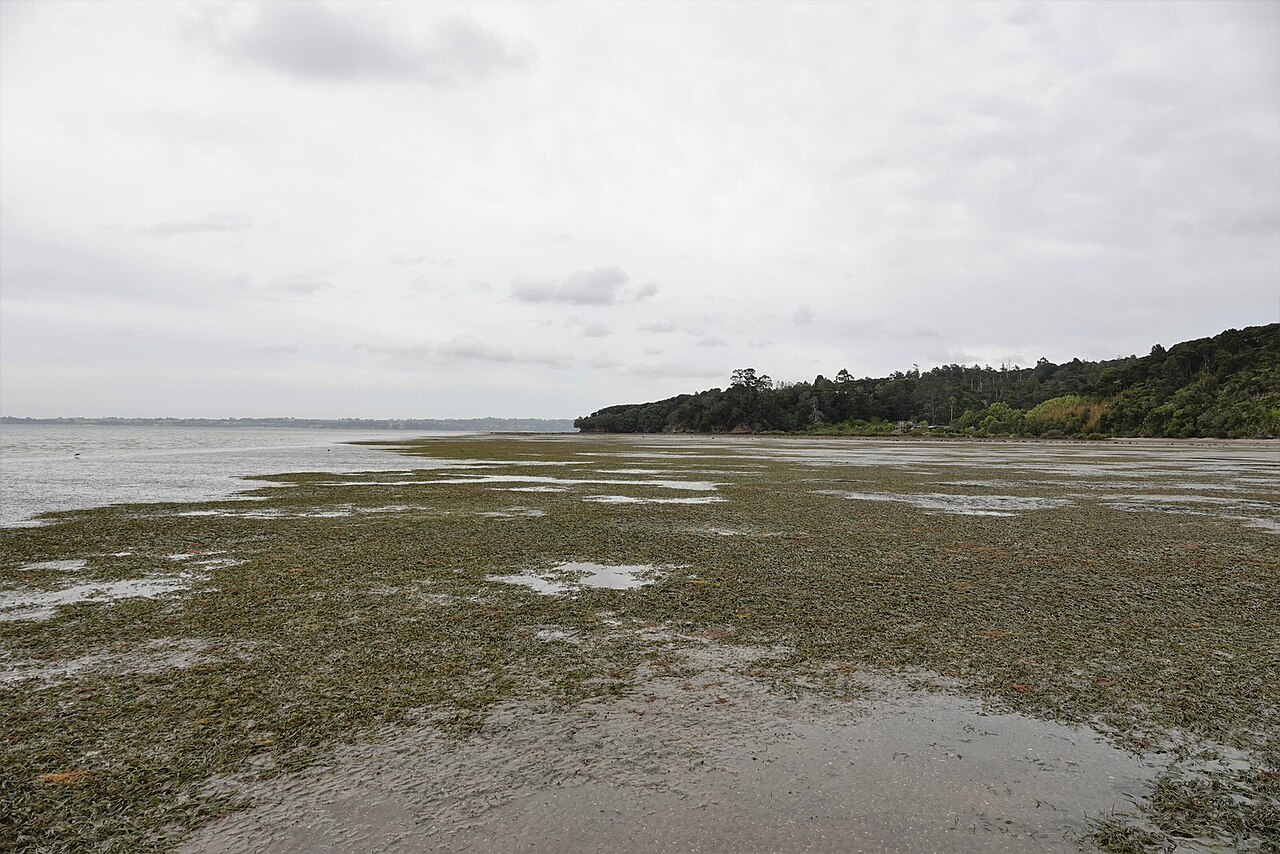
Seagrasses are flowering plants adapted to marine coastlines. The genus *Zostera* appears worldwide, including Australia, Southeast Asia, southern Africa, and the Northern Hemisphere. Until recently, New Zealand’s seagrasses were thought to include two species: *Zostera capricorni* (also found in Australia) and *Zostera novazelandica* (unique to New Zealand). However, some studies suggest these are actually the same species, and that *Zostera muelleri* and *Zostera mucronata* also belong to that single species. If this merger is accepted, the plant’s range extends to northeastern and southeastern Australia, Papua New Guinea, and New Zealand. If not, *Zostera novazelandica* is considered a smaller form of *Zostera capricorni* and strictly endemic to New Zealand, found from Parengarenga Harbour in the North Island down to Stewart Island. It grows in meadows or patches in intertidal beds and estuaries, with patch sizes ranging from one to fifteen square meters. Specific locations include Harwood (Otago Peninsula), Manukau Harbour, and Whangaparoa Harbour.
Quick Facts
- Genus
- Zostera
- Species
- novazelandica
Facts from the source article.
Lore & Background
Zostera novazelandica is a marine flowering plant with long, narrow blade-like leaves and a rhizome root structure submerged below the ground. Its elongated, olive-green leaves consist of three longitudinal veins. The species has a minimum of two spathes, each spadix consisting of four to eight female and male flowers. The monoecious plant produces flowers with petals, stamens, pistils, and sepals, with carpels and stamens compacted tightly within the flower. The achene is smooth, yellow, oval, and approximately 2.5 x 1.0 mm, while seeds are ellipsoidal, brown, and 2 mm in length.
The species occurs in subtidal and large intertidal zones of New Zealand, growing in patches in locations sheltered from wave action or where water is trapped at low tide, such as reef platforms and tide pools. It prefers shallow, soft-sediment environments like mud or sandy-silt seafloors, and requires 10-20% surface light to survive. Zostera novazelandica prefers brackish, slightly saline waters, showing increased reproductive and vegetative growth in low salinity. It inhabits siltstone platform reefs along New Zealand shorelines.
The species experiences a perennial lifecycle, with patch sizes reduced in winter and regrowth occurring in spring. Flowering shoots appear in spring, with mature embryos and seeds visible from late December to March. Seed recruitment occurs at low levels, making the species rely on vegetative growth for survival. The flowering season lasts about 8 months, from spring to late autumn, and water movement is important for summer pollination.
Reader's Guide
Zostera novazelandica is notable for its disputed taxonomic status, regarded by some authors as a distinct species endemic to New Zealand and by others as a synonym of Zostera muelleri. Where the merge of species is accepted, the seagrass can be found in Northeastern and Southeastern Australia, Papua New Guinea, and New Zealand. Where not accepted, it is considered strictly endemic to New Zealand, established from Parengarenga harbour in the North Island to Stewart Island in the South Island. The species forms large meadows or small patches in intertidal beds or estuaries, with concentrations ranging from one to fifteen meters squared.
The species is significantly affected by the small endemic crab Macrophthalmus hirtipes, which burrows in 63% of patches on average and feeds on blades, basal sheaths, rhizomes, and roots, relying on Zostera novazelandica for 30% to 50% of its diet. The crab also deteriorates patch edges and accelerates erosion. Additionally, the species is affected by wasting disease, which deteriorates leaf blades. The species' reliance on vegetative growth and low seed recruitment highlights its vulnerability to environmental changes, while its preference for brackish waters and specific light requirements shape its distribution along New Zealand coastlines.
Did You Know?
- The Maori names for Zostera novazelandica are karepō, nana, rehia, and rimurehia.
- Macrophthalmus hirtipes, a small endemic crab, relies on Zostera novazelandica for 30% to 50% of its diet.
Taxonomic Identity and the Question of Species Boundaries
Zostera novazelandica, a marine flowering plant belonging to the family Zosteraceae, occupies a somewhat contested position in botanical taxonomy. Some researchers treat it as a fully independent species, while others classify it merely as a synonym of Zostera muelleri. This ambiguity stems from recent investigations revealing that what were long considered two separate New Zealand seagrass species—Zostera capricorni and Zostera novazelandica—are actually conspecific, meaning they belong to the same biological species. The analysis further showed that Zostera muelleri and Zostera mucronata also fall within the same group as Z. capricorni. When this taxonomic merging is accepted, the combined species' range extends across northeastern and southeastern Australia, Papua New Guinea, and New Zealand. However, where the merge is rejected, Z. novazelandica retains its identity as a smaller, distinct form endemic strictly to New Zealand waters. The plant carries several Māori names—karepō, nana, rehia, and rimurehia—reflecting its long-standing presence in the cultural landscape of the region.
Morphology and Reproductive Architecture
Physically, Zostera novazelandica presents as a slender marine angiosperm with elongated, olive-green blade-like leaves that can stretch to fifty centimetres in length while measuring between 0.75 and 1.75 millimetres in width. Each leaf bears three distinct longitudinal veins, and the entire root system takes the form of a submerged rhizome network. The reproductive structures are notably compact and understated. The plant is monoecious, producing both male and female flowers on the same individual, with each spadix carrying four to eight flowers enclosed within at least two spathes—sheathing bracts that wrap around the bloom. The carpels number fewer than six, while approximately twelve anther-sacs are present, all packed tightly and angled diagonally inward and upward within the flower. Flowering shoots branch once or more, and each inflorescence is nearly fully enveloped by a leaf sheath. The resulting fruit, a smooth yellow achene, measures roughly 2.5 by 1.0 millimetres, and the brown ellipsoidal seeds inside are about two millimetres long.
Geographic Range and Habitat Preferences
When treated as a distinct entity, Zostera novazelandica is endemic to New Zealand, establishing itself along coastlines from Parengarenga Harbour on the North Island down to Stewart Island in the South. Specific documented sites include Harwood on the Otago Peninsula, Manukau Harbour, and Whangaparoa Harbour. The seagrass forms discrete patches ranging from one to fifteen square metres, growing in subtidal and broad intertidal zones. It thrives in sheltered settings where wave energy is dampened, or where water becomes trapped at low tide—such as on reef platforms and within tide pools. The species shows a mild but non-significant preference for tide pools and typically grows interspersed among algal beds on siltstone platform reefs. Light is a critical constraint: below ten to twenty percent of surface illumination the plant will die, while increased light drives linearly greater growth. Deep water is unsuitable because it simultaneously reduces light availability and increases hydrostatic pressure on the tissue. Salinity preference leans toward brackish, slightly saline conditions, with both reproductive output and vegetative growth accelerating in lower-salinity estuaries. The seagrass favours shallow, soft-sediment substrates of mud or sandy silt.
Seasonal Life Cycle and Population Dynamics
Zostera novazelandica follows a perennial lifecycle spanning at least two years, with pronounced seasonal fluctuations in patch size and reproductive activity. During winter, patches contract to their smallest extent, shedding an average of thirty-four percent of their initial surface area, and mortality peaks across all four seasons. New patches are recruited between July and November, predominantly through the fragmentation of larger existing patches occurring in mid-winter. Spring brings regrowth driven by basal elongation, with new recruits arising from seed germination (forty percent) or fragmentation (sixty percent), establishing in tide pools or rock cracks. Immature inflorescences appear by late October across low and mid tidal zones, and flowering shoots migrate to higher shore positions in summer. Mature embryos and seeds develop from late December through March, overwintering before germinating the following spring. Crucially, seed-based recruitment remains at very low or episodic levels, meaning the species depends heavily on vegetative growth for persistence. Once a patch reaches 0.4 square metres, its survival probability increases substantially. Leaf surface area peaks in summer while rhizome biomass remains essentially constant year-round.
Gallery
Frequently Asked Questions
What is Zostera novazelandica?
It is a marine flowering plant in the Zosteraceae family that grows along New Zealand's coastlines. Its taxonomic standing is contested: some botanists treat it as a fully distinct species, while others regard it as simply a variant of Zostera muelleri.
What does Zostera novazelandica look like?
It grows long, narrow olive-green blades up to 50 cm in length yet only 0.75 to 1.75 mm wide, each marked by three longitudinal veins. The flowers and fruits are tiny and tucked among the leaf blades, so they are easy to miss in the field.
Why is Zostera novazelandica's species status disputed?
Its morphology overlaps so heavily with Zostera muelleri that many researchers consider the two names synonymous. Those who do separate it view it as a seagrass endemic to New Zealand's shores, but no universal consensus has been reached.
What are the Māori names for Zostera novazelandica?
In te reo Māori the plant is known by several names, including karepō, nana, rehia, and rimurehia. These terms reflect its long-standing role in New Zealand's coastal environments.
How does Zostera novazelandica spread and reproduce?
It expands vegetatively through rhizomes buried in the sediment, building dense underwater meadows. Its flowering shoots bear small achenes roughly 2.5 by 1.0 mm in size, with fewer than six carpels and approximately twelve anther sacs per structure.
More in Seagrasses 1-24
Spotted an error? Know more?
Reader corrections go straight into our review queue. Suggest an edit · How this site is sourced