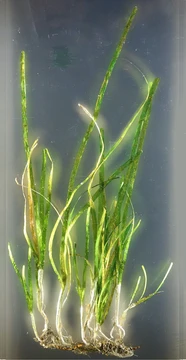
Zostera capensis
A dominant but fragmented seagrass along African coasts.

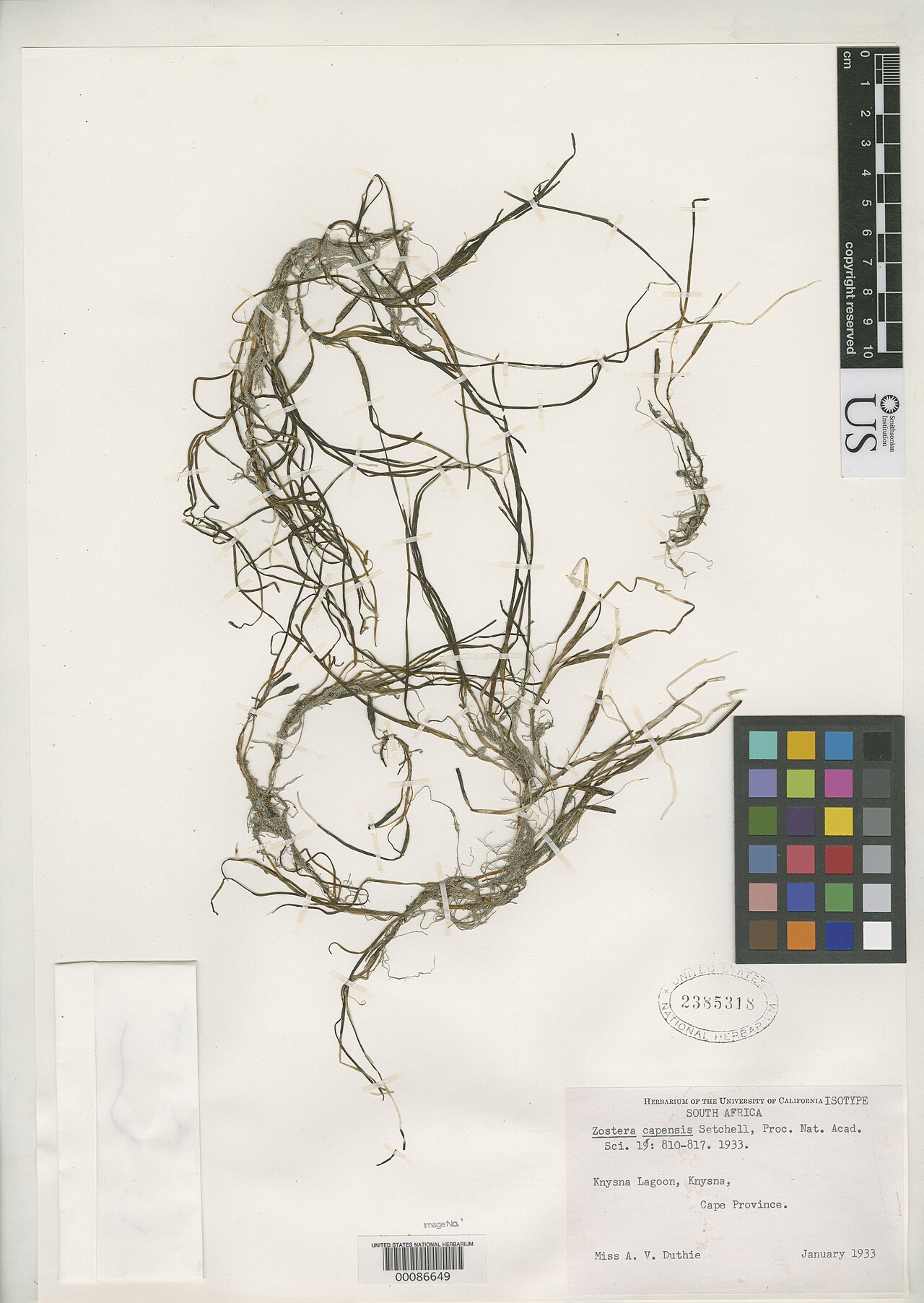
National Museum of Natural History · CC0
Zostera capensis, a type of dwarf eelgrass, is found along the African coastline of both the Indian and Atlantic Oceans. Its distribution runs from southern Kenya, through Tanzania, Mozambique, Madagascar, and South Africa, all the way up to Angola. In South Africa, it is the most common seagrass, though its populations are fragmented. It lives in shallow bays, estuaries, and lagoons, in both subtidal and intertidal zones. The two largest meadows in South Africa are in the Knysna lagoon and the Berg river estuary. In 2007, the Berg river estuary’s Zostera capensis cover was measured at 206 hectares; by 2019, the Knysna lagoon’s cover was mapped at 316 hectares. Further north, Maputo bay in Mozambique is a key habitat, with roughly 4016 hectares of mixed Zostera capensis and Halodule wrightii on muddy flats. Across its entire range, this species is thought to cover less than 2000 km².
Although Zostera capensis can grow quickly, it is slow to colonize new areas and faces many human-caused threats. Nutrient enrichment, or eutrophication, harms the plants by increasing epiphytic fouling, which is strongly linked to lower shoot survival. Flooding of estuaries, pollution, and sedimentation are also major dangers. Bioturbation negatively affects populations that already have low biomass and are highly fragmented. In Mozambique, shellfish harvesting, known as gleaning, is reported as one of the biggest threats. Despite being a keystone species, Zostera capensis remains poorly protected and severely fragmented.
Quick Facts
- Genus
- Zostera
- Species
- capensis
Facts from the source article.
Lore & Background
Zostera capensis is a slow colonizer despite its fast growth, and it faces numerous anthropogenic threats. Populations are threatened by nutrient enrichment (eutrophication), which increases epiphytic fouling and is strongly associated with lower shoot survival. Flooding of estuarine areas, pollution, and sedimentation also present major threats, as does bioturbation, which negatively impacts populations with lower biomass and highly fragmented patches. In Mozambique, shellfish harvesting (gleaning) has been reported as one of the major threats to this species. Zostera capensis remains a poorly protected yet severely fragmented keystone species.
Reader's Guide
Zostera capensis is notable as the dominant seagrass species in South Africa, where it occurs in fragmented populations along the coast. Its two largest meadows are in the Knysna lagoon (mapped at 316 hectares in 2019) and the Berg river estuary (estimated at 206 hectares when last mapped in 2007). Further north, Maputo bay in Mozambique contains approximately 4016 hectares of mixed Zostera capensis and Halodule wrightii on muddy flats, representing an important habitat. Over its total distribution, the species is estimated to occupy less than 2000 km². Despite its ecological importance as a keystone species, it remains poorly protected and severely fragmented. Threats include eutrophication, flooding, pollution, sedimentation, bioturbation, and shellfish harvesting in Mozambique. Its slow colonization ability makes it vulnerable to these pressures.
Did You Know?
- Zostera capensis is the dominant seagrass species in South Africa.
- The two largest meadows in South Africa are in the Knysna lagoon (316 hectares in 2019) and Berg river estuary (206 hectares in 2007).
Taxonomic Placement and Geographic Range
Zostera capensis, named by Setchell, is one of fifteen recognized species within a small genus of marine seagrasses commonly referred to as eelgrass. The genus enjoys a broad global footprint, with members colonizing seashores across much of the Northern Hemisphere as well as Australia, New Zealand, Southeast Asia, and southern Africa. Z. capensis specifically occupies the African and Indian Ocean littoral, with its range stretching from Madagascar through Kenya to the Cape Province. This positions it among the genus members whose habitats lie in the Southern Hemisphere rather than the temperate Atlantic, Pacific, or Mediterranean coasts favored by species such as Z. marina and Z. noltii. The genus's distribution was notably extended in 2005 with the formal recognition of Z. chilensis on Chile's Pacific shoreline, while the land-locked Caspian Sea provides an unusual inland home for Z. noltii. Together these ranges illustrate the ecological versatility of a genus whose members share a common body plan yet tolerate a striking variety of coastal and semi-enclosed waters.
Morphology and Tidal Physiology
Members of the Zostera genus, including Z. capensis, are perennial plants that typically establish themselves on sandy substrates or within estuarine settings where they may be fully submerged or only partially floating. Their most conspicuous feature is a cluster of long, bright green, ribbon-like leaves roughly one centimetre in width, rising from short stems that emerge out of an extensive network of white, branching rhizomes. Reproduction is somewhat concealed: the flowers are tucked inside the sheaths at the base of the leaves, and the resulting fruits are bladdery structures capable of floating free, which likely aids in dispersal. One of the genus's most remarkable physiological traits is its ability to hold cell turgor pressure at a near-constant level despite the dramatic osmolarity swings that accompany the tidal cycle. As the tide retreats and the surrounding water becomes more concentrated, the plant actively sheds solutes; when the tide returns and dilutes the medium, it takes solutes back up. This dynamic solute exchange allows the grass to remain turgid and functional through every phase of the tidal rhythm, a critical adaptation for any organism anchored to an intertidal or shallow-subtidal substrate.
Ecological Engineering and Trophic Connections
Seagrass beds formed by Zostera species serve as foundational ecosystem engineers in their habitats. The dense root and rhizome mats trap and stabilize sediment, reducing erosion and creating a firm substrate on which epiphytic algae and a diverse community of micro-invertebrates can attach and thrive. In estuarine environments, Zostera frequently forms thick beds within soft bay mud, and these meadows double as nursery grounds where numerous commercially important fish and shellfish species spend their early life stages. The trophic web built around the grass extends well beyond invertebrates: brant geese and wigeons graze on the foliage, and on occasion the caterpillars of the grass moth Dolicharthria punctalis also feed on the leaves. This ecological richness makes the system vulnerable to disease. The slime mold Labyrinthula zosterae is responsible for a wasting condition that devastates Zostera populations, with Z. marina being especially susceptible. When the grass dies back, the entire assemblage of fauna that depends on the meadow for shelter, food, and breeding habitat suffers a corresponding decline, illustrating how a single pathogen can cascade through an entire coastal food web.
Human Uses from Food to Future Energy
Long before modern agriculture, the Seri people of Sonora's coast in Mexico harvested eelgrass rhizomes and leaf-bases, eating them fresh or drying them into cakes that sustained families through winter. The same plant was employed to smoke deer meat, and the Seri language preserves a rich vocabulary of eelgrass-related terms, including a name for April that translates to the month when eelgrass seed matures. On Denmark's Læsø island, dried eelgrass was traditionally laid as thatch; the resulting roofs are heavy but reportedly outlast conventional thatch and are simpler to maintain. In the early twentieth-century United States, the Samuel Cabot Company of Boston marketed a commercial insulation product called Cabot's Quilt, though a Labyrinthula outbreak and the Great Depression ended production, and fiberglass took over by the late 1930s. Today, dried eelgrass reappears in eco-friendly building insulation and as a permaculture ground cover in places like the Friland eco-village. Research also points to eelgrass meadows as potential carbon sinks for mitigating anthropogenic climate change, and the Jean Pain method offers a route to converting the biomass into usable energy.
Gallery
Frequently Asked Questions
Who is Zostera capensis?
Zostera capensis is a dwarf eelgrass species that calls the western and eastern coasts of southern Africa its home. It is the most widespread seagrass in South African waters, though its meadows tend to be patchy rather than forming one continuous carpet.
What are Zostera capensis's powers/role?
As a foundational habitat-builder, it provides shelter and nursery ground for fish, invertebrates, and other marine life in shallow bays, estuaries, and lagoons. It also stabilizes sediments and traps nutrients, helping keep the surrounding water column clearer.
Where does Zostera capensis live?
Its range stretches from southern Kenya down through Tanzania, Mozambique, Madagascar, and South Africa, reaching as far north as Angola. In South Africa, its two biggest strongholds are the Knysna lagoon (around 316 hectares) and the Berg River estuary (roughly 206 hectares).
Why is Zostera capensis important?
It anchors entire coastal food webs and supports fisheries that communities along the African coast depend on. With a total occupied area estimated at under 2,000 km², every remaining meadow—such as the roughly 4,000-hectare mixed stand in Maputo Bay—represents a critical piece of the region's marine biodiversity.
More in Seagrasses 1-24
Spotted an error? Know more?
Reader corrections go straight into our review queue. Suggest an edit · How this site is sourced