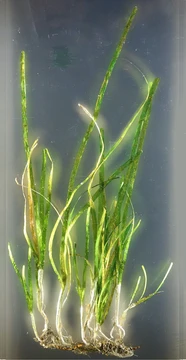
Zostera japonica
A small seagrass native to East Asia, invasive in North America.

Muséum national d'histoire naturelle · CC BY 4.0
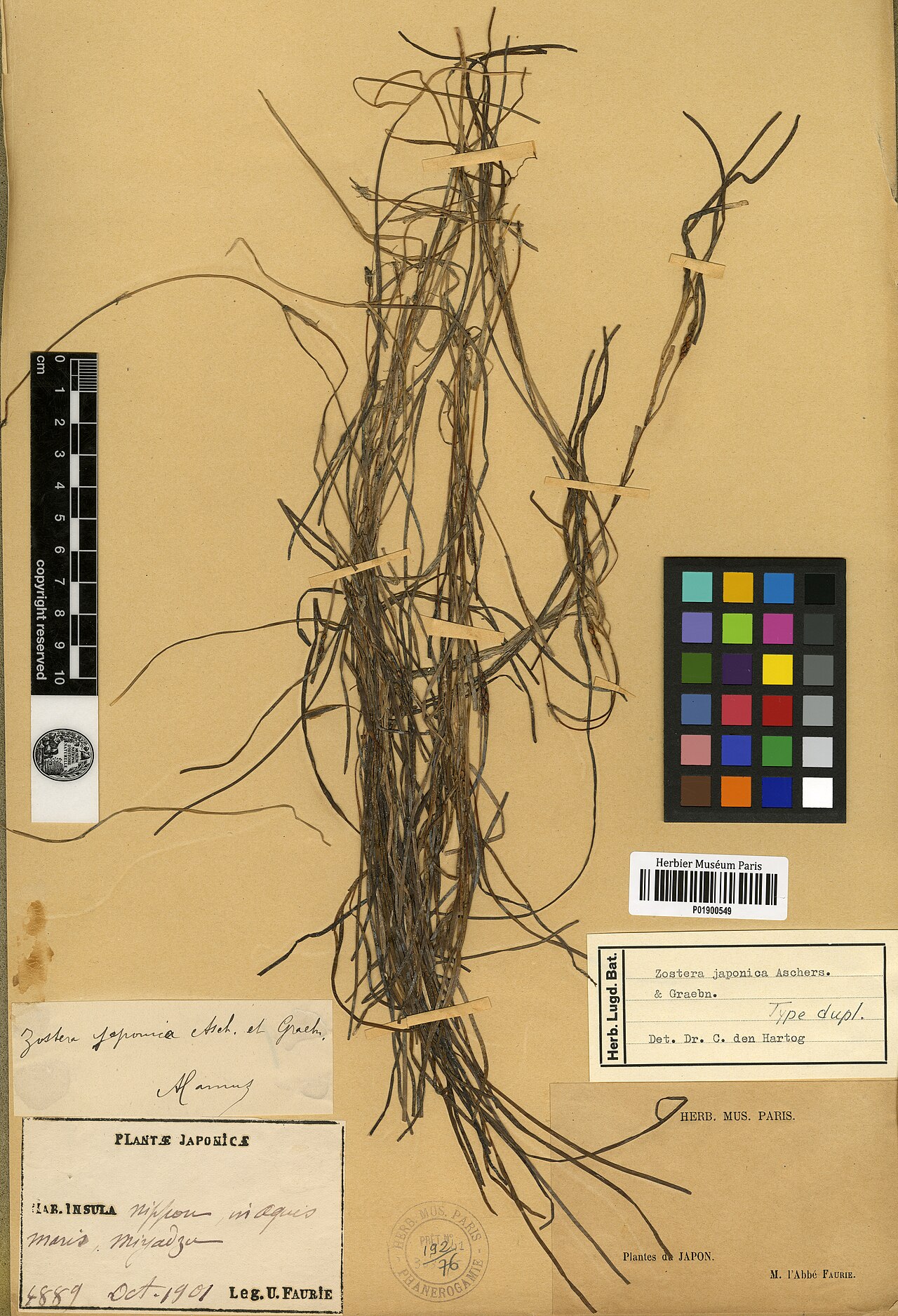
Zostera japonica is a species of aquatic plant in the Zosteraceae family, commonly known as dwarf eelgrass or Japanese eelgrass. It is notable for being native to the seacoast of eastern Asia from Russia to Vietnam and for its introduction to the western coast of North America, where it has become invasive.
Quick Facts
- Genus
- Zostera
- Species
- japonica
Facts from the source article.
Lore & Background
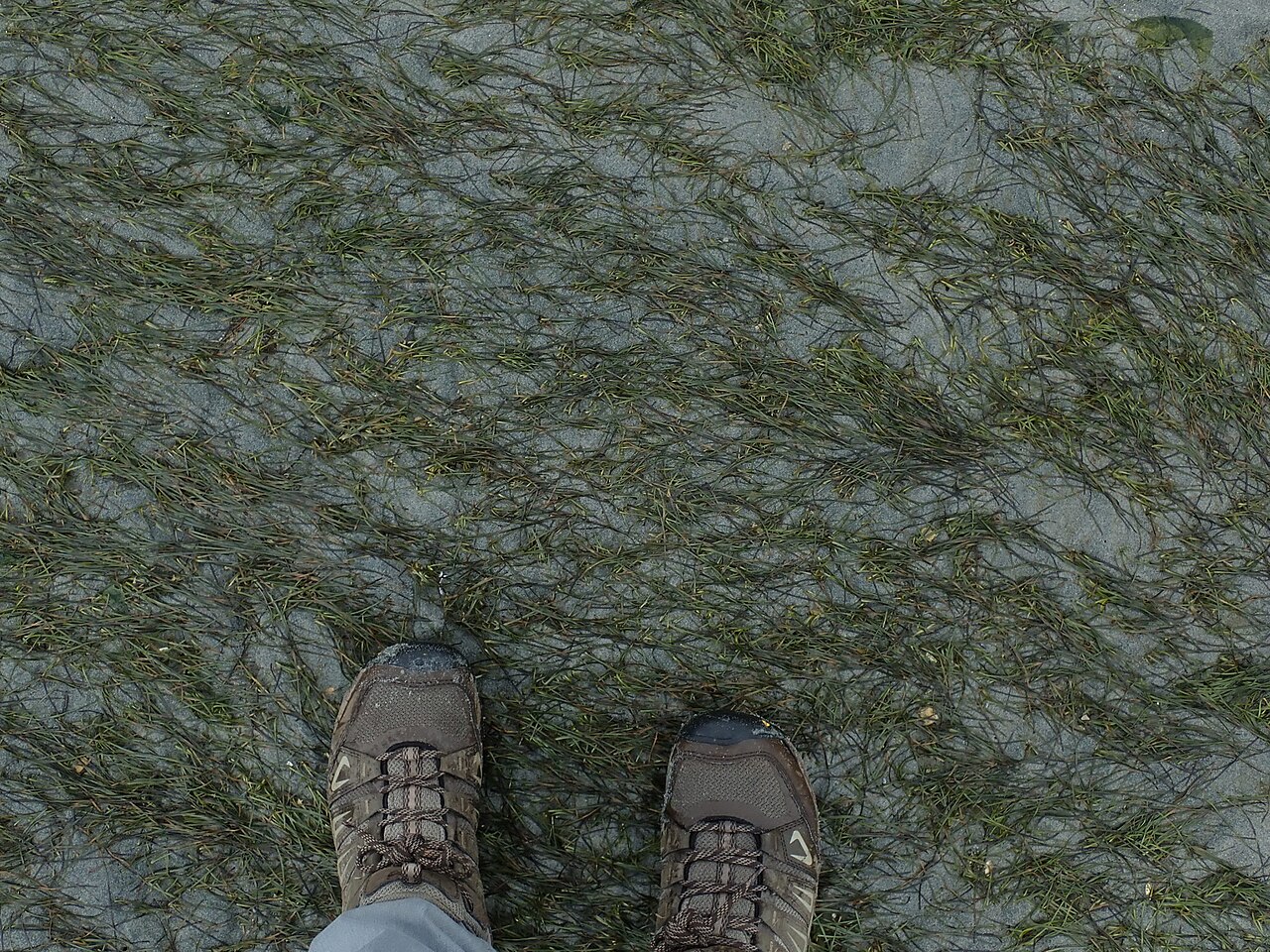
Zostera japonica is a small species that typically grows on the upper edge of seagrass beds, often on mudflats exposed at low tide. The plants lose many of their leaves in the winter. In Hong Kong, algae grows on the blades of this seagrass, and snails in the species Clithon graze on this epiphytic growth. A research study showed that when snails were excluded from certain areas, the epiphytic load increased, reducing photosynthesis and increasing physical damage from waves and currents, thereby decreasing total biomass. In the presence of snails, the blades were kept cleaner and total biomass increased.
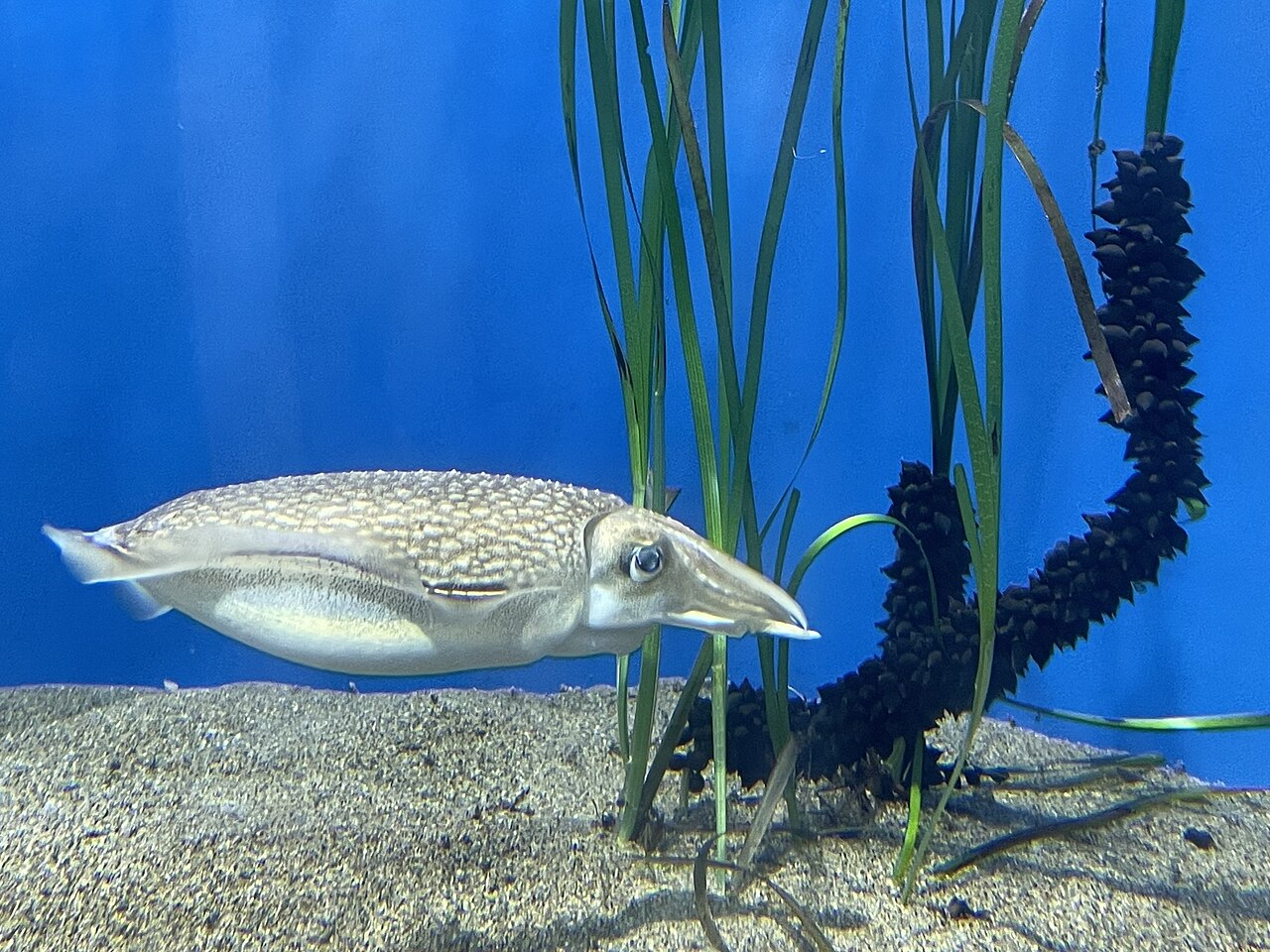
On the west coast of North America, the non-native Japanese eelgrass now occupies the same habitats as the native common eelgrass (Zostera marina), growing beside it and sometimes displacing it. The habitat shared by both species is used by economically important shellfish. One ecological difference noted is that Zostera marina undergoes microbial decomposition more slowly than does Zostera japonica, so nutrients are recycled more quickly with the latter, altering total productivity and the structure of the decomposer community.
Reader's Guide
The significance of Zostera japonica lies in its dual role as a native species in East Asia and an invasive species on the west coast of North America. Its introduction, likely via Japanese oyster shipments in the early twentieth century, has led to its spread from British Columbia and Washington south to California. In its introduced range, it competes with the native Zostera marina, sometimes displacing it in shared habitats that support economically important shellfish. The article notes that further research is needed to clarify the roles of the two species and whether management strategies are needed to protect the native species from the invader. Ecologically, Zostera japonica differs from Zostera marina in decomposition rate, with the former recycling nutrients more quickly, which affects total productivity and decomposer community structure. In its native Hong Kong habitat, the species benefits from grazing by Clithon snails, which reduce epiphytic algae and improve seagrass health. The species' ability to thrive in intertidal mudflats and shallow subtidal zones on sandy, muddy, and silty substrates underscores its adaptability.
Did You Know?
- Zostera japonica is also known as dwarf eelgrass or Japanese eelgrass.
- It was first reported as naturalized in British Columbia and Washington, and is now considered invasive as far south as California.
- In Hong Kong, snails of the species Clithon graze on algae growing on the seagrass blades, helping to keep them clean and increase biomass.
- Zostera japonica decomposes more quickly than the native Zostera marina, leading to faster nutrient recycling.
Taxonomic Identity and Geographic Reach
Zostera japonica belongs to a compact genus of fifteen seagrass species collectively known as marine eelgrass. While the genus as a whole stretches across seashores throughout much of the Northern Hemisphere, as well as the coasts of Australia, New Zealand, Southeast Asia, and southern Africa, Z. japonica itself occupies a more focused range spanning the Russian Far East, Japan, Korea, China, and Vietnam. This distribution places it among several closely related species—Z. asiatica, Z. caespitosa, and Z. caulescens—that share the same East Asian and Northeast Asian littoral zone. The genus's range is not strictly oceanic: one species, Z. noltii, thrives along the shores of the land-locked Caspian Sea, and the 2005 description of Z. chilensis extended the known distribution to an isolated Pacific coast population in South America. Despite this broad global footprint, each species tends to occupy a relatively narrow geographic corridor, and Z. japonica's presence across multiple East Asian countries underscores its adaptability within that specific coastal belt.
Morphology and Ecological Role
As a perennial seagrass, Zostera japonica grows from extensive networks of white, branching rhizomes that anchor the plant in sandy substrates and estuarine bay mud. Short stems rise from these underground structures, bearing leaves that are long, vividly green, and ribbon-shaped, measuring about a centimetre across. Flowering occurs within the protective sheaths at the base of each leaf, and the resulting fruits are bladdery and buoyant, capable of drifting on the water's surface. Beyond its physical form, the plant plays a critical role in coastal ecology: its dense beds promote sediment deposition, stabilize the substrate, and provide attachment surfaces for epiphytic algae and micro-invertebrates. These meadows serve as nursery grounds for numerous commercially important fish and shellfish species. The plant also supports herbivores such as brant geese and wigeons, and on occasion the caterpillars of the grass moth Dolicharthria punctalis. A remarkable physiological trait is its ability to maintain constant turgor pressure despite tidal osmolarity shifts, achieved by actively shedding solutes during low tide and reabsorbing them as the water returns.
Cultural and Practical Uses
Eelgrass has a long history of human utilization across diverse cultures. The Seri people of Sonora's coast in Mexico consumed the rhizomes and leaf-bases of eelgrass both fresh and dried into cakes for winter sustenance, and also employed the plant in smoking deer meat. Their language contains a rich vocabulary of terms tied to eelgrass and its harvesting, and the month of April is literally named the month when the eelgrass seed reaches maturity. In Denmark, the island of Læsø has a tradition of thatching roofs with eelgrass; these roofs are noted for being heavy yet remarkably durable and easier to maintain than conventional thatch. In the early twentieth-century United States, the Samuel Cabot Company of Boston commercially marketed dried eelgrass insulation under the brand name Cabot's Quilt. More recently, washed and dried eelgrass has found application as insulation in eco-friendly construction and as ground cover in permaculture gardens, such as at the Friland eco-village in Denmark. Researchers have also identified the potential for eelgrass meadows to sequester atmospheric carbon, and the plant can be processed into biomass energy using the Jean Pain method.
Vulnerability and the Future of Eelgrass
The ecological importance of Zostera beds makes them vulnerable to threats that cascade through entire coastal food webs. The slime mold Labyrinthula zosterae is responsible for a wasting disease that devastates eelgrass populations, with Z. marina appearing especially vulnerable to this pathogen. Outbreaks have historically triggered sharp declines in the fish, shellfish, and invertebrate communities that depend on the meadows for shelter and forage. The same organism played a role in the collapse of the commercial eelgrass insulation industry in the United States: an outbreak destroyed crops just as the Great Depression shuttered the homebuilding sector, and by the late 1930s fiberglass had replaced eelgrass in new construction. Looking forward, however, eelgrass meadows hold promise as a tool in combating anthropogenic climate change, with studies suggesting their capacity to sequester atmospheric carbon. Additionally, the plant's potential for biomass energy production via the Jean Pain method points to further sustainable applications. Balancing these opportunities against the fragility of seagrass ecosystems remains a central challenge for coastal management.
Gallery
Frequently Asked Questions
Who is Zostera japonica?
Zostera japonica is a small seagrass in the Zosteraceae family, widely known by the common names dwarf eelgrass and Japanese eelgrass. It is a native of East Asian coastlines that has since spread to the Pacific shore of North America.
What are Zostera japonica's powers and ecological role?
It builds underwater meadows in the intertidal and shallow subtidal zone, anchoring sandy, muddy, and silty sediments and sheltering small marine life. It typically colonizes soft substrates at depths up to about three meters (roughly ten feet).
Why is Zostera japonica important?
In East Asia it underpins shallow-water biodiversity by stabilizing sediments and creating habitat structure. Its accidental introduction to North America has also turned it into a major case study in marine bio-invasion and coastal-ecosystem management.
Where does Zostera japonica live?
Its native range runs along the eastern Asian seacoast from the Russian Far East through Japan, Korea, China, the Ryukyu Islands, Taiwan, and Vietnam. It has since been introduced to the Pacific coasts of British Columbia, Washington, and California, where it now occupies intertidal and shallow subtidal zones.
More in Seagrasses 1-24
Spotted an error? Know more?
Reader corrections go straight into our review queue. Suggest an edit · How this site is sourced