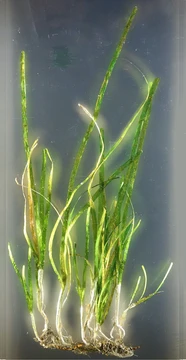
Phyllospadix scouleri
A slender, vivid green surfgrass of western North American shores.

Carlquist, Sherwin John, 1930-2021 · CC BY 4.0
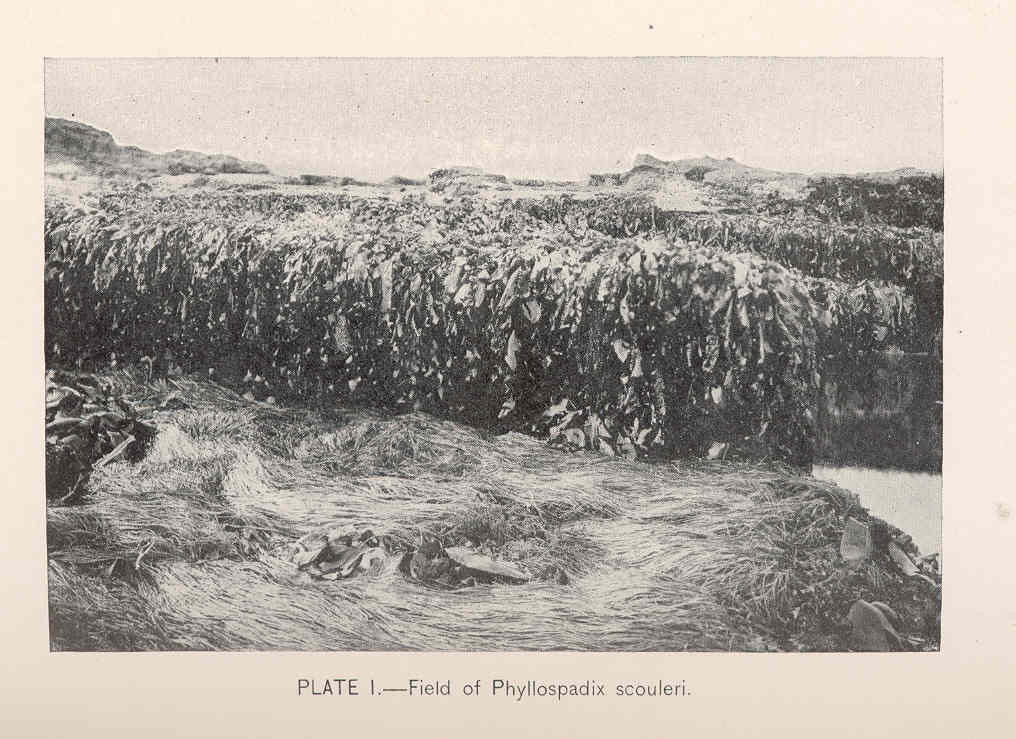
Phyllospadix scouleri, called Scouler's surfgrass, is a flowering marine plant belonging to the Zosteraceae family. Its range runs along the western North American coast, from the Alaskan panhandle down to Baja California. This slender, bright green plant has long, flat leaves. It grows in large clumps or beds that are uncovered during low tide and submerged when the tide rises, attaching to rocks in the middle to low intertidal zones.
Male and female flowers appear on separate plants, with female plants far outnumbering males. The flowers grow in spikes at the leaf bases and lack petals. Pollen is carried by water movement, which can happen underwater, but most pollination occurs on the sea surface during very low tides. Seedlings cannot attach directly to rocks or colonize bare areas. Instead, they germinate among algae like red coralline algae, latching on with small barbs and weaving their roots into the algae as they develop. The plants also send out rhizomes to colonize new areas. Once established, surfgrass can dominate its habitat. A diverse community of invertebrates, including snails, limpets, and crustaceans, lives in surfgrass beds, and algae may grow on the stems and leaves.
Native American tribes along the Southern California coast used this seagrass to make cordage and other woven items. Examples from San Miguel Island date back to between about 10,000 and 8,600 years ago. The plant is endemic to Baja California and thrives in rocky areas with turbulent tides.
Quick Facts
- Genus
- Phyllospadix
- Species
- scouleri
Facts from the source article.
Lore & Background
Phyllospadix scouleri is a slender, vivid green plant with long, flat blades. It grows in large clumps or beds that are exposed during low tide and submerged at high tide, attached to rocks in the middle to low intertidal zones. Male and female flowers are borne on different plants, with many more female plants than males; the flowers are in spikes at the base of the leaves and lack petals. Pollen is spread by water movement, which can occur underwater, but most pollination takes place on the surface of the sea at very low tides. Seedlings cannot establish directly on rocks or colonize bare areas; instead, they germinate among algae, such as red coralline algae, attaching themselves by small barbs and intertwining their roots among the algae as they grow. The plants also send out rhizomes that can colonize new areas. Once established, the surfgrass may dominate the habitat.
Reader's Guide
Phyllospadix scouleri is significant as a foundation species in its habitat, forming beds that support a biodiverse invertebrate community including snails, limpets, and crustaceans, with algae growing on its stems and leaves. Its ecological role is tied to its unique reproductive strategy, with pollination occurring primarily on the sea surface at very low tides, and seedling establishment dependent on existing algae. Historically, Native American tribes along the Southern California Coast used this seagrass to make cordage and other woven objects, as evidenced by specimens from San Miguel Island. The species is endemic to Baja California and lives in rocky areas with turbulent tides, highlighting its adaptation to dynamic intertidal environments. Its dominance in established beds underscores its importance in shaping local marine communities.
Did You Know?
- Phyllospadix scouleri is native from the Alaskan panhandle to Baja California.
- Seedlings germinate among algae, such as red coralline algae, and attach using small barbs.
- Native American tribes along the Southern California Coast used it to make cordage and woven objects.
Taxonomic Identity & Classification
Phyllospadix scouleri holds a distinguished position within the botanical world as the type species of the genus Phyllospadix, a group of seagrasses belonging to the family Zosteraceae. The genus was formally described in 1840, establishing a taxonomic framework that has endured for well over a century. As a true flowering plant adapted to marine life, P. scouleri is not an alga or a weed but a bona fide angiosperm that has conquered the saltwater realm. Its placement within Zosteraceae links it to other marine flowering plants that share similar evolutionary adaptations to aquatic existence. The designation as type species carries profound taxonomic weight: P. scouleri serves as the reference point from which the entire genus is defined. Any future revisions to the boundaries of Phyllospadix will be measured against this particular species. This foundational role underscores its importance in marine botany, anchoring the identity of all six accepted species that carry the Phyllospadix name across the North Pacific and into East Asian waters.
Geographic Range & Distribution
Phyllospadix scouleri commands an extraordinary stretch of coastline, spanning from the cold waters of Alaska all the way south to the warmer shores of Baja California. This vast north-south range places it squarely within the temperate North Pacific, where it thrives in marine waters along the continental coasts. The breadth of this distribution is remarkable for a single seagrass species, suggesting a notable capacity to tolerate a wide gradient of oceanic conditions from frigid northern currents to milder southern waters. Within the broader genus, P. scouleri's range is the longest of all six accepted species. While its relatives occupy more restricted territories—P. iwatensis confined to East Asian waters, P. juzepczukii limited to the Russian Far East, or P. serrulatus restricted to the Pacific Northwest—P. scouleri stretches across an entire continental margin. This expansive footprint makes it one of the most geographically significant members of the Zosteraceae family in the North Pacific.
Reproductive Biology
One of the most remarkable biological traits associated with the genus Phyllospadix is its capacity for completely submerged pollination. In a world where most flowering plants rely on wind, insects, or water currents to carry pollen between flowers, members of this genus have evolved the ability to complete the entire pollination process beneath the ocean's surface. For P. scouleri, this means fertilization occurs in a fully aquatic environment, with pollen traveling through seawater rather than through air. This adaptation represents a solution to a fundamental challenge: how does a flowering plant reproduce when its reproductive structures are permanently immersed in saltwater? The genus Phyllospadix is identified as one of the seagrass genera capable of this entirely underwater pollination, placing it among a select group of marine angiosperms that have mastered this feat. For a plant anchored in the temperate North Pacific, this reproductive strategy ensures P. scouleri can propagate without depending on aerial or terrestrial pollinators, securing its persistence in an environment where such organisms are entirely absent.
Position Among Sister Species
Within the genus Phyllospadix, P. scouleri occupies a central and defining role as the type species—the taxonomic anchor against which all other members are measured. The genus comprises six accepted species, each carved out by distinct geographic boundaries. P. iwatensis ranges across China, Korea, Japan, and the Russian Far East, while P. japonicus occupies a similar but slightly narrower East Asian footprint. P. juzepczukii is restricted to the Russian Far East, and P. serrulatus is found along the coasts of Alaska, British Columbia, and Washington. P. torreyi stretches from British Columbia down to northwestern Mexico. Against this backdrop, P. scouleri's range from Alaska to Baja California overlaps with several of these relatives yet extends further south than any other. Its status as the type species, combined with this broad distribution, positions P. scouleri as the most geographically and taxonomically central member of the genus, a linchpin in the classification of North Pacific seagrasses described under the Zosteraceae family since 1840.
Gallery



Frequently Asked Questions
What is Phyllospadix scouleri?
Scouler's surfgrass is a flowering marine plant in the Zosteraceae family, recognizable by its slender, vivid green, flat leaves. It grows in dense clumps or beds anchored to rocks, alternating between being exposed at low tide and submerged at high tide.
Where does Scouler's surfgrass grow?
Its range spans the western North American coast from the Alaskan panhandle down to Baja California. Within that range it targets rocky, tide-swept areas in the middle to low intertidal zones.
How does Phyllospadix scouleri reproduce?
Male and female flowers grow on separate plants—females vastly outnumber males—and the petal-less blooms appear in spikes at the leaf bases. Water movement carries the pollen, with most pollination actually occurring at the sea surface during very low tides. New seedlings take hold among red coralline algae, gripping with tiny barbs and intertwining roots.
How does Scouler's surfgrass survive being exposed to air at low tide?
It anchors itself firmly to rock in the middle to low intertidal zone, so the plant simply dries out briefly before the rising tide re-submerges it. Its dense, clumping growth habit also helps it resist the turbulent water that characterizes its rocky habitat.
Why is Phyllospadix scouleri ecologically important?
By forming large beds over bare rock, it creates a three-dimensional structure that shelters small invertebrates and juvenile fish in an otherwise open, wave-battered environment. Its seedlings also establish within red coralline algae communities, linking the surfgrass to the broader intertidal food web.
More in Seagrasses 1-24
Spotted an error? Know more?
Reader corrections go straight into our review queue. Suggest an edit · How this site is sourced