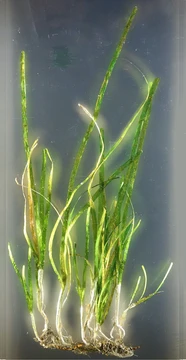
Halophila
A genus of seagrasses with unisexual flowers and salt-loving name.

Halophila is a genus of seagrasses belonging to the tape-grass family, Hydrocharitaceae. The genus was first formally described in 1806. Both the number of species within it and its classification within the order Alismatales have changed over time.
These marine plants grow fully submerged, with creeping, stolon-like stems and leafy joints. A distinctive feature is that, unlike most other seagrasses, the leaves of some Halophila species lack basal sheaths—the leaf base does not wrap around the stem.
The flowers are unisexual. Male flowers grow on stalks, with their parts arranged in multiples of three in a single row. Female flowers are stalkless and divided into three segments. The ovary has a single chamber with a long beak, and the three styles are long and simple. Ovules attach to the tops of three placentas.
The fruit is enclosed within the bract that surrounds the flower cluster (the spathe) and is topped by a beak. Each fruit contains many seeds with thick embryos.
Halophila is widespread in tropical waters, with its range extending into subtropical and temperate regions. It is found primarily in the Indian and Pacific Oceans, as well as the Mediterranean and Caribbean Seas and the Gulf of Mexico. The genus grows off the coasts of Africa, India, Australia, and various Pacific Islands.
The Latin specific epithet *halophila* means "salt-loving."
The following species are accepted by the Kew Botanical Garden:
*Halophila australis* – southern Australia *Halophila baillonii* – Caribbean, North and South America *Halophila beccarii* – South, East, and Southeast Asia *Halophila capricorni* – New Caledonia, Coral Sea islands *Halophila decipiens* – Indian and Pacific Ocean shores; Caribbean, Gulf of Mexico *Halophila engelmannii* – Mexico, Costa Rica, Bahamas, Cayman Islands, Cuba, United States (Puerto Rico, Florida, Louisiana, Texas) *Halophila gaudichaudii* – Indian Ocean, western Pacific *Halophila hawaiiana* – Hawaii *Halophila major* – Japan, Taiwan, Southeast Asia, Caroline Islands, Sri Lanka *Halophila mikii* – Japan *Halophila minor* – Indian Ocean, western Pacific *Halophila nipponica* (syn.
Quick Facts
- Taxon
- Halophila
Facts from the source article.
Lore & Background
Halophila was described as a genus in 1806. Its placement within the order Alismatales and the number of its contained species have evolved over time. The Latin specific epithet halophila refers to salt loving. The flowers are unisexual: male flowers are borne on stems with parts in multiples of three along a single row; female flowers are stalkless, divided into three segments, with a single-chambered ovary, long beak, three long simple styles, and ovules attached on top of three placentas. The fruit is included in the bract surrounding the inflorescence (the spathe) and crowned by a beak, containing many seeds with thick embryos. Unlike other seagrasses, the leaves of some species lack basal sheaths.
Reader's Guide
Halophila is notable as a widespread genus of seagrasses found in tropical, subtropical, and temperate waters, primarily in the Indian and Pacific Oceans, but also extending to the Mediterranean and Caribbean Seas and the Gulf of Mexico. It grows off the coasts of Africa, India, Australia, and the Pacific Islands. The genus was first described in 1806, and its classification within the order Alismatales and the number of its species have been subject to change. The species list accepted by Kew Botanical Garden includes 18 named species, such as Halophila ovalis from the Red Sea and western Pacific, and Halophila stipulacea, which is noted as invasive in the Caribbean. The plants are characterized by unisexual flowers, with male flowers on stems and female flowers stalkless, and fruit that is enclosed in a spathe and crowned by a beak. The name Halophila means salt loving, reflecting its marine habitat.
Did You Know?
- Unlike other seagrasses, the leaves of some Halophila species do not have basal sheaths.
- Halophila stipulacea is invasive in the Caribbean.
Frequently Asked Questions
Who is Halophila?
Halophila is a genus of fully submerged marine seagrasses placed in the tape-grass family Hydrocharitaceae, within the order Alismatales. The name was first formally published in 1806, and the genus has since gone through several taxonomic revisions.
What makes Halophila different from other seagrasses?
Its creeping, stolon-like stems and leafy joints give it a low, spreading growth habit, but its standout trait is that some species produce leaves without the basal sheath that wraps around the stem in most other seagrass genera. Additionally, its flowers are unisexual, with male blooms borne on stalks.
Where does Halophila live?
Halophila species are found in tropical, subtropical, and temperate coastal waters across the Indian and Pacific Oceans, the Mediterranean and Caribbean Seas, and the Gulf of Mexico. The salt-loving name (halo = salt, phila = loving) reflects its preference for these saline marine environments.
Why is Halophila important to the seagrass community?
Like other seagrasses, Halophila helps stabilize coastal sediments and provides habitat for small marine organisms. Its unique leaf morphology and unisexual flowering pattern also make it a key reference point for understanding evolutionary diversity within Hydrocharitaceae.
More in Seagrasses 1-24
Spotted an error? Know more?
Reader corrections go straight into our review queue. Suggest an edit · How this site is sourced