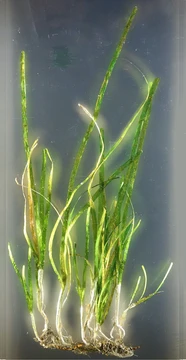
Johnson's seagrass
A clonal seagrass once listed as endangered, now considered a synonym.

Johnson's seagrass is a small, asexual marine plant belonging to the tape-grass family, Hydrocharitaceae. Though once classified as *Halophila johnsonii*, it is now understood to be a clone of the widespread species *Halophila ovalis*. As of March 2024, Plants of the World Online lists *Halophila johnsonii* as a synonym of *Halophila ovalis* subsp. *ovalis*. This seagrass grows only along roughly 200 kilometers of Florida’s southeastern coast, in lagoons from Sebastian Inlet to northern Biscayne Bay. It forms small patches, from a few centimeters to a few meters across, at depths from the intertidal zone down to three meters. It made history as the first marine plant on the U.S. endangered species list, but was removed from that listing in April 2022.
The plant has pairs of linear, petiolate leaves, each typically 2–5 centimeters long including the stem. Leaves sprout from nodes on a thin, creeping rhizome that lies at or just below the sediment surface, held down by unbranched roots. The gaps between rhizome nodes rarely exceed 3–5 centimeters, giving the plant a compact look. Female flowers have been observed, but despite decades of study, no male flowers or seeds have ever been found.
Johnson’s seagrass was the first marine plant listed under the U.S. Endangered Species Act. However, in 2022, the National Marine Fisheries Service and NOAA removed *Halophila johnsonii* from the act, based on evidence that it is not a genetically distinct taxon. Multiple studies showed it is genetically identical to the Indo-Pacific species *H. ovalis*. Because it lacks genetic diversity, it no longer meets the ESA’s definition of a species, which requires a subspecies or distinct population segment that interbreeds. All gene samples taken from the Indian River Lagoon over 17 years were uniform, confirming that Johnson’s seagrass is a clone of *H. ovalis*, closely related to populations in Africa and Antigua. The clone may have come from a recent introduction from one of those regions.
Green sea turtles, West Indian manatees, and some herbivorous fish feed on the plant. But the main threat to its survival is likely human activity, including eutrophication, dredging, turbidity, and thermal pollution.
- Family
- Hydrocharitaceae
- Former scientific name
- Halophila johnsonii
- Current treatment
- synonym of Halophila ovalis subsp. ovalis
- Geographic range
- southeastern coast of Florida, between Sebastian Inlet and northern Biscayne Bay
- Depth range
- intertidal zone down to 3 meters
- Leaf length
- 2-5 cm including petiole
- Rhizome node spacing
- rarely exceeds 3-5 cm
- Endangered listing date
- first marine plant listed on U.S. endangered species list
- Delisting date
- April 2022
Lore & Background
Johnson's seagrass occurs only on the southeastern coast of Florida, in lagoons along roughly 200 km of the Florida coastline between Sebastian Inlet and the northern part of Biscayne Bay, where it grows in small patches of a few centimeters to a few meters in diameter at depths ranging from the intertidal zone down to 3 meters. It has pairs of linearly shaped petiolate leaves, each generally 2-5 cm long including the petiole. The leaves grow from the nodes of a horizontally creeping rhizome found at or just below the surface of the sediment and held down by unbranched roots. The distance between the nodes of the rhizomes rarely exceeds 3-5 cm, making this species appear relatively small. Female flowers have been seen, but even with decade-long observational studies, neither male flowers nor seed have ever been observed.
Johnson's seagrass was the first marine plant listed on the United States endangered species list. However, in 2022 the National Marine Fisheries Service (NMFS) and National Oceanic and Atmospheric Administration (NOAA) ruled to remove Halophila johnsonii from the Federal Endangered Species Act (ESA). This ruling was based on data that showed that Johnson's seagrass is not a genetically unique taxon. All gene samples of Johnson's seagrass from Indian River Lagoon over a 17 year study were genetically uniform. In the same study it was determined that due to the lack of genetic diversity, Johnson's seagrass was a clone of H. ovalis, closely related to populations in Africa and Antigua. The clone may be derived from a recent introduction from one of those regions.
Reader's Guide
Johnson's seagrass holds a notable place in conservation history as the first marine plant listed on the United States endangered species list. Its significance stems from this pioneering status, though its legacy is complicated by subsequent taxonomic revision. In 2022, the National Marine Fisheries Service and National Oceanic and Atmospheric Administration ruled to remove it from the Federal Endangered Species Act, based on data showing it is not a genetically unique taxon. Genetic studies over a 17-year period in Indian River Lagoon found all samples to be genetically uniform, leading to the conclusion that Johnson's seagrass is a clone of the Indo-Pacific species Halophila ovalis, closely related to populations in Africa and Antigua. The clone may be derived from a recent introduction from one of those regions. Both the green sea turtle and the West Indian manatee are known to feed upon the plant, as well as some herbivorous fish. However, the main threat to its survival is probably human activity, including eutrophication, dredging, turbidity, and thermal pollution. Its removal from the ESA reflects a shift in understanding of what constitutes a species under the law, rather than an improvement in its conservation status.
More in Seagrasses 1-24
Spotted an error? Know more?
Reader corrections go straight into our review queue. Suggest an edit · How this site is sourced