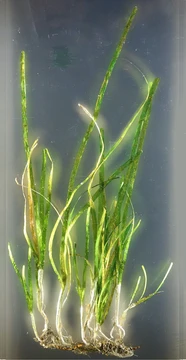
Halophila ovalis
A seagrass known as dugong grass, stabilizing sea floors.

Halophila ovalis, commonly known as paddle weed, spoon grass or dugong grass, is a seagrass in the family Hydrocharitaceae. It is a small herbaceous plant that naturally occurs in sea beds and other saltwater environments in the Indo-Pacific, and has been introduced as isolated populations in Florida, Cuba and Antigua. It is notable for its role as a food source for dugongs and for providing stability to the sea floor and habitat for other species.
Quick Facts
- Genus
- Halophila
- Species
- ovalis
Facts from the source article.
Lore & Background
The first description of the species was by Robert Brown as Caulinia ovalis, and this was transferred to the genus Halophila by Joseph Dalton Hooker in Flora Tasmaniae (1858). The species name Halophila ovata is now regarded as a synonym of this species. The plant occurs around reefs, estuaries, islands, inter-tidal areas, on soft sand or mud substrates. The leaves are ovate in outline, appearing on stems that emerge from rhizome beneath the sand. The roots get up to 800 mm long and are covered in fine root hairs. It is often found in meadows that dominate a sand bank or other patch of sea floor. The arrangement of the plant, above and below ground, provides stability to the sea floor and habitat for other species. It is used as food by dugong, and is therefore known as dugong grass. A clone of Halophila ovalis known as Johnson's seagrass occurs only on the southeastern coast of Florida; it was formerly treated as the species Halophila johnsonii, a synonym of Halophila ovalis subsp. ovalis.
Reader's Guide
Halophila ovalis is significant as a foundational species in Indo-Pacific sea beds, where its meadows dominate sand banks and provide stability to the sea floor. Its root system, reaching up to 800 mm with fine root hairs, anchors the substrate and creates habitat for other organisms. The plant is notably a primary food source for dugongs, earning it the common name dugong grass. Its introduction to isolated populations in Florida, Cuba, and Antigua extends its range beyond its natural Indo-Pacific distribution. The taxonomic history includes a transfer from Caulinia ovalis by Robert Brown to Halophila ovalis by Joseph Dalton Hooker, with Halophila ovata now considered a synonym. A distinct clone, Johnson's seagrass, occurs only on the southeastern coast of Florida and was formerly treated as the separate species Halophila johnsonii, now recognized as a synonym of Halophila ovalis subsp. ovalis. This seagrass thus illustrates both ecological importance and taxonomic complexity.
More in Seagrasses 1-24
Spotted an error? Know more?
Reader corrections go straight into our review queue. Suggest an edit · How this site is sourced