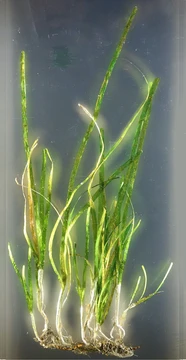
Halophila engelmannii
A seagrass with oval blades and finely serrated margins.

Halophila engelmannii is a species of seagrass in the Hydrocharitaceae family, commonly known as star grass or Engelmann's seagrass. It grows underwater on shallow sandy or muddy sea floors and is notable for being one of the few seagrasses that can thrive at depths down to 14.4 metres, often forming mixed meadows with other Halophila species.
Quick Facts
- Genus
- Halophila
- Species
- engelmannii
Facts from the source article.
Lore & Background
Halophila engelmannii is the only genus of seagrass lacking basal sheaths on the leaf stems. It has rhizomes that run along near the surface of sand or mud, with roots at the nodes to anchor them in place. Each leaf stem grows from a node and has a pair of scales halfway up and another pair at the base of the leaf blades. There are 4 to 8 blades on each stem, each up to 30 millimetres long and 6 millimetres wide, oval in shape with 6 to 8 veins and a finely serrated margin.
It is native to the Bahamas, the Cayman Islands, Costa Rica, Cuba, the Gulf Coast of the United States, the Gulf Coast of Mexico, Puerto Rico, and Trinidad and Tobago. It can grow in deeper waters than some other seagrass species, at depths down to 14.4 metres. In the Indian River Lagoon, Florida, it is one of three species of Halophila, often forming mixed seagrass meadows at greater depths than other seagrasses normally grow.
Flowering occurs in early summer when the water temperature reaches at least 22 °C. Fragments of the plant that become detached are able to grow into new plants. The seagrass meadow acts as habitat and food source for many invertebrates and fish. In the Indian River Lagoon, animals that feed on it include sea turtles, sea urchins, parrotfish, surgeonfish and possibly pinfish. The sea slug Elysia serca preferentially feeds on it by sucking sap.
Reader's Guide
Halophila engelmannii is significant as a seagrass species that contributes to underwater ecosystems in shallow sandy or muddy sea floors across the Bahamas, the Cayman Islands, Costa Rica, Cuba, the Gulf Coast of the United States, the Gulf Coast of Mexico, Puerto Rico, and Trinidad and Tobago. Its ability to grow at depths down to 14.4 metres allows it to occupy deeper zones than some other seagrasses, often forming mixed meadows with Halophila decipiens and Halophila ovalis in places like the Indian River Lagoon, Florida. These meadows serve as critical habitat and food sources for a variety of marine life, including sea turtles, sea urchins, parrotfish, surgeonfish, and possibly pinfish, as well as the sea slug Elysia serca, which preferentially feeds on it by sucking sap. The species reproduces both through flowering in early summer when water temperatures reach at least 22 °C and through vegetative propagation via detached fragments that can grow into new plants. Its unique morphology—lacking basal sheaths on leaf stems, having paired scales on the stem, and bearing oval blades with finely serrated margins—distinguishes it within the Halophila genus. The legacy of this seagrass lies in its role as a foundational component of deeper seagrass communities, supporting biodiversity and ecosystem stability in subtropical and tropical coastal waters.
Did You Know?
- Halophila engelmannii is the only seagrass genus lacking basal sheaths on the leaf stems.
- The sea slug Elysia serca preferentially feeds on Halophila engelmannii by sucking sap.
- It can grow at depths down to 14.4 metres, deeper than some other seagrass species.
More in Seagrasses 1-24
Spotted an error? Know more?
Reader corrections go straight into our review queue. Suggest an edit · How this site is sourced