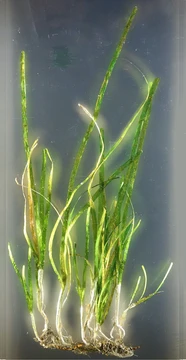
Halophila decipiens
A globally distributed seagrass with understudied ecological roles.

Halophila decipiens, called paddle grass, is a seagrass that grows in tropical waters across the Atlantic, Indo-Pacific, and beyond. Its oval leaves, 1 to 2.5 centimeters long, have serrated edges and are covered in tiny hairs. These leaves sprout from thin, white rhizomes—slightly thicker than the roots—that form branching networks on the seafloor. Unlike other seagrasses, Halophila species lack basal sheaths, the protective casings around the stem base.
This species is one of the few seagrasses with a truly global range, found in shallow waters worldwide. Genetic data show very little DNA variation between distant populations, suggesting its spread happened recently in geological time. How it achieved this global dispersal is unknown, though its small seeds may hitch a ride inside large drifts of algae or other vegetation. While present globally, it is most common in subtropical and tropical areas, forming meadows near reefs or on sandy bottoms. It grows in water deeper than 50 meters, except off southern Australia and southern Mozambique, where it appears near the shallow mouths of open estuaries. As a euryhaline species, it tolerates low salinity.
Halophila decipiens is monoecious, with male and female flowers on the same stem. The male flower emerges first, producing pollen without an exine. The female flower follows, sometimes developing into green fruits that hold up to 30 seeds. Flowering occurs in January, with fruiting and seed germination in late spring.
Seagrass beds provide habitat and breeding grounds for many organisms and are a key food source for sea urchins, sea turtles, parrotfish, and surgeonfish. This species is ephemeral and annual: its population dies off in late autumn and regenerates from seeds in spring. It often grows in mixed meadows with Halophila ovalis and Halophila spinulosa. In Hawaii, where it was discovered in 2000, it is classified as invasive and considered a threat to native Halophila hawaiiana. Elsewhere, its global distribution prevents an invasive label, but its easy dispersal and reproduction may allow it to outcompete other seagrasses in some areas. The dense root networks of Halophila decipiens have been shown to trap microplastics in the roots and surrounding sediment, raising the possibility of using it as a natural filter for ocean microplastic pollution.
Quick Facts
- Genus
- Halophila
- Species
- decipiens
Facts from the source article.
Lore & Background
Halophila decipiens has oval-shaped leaves lined with serrated edges, typically growing to a length of 1-2.5 cm. The leaves are covered in minute hairs and stem from rhizomes that create branching networks on the seafloor. The rhizomes are thin, white, and slightly thicker than the roots. Unlike other seagrass genera, Halophila species lack basal sheaths. The plant grows in short patches on the seafloor with extensive root systems underneath. It is a euryhaline species, found in areas with low salinity, and grows in water deeper than 50 m, except in southern Australia and southern Mozambique where it occurs near shallow estuary entrances. Gene sequencing shows very little DNA differences between global populations, suggesting recent dispersal, possibly aided by small seeds trapped in algal drifts.
Reader's Guide
Halophila decipiens is significant as one of the only seagrasses with a true global distribution, found in shallow waters worldwide. Its role in marine ecosystems remains understudied, though it is known to form meadows near reefs or sandy habitats, especially in subtropical and tropical environments. The plant is an ephemeral annual, dying in late autumn and recovering from seed germination in spring. It can be found in mixed meadows with Halophila ovalis and Halophila spinulosa. Seagrass beds act as habitat and breeding grounds for organisms such as sea urchins, sea turtles, parrotfish, and surgeonfish. Notably, Halophila decipiens has been classified as invasive in Hawaii, where it was discovered in 2000 and deemed a threat to local Halophila hawaiiana. Its dense root networks have been proven to trap microplastics, suggesting potential use as a natural filter for microplastic pollution. However, its overall effects on other seagrass populations and marine ecosystems remain relatively understudied.
Did You Know?
- Halophila decipiens is one of the only seagrass species with a true global distribution.
- Its leaves are covered in minute hairs and lack basal sheaths, unlike other seagrass genera.
- The plant is monoecious, with male flowers developing first, followed by female flowers that produce fruits with up to 30 seeds.
More in Seagrasses 1-24
Spotted an error? Know more?
Reader corrections go straight into our review queue. Suggest an edit · How this site is sourced