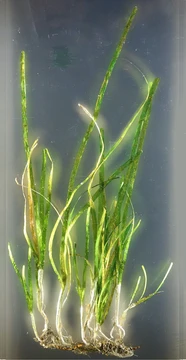
Halophila baillonis
A rare Caribbean seagrass with fragmented populations and vulnerable status.

Halophila baillonis, called clover grass, is an aquatic plant from the Hydrocharitaceae family. It is listed as vulnerable on the IUCN Red List because it is naturally uncommon and its populations are scattered.
The plant has delicate rhizomes, with one stem and one root growing from each node. Erect shoots reach up to 24 mm tall, each bearing two keeled, oval scales in the middle and a false whorl of four leaves at the tip. The leaf blades are oblong to lance-shaped, 7 to 12 mm long and 3 to 4 mm wide, with clear midribs and fine teeth along the edges. Up to 2,500 shoots can grow in a single square meter.
Clover grass is native to the Caribbean region, found in the Greater Antilles, Lesser Antilles, Colombia, Venezuela, and Belize, though its distribution is very spotty. It once grew in Guanacaste Province on Costa Rica’s Pacific coast, but has not been seen there since a severe storm in 1996, and it is unknown elsewhere in the Pacific. It lives on sandy or muddy bottoms down to about 15 m deep. In 2015, it was discovered on Brazil’s coast in Paraíba, on a sheltered sandbar at the mouth of the Mamanguape River.
Where it is abundant, such as in Belize, it grows among mangrove prop roots, mixed with *Thalassia testudinum*, *Halophila decipiens*, *Halodule wrightii*, and *Caulerpa* species. It serves as food for the West Indian manatee and provides cover for young nurse sharks. The scorched mussel lives in these seagrass meadows, and fish like the flag-fin mojarra and the permit feed on the mussels, also consuming the seagrass in the process.
This seagrass is rare and has a highly fragmented range. Its largest population is in Belize’s Placencia Lagoon, where it forms dense, single-species stands. In some areas, such as Colombia and Puerto Rico, it was confirmed in the past but has not been seen recently. Its total population appears to be declining; its area of occupancy is about 2,000 km², and it is known from roughly seven locations. For these reasons, the IUCN classifies it as vulnerable.
Quick Facts
- Genus
- Halophila
- Species
- baillonis
Facts from the source article.
Lore & Background
Halophila baillonis has fragile rhizomes with a single stem and a single root at each node. Its erect shoots reach up to 24 mm long, each bearing two obovate, keeled scales in the central portion and a pseudo-whirl of four leaves at the tip. The leaf-blades are oblong to lanceolate, 7 to 12 mm long by 3 to 4 mm wide, with pronounced midribs and fine marginal serrations. Shoot densities can reach as many as 2,500 per square metre.
Clover grass is native to the Caribbean area, known from several sites in the Greater Antilles, Lesser Antilles, Colombia, Venezuela and Belize, but its distribution is very patchy. It was previously known from Guanacaste Province on the Pacific coast of Costa Rica, but has not been seen there since a severe storm in 1996 and is not known from elsewhere in the Pacific. It grows on sandy or muddy bottoms down to about 15 m depth. In 2015 it was found on the coast of Brazil in the state of Paraíba on a sheltered bar at the mouth of the Mamanguape River.
Where plentiful, as in Belize, it grows among mangrove prop roots, intermingled with Thalassia testudinum, Halophila decipiens, Halodule wrightii and Caulerpa spp. It provides food for the West Indian manatee and concealment for young nurse sharks. The scorched mussel lives in the seagrass meadows, and fish such as the flag-fin mojarra and the permit feed on the mussels and consume the seagrass while doing so.
Reader's Guide
Halophila baillonis is significant as a rare seagrass species with a very fragmented distribution. Its greatest abundance is in the Placencia Lagoon in Belize, where it grows in dense monospecific stands. In several places, such as in Colombia and Puerto Rico, its presence has been confirmed in the past but it has not been found recently. Its total population seems to be in decline; its total area of occupancy is about 2,000 km² and it is known from about seven locations. For these reasons, the International Union for Conservation of Nature has assessed its conservation status as being 'vulnerable'. The species' patchy occurrence and apparent decline highlight the fragility of its habitats, which include sandy and muddy bottoms, mangrove prop roots, and estuarine bars. Its role in the ecosystem—providing food for manatees, concealment for young nurse sharks, and habitat for mussels and fish—underscores its ecological importance despite its rarity.
Frequently Asked Questions
What is Halophila baillonis?
Halophila baillonis, nicknamed clover grass, is a small aquatic seagrass in the Hydrocharitaceae family. It is a rare species native to Caribbean coastal waters.
What does Halophila baillonis look like?
Its erect shoots top out at just 24 mm, each crowned by a false whorl of four slender, lance-shaped leaves with finely toothed margins. The blades are roughly 7 to 12 mm long and 3 to 4 mm wide, with a distinct midrib and two keeled oval scales at the mid-shoot.
Where is Halophila baillonis native to?
Its range stretches across the Caribbean, including Brazil, the Cayman Islands, Colombia, Costa Rica, Jamaica, the Leeward Islands, the Netherlands Antilles, Panama, Puerto Rico, Trinidad and Tobago, and Venezuela. Populations tend to be scattered rather than forming dense continuous meadows.
What is Halophila baillonis's IUCN status?
The species is listed as vulnerable on the IUCN Red List, a designation driven by its naturally low abundance and the fragmented, scattered distribution of its surviving populations.
Why is Halophila baillonis important?
As one of the tiniest seagrasses in the Caribbean, it highlights how even small, low-profile plants contribute to shallow-water habitats. Its vulnerable status and patchy distribution make it a key species for conservation monitoring among seagrass enthusiasts.
More in Seagrasses 1-24
Spotted an error? Know more?
Reader corrections go straight into our review queue. Suggest an edit · How this site is sourced