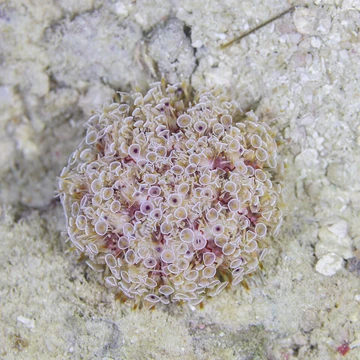
Red sea urchin
A keystone grazer and ecosystem engineer of temperate rocky reefs.

Nandaro · CC BY-SA 3.0
The red sea urchin (Mesocentrotus franciscanus) ranges from Alaska down to Baja California in the northeastern Pacific. It inhabits shallow, rocky shorelines sheltered from heavy waves, from the low-tide line down to over 280 meters (920 feet) deep, and is usually found where kelp grows.
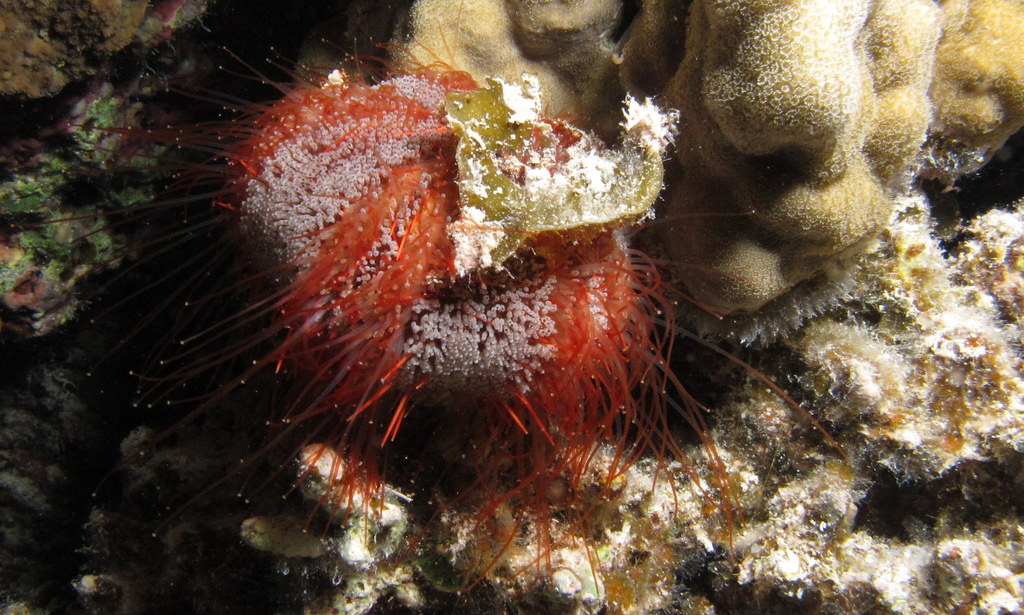
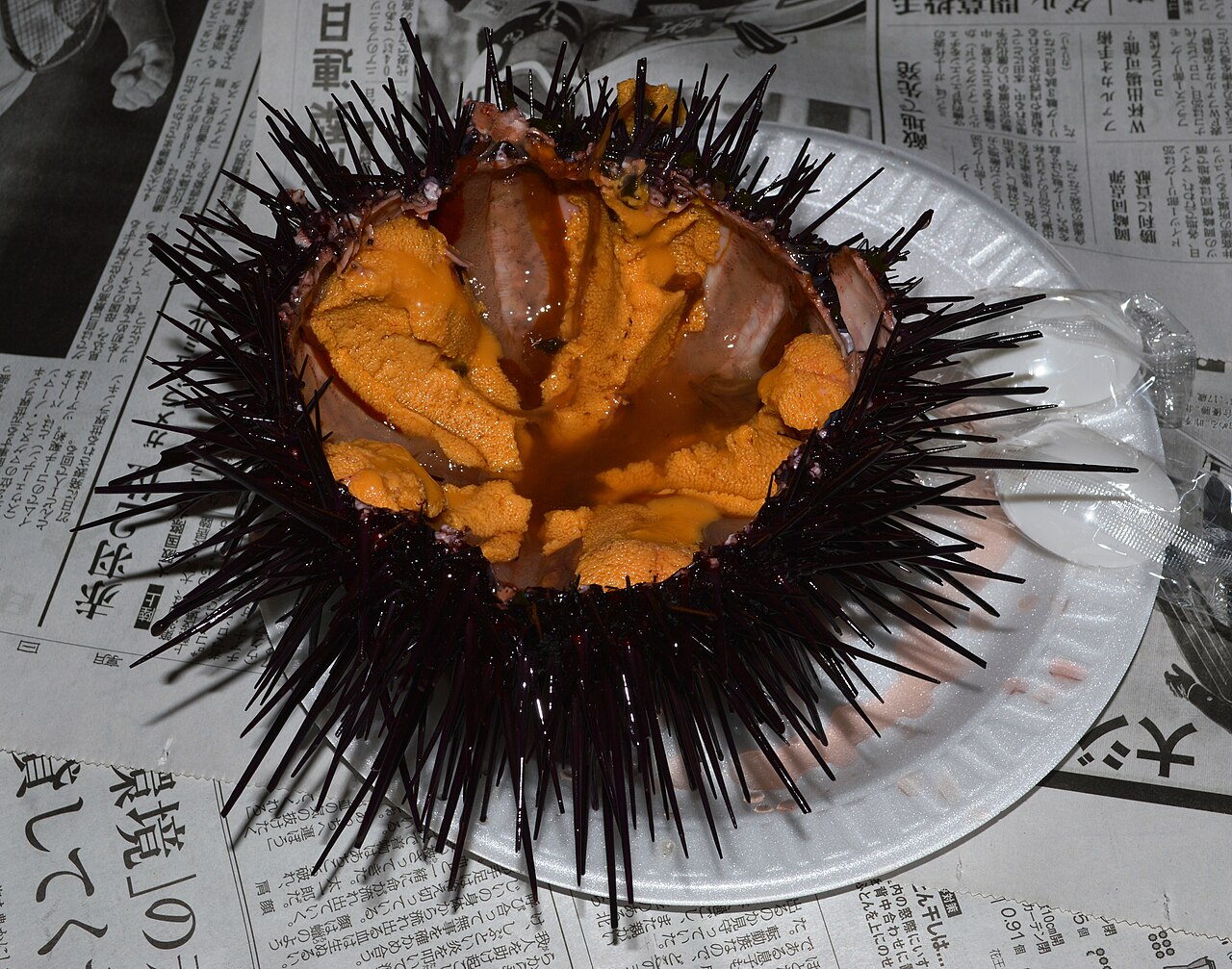
Its round body is encased in a hard shell called a test, covered in sharp spines. Color ranges from red to dark burgundy, though rare albino individuals occur. The mouth sits on the underside, ringed by five teeth. As a larva, the urchin is bilaterally symmetrical (a stage called an echinopluteus), but it later develops the five-part radial symmetry typical of echinoderms. It moves slowly across the seafloor using its spines like stilts, aided by rows of tiny tube feet with suckers that help it grip surfaces.
The mouth contains a specialized jaw structure known as Aristotle’s lantern. Its preferred food is seaweed and algae, especially giant kelp (Macrocystis pyrifera) and bull kelp (Nereocystis luetkeana), which it scrapes and tears from the seafloor. If these are scarce, adults may eat plankton, particularly *Lithothamnion* sp. and *Bossiella* sp. During larval development, urchins use bands of cilia to capture zooplankton from the water. In channels near San Juan Island, red urchins lead a notably sedentary life, with strong currents delivering abundant food.
These urchins often gather in groups of five to ten. They can regrow lost spines. Lifespans frequently exceed 30 years, and some individuals have been estimated to live over 200 years. They are voracious kelp eaters, forming grazing fronts that can devastate kelp beds. This intense grazing plays a key role in a trophic cascade along the west coast of North America, where sea otter predation controls urchin numbers, which in turn affects kelp destruction. However, in the San Juan Islands, their sedentary behavior and capture of drifting seaweed may create important habitat and energy sources below the sunlit zone, highlighting their role as ecosystem engineers in temperate rocky reefs.
Spawning peaks from June to September. Eggs are fertilized externally in the ocean, and the planktonic larvae drift for about a month before settling on the seafloor, where they metamorphose into juveniles.
Quick Facts
- Genus
- Mesocentrotus
- Species
- franciscanus
Facts from the source article.
Lore & Background
The red sea urchin's spherical body is completely covered by sharp spines that grow on a hard shell called the test, which encloses the animal. Its color can vary from red to dark burgundy, with rare albino specimens. It has a mouth on its underside surrounded by five teeth. During larval development, the body transitions from bilateral to radial symmetry; the bilaterally symmetrical larva, called an echinopluteus, develops pentaradiate symmetry. The adult crawls slowly over the sea bottom using its spines as stilts, aided by tube feet with suckers that help it move and stick to the sea floor.
Its mouth has special jaws (Aristotle's lantern) located on the bottom surface. Its preferred diet is seaweeds and algae, including giant kelp (Macrocystis pyrifera) and bull kelp (Nereocystis luetkeana), which it scrapes and tears from the sea floor. Adults may consume plankton (particularly Lithothamnion sp. and Bossiella sp.) if other food sources are not available. During larval development, urchins use bands of cilia to capture zooplankton from the water column. Red sea urchins in the channel adjacent to San Juan Island live a uniquely sedentary lifestyle, with heavy currents bringing abundant food.
Sea urchins are often found living in groups of five to ten individuals. They can regenerate lost spines. Their lifespan frequently exceeds 30 years, and some individuals have been estimated to live more than 200 years. They are notoriously ravenous kelp-eaters and are implicated in devastating kelp beds by forming grazing fronts. This intense grazing pressure is an important link in a trophic cascade along the west coast of North America, where sea otter predation influences urchin abundance, which in turn influences kelp devastation. In contrast, the sedentary behavior and capture of detrital seaweed in the San Juan Islands is hypothesized to create important habitat and energy source below the photic zone.
Reader's Guide
The red sea urchin is significant as an ecosystem engineer in temperate rocky reef ecosystems. Its intense grazing pressure on kelp beds forms a key link in a trophic cascade observed along the west coast of North America: sea otter predation influences urchin abundance, which in turn influences kelp devastation. This grazing can devastate kelp beds through grazing fronts. However, in the San Juan Islands, the urchins' sedentary lifestyle and capture of detrital seaweed is hypothesized to create important habitat and an energy source below the photic zone, contrasting with their negatively perceived impact in open coastal kelp beds. These diverse ecosystem effects highlight their importance. Spawning peaks between June and September, with external fertilization and planktonic larvae remaining in the water column for about a month before settling and metamorphosing into juveniles. Juveniles use chemical cues to locate adults, and although found almost exclusively under aggregated adults, the adults and juveniles are not directly related.
Did You Know?
- Red sea urchins can live for more than 200 years.
- They use their spines as stilts and tube feet with suckers to move and stick to the sea floor.
- Juveniles use chemical cues to locate adults, but are not directly related to them.
- In the San Juan Islands, red sea urchins live a uniquely sedentary lifestyle due to heavy currents bringing abundant food.
Physical Architecture & Symmetry
Sea urchins belong to the class Echinoidea, a name drawn from the Greek word for spine, and their bodies are a masterclass in radial design. Adults display pentagonal symmetry—five equal segments radiating from a central axis—while their pluteus larvae begin life with bilateral, mirror-image symmetry, a trait shared with chordates, arthropods, annelids, and molluscs. The rigid test, a fused calcium-carbonate endoskeleton rather than a true exoskeleton, encloses the internal organs and is divided into five ambulacral grooves and five interambulacral areas, totaling twenty plate columns. Moveable spines attach to rounded tubercles on the test's surface; most species carry two series—long primary and short secondary—arranged so the longest ring sits at the equator and the shortest at the poles. Hundreds of tiny, transparent tube feet emerge through pairs of holes in the ambulacral plates, providing both locomotion and adhesion. The mouth sits at the base, the oral surface, and the anus at the top, the aboral surface, a layout that makes the fivefold pattern immediately visible in a dried specimen even when it is subtle in living animals.
Ecological Role & Predation
In the marine food web, sea urchins occupy a pivotal middle position. They graze primarily on algae but will also consume slow-moving or sessile animals such as crinoids and sponges, making them important grazers across every ocean and climate zone, from tropical reefs to polar seabeds and even the hadal depths. Their predators are equally diverse: sharks, sea otters, starfish, wolf eels, triggerfish, and humans all prey upon them. When those natural checks are removed—whether through overfishing of predators or environmental disruption—urchin populations can explode unchecked. The consequence is the formation of urchin barrens: degraded stretches of seabed stripped of the large algae that once anchored the ecosystem, along with the animals that depended on those algae for shelter and food. This cascade effect underscores how a small, slow-crawling invertebrate, typically only three to ten centimetres across, can reshape entire benthic communities. Their very abundance and adaptability, traits that make them successful across roughly 950 species, also make them a sensitive indicator of ecosystem balance.
Deep Time & Evolutionary Lineage
Echinoid fossils reach back to the Ordovician period, approximately 450 million years in the past, making sea urchins among the oldest continuously represented animal groups on Earth. They sit within the phylum Echinodermata alongside starfish, sea cucumbers, sand dollars, brittle stars, and crinoids, and together with sea cucumbers they form the subphylum Echinozoa, defined by a globoid body plan without arms or projecting rays. Their closest echinoderm relatives are the sea cucumbers, and both groups are deuterostomes—a clade that also encompasses chordates, the lineage that includes vertebrates. This deep kinship is one reason urchins have long fascinated evolutionary biologists. The class divides into two main subclasses: Euechinoidea, the modern urchins that also contain the irregular forms like sand dollars and heart urchins, and Cidaroidea, the slate-pencil urchins with their thick, blunt spines that serve as living substrates for algae and sponges. Irregular echinoids further split into Atelostomata and Neognathostomata, reflecting secondary evolutionary shifts toward flattened, bilateral body plans suited to burrowing in soft sediments.
Scientific Legacy & Cultural Presence
Since the nineteenth century, sea urchins have served as model organisms in developmental biology, prized because their embryos proved straightforward to observe. That early utility has carried into the modern era, where researchers continue to study urchin genomes, drawn by the organism's unusual fivefold symmetry and its evolutionary relationship to chordates—insights that illuminate how bilateral and radial body plans diverged from a common deuterostome ancestor. Beyond the laboratory, certain species such as the slate-pencil urchin have become popular in home aquaria, where they prove genuinely useful for keeping algae growth in check. In a different cultural register, fossil urchin tests have been fashioned into protective amulets, a practice that hints at how long humans have regarded these spiny globes as objects of both fascination and warding power. From the hadal zone to a living room tank, the sea urchin's small, spiny body has opened windows into some of biology's most fundamental questions.
Gallery
Frequently Asked Questions
Who is Red sea urchin?
The red sea urchin (Mesocentrotus franciscanus) is a spiny marine invertebrate native to the northeastern Pacific, ranging from Alaskan waters down to Baja California. It is instantly recognizable by its round, hard-shelled body densely covered in sharp spines and a coloration that shifts from vivid red to deep burgundy, with rare albino individuals occasionally turning up.
What are Red sea urchin's powers/role?
It acts as a keystone grazer on temperate rocky reefs, continuously cropping algae and kelp to keep those communities from overgrowing. By determining which organisms can establish on the substrate, it effectively engineers the physical structure of its entire habitat.
Where can I find Red sea urchin?
You will most often encounter it on sheltered rocky shorelines where kelp forests thrive, from the low-tide zone down past 280 meters (roughly 920 feet). It strongly prefers areas buffered from heavy wave action rather than open, exposed coastlines.
How long does Red sea urchin live?
Most individuals comfortably surpass the 30-year mark, yet some specimens are estimated to survive well beyond 200 years. That extraordinary longevity makes it one of the longest-lived invertebrates in the temperate Pacific.
Why is Red sea urchin important?
Without its steady grazing pressure, algal and kelp communities on rocky reefs would shift dramatically, sending cascading effects through the food web and altering habitat for countless other species. Its dual role as grazer and ecosystem engineer makes it a linchpin of temperate Pacific marine biodiversity.
More in Sea Urchins, Part 2 1-24
Spotted an error? Know more?
Reader corrections go straight into our review queue. Suggest an edit · How this site is sourced