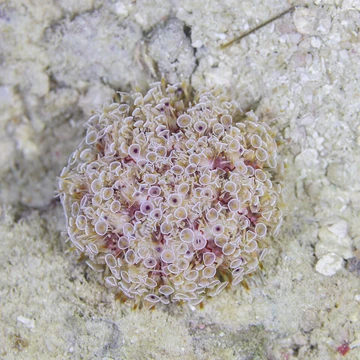
Echinarachnius parma
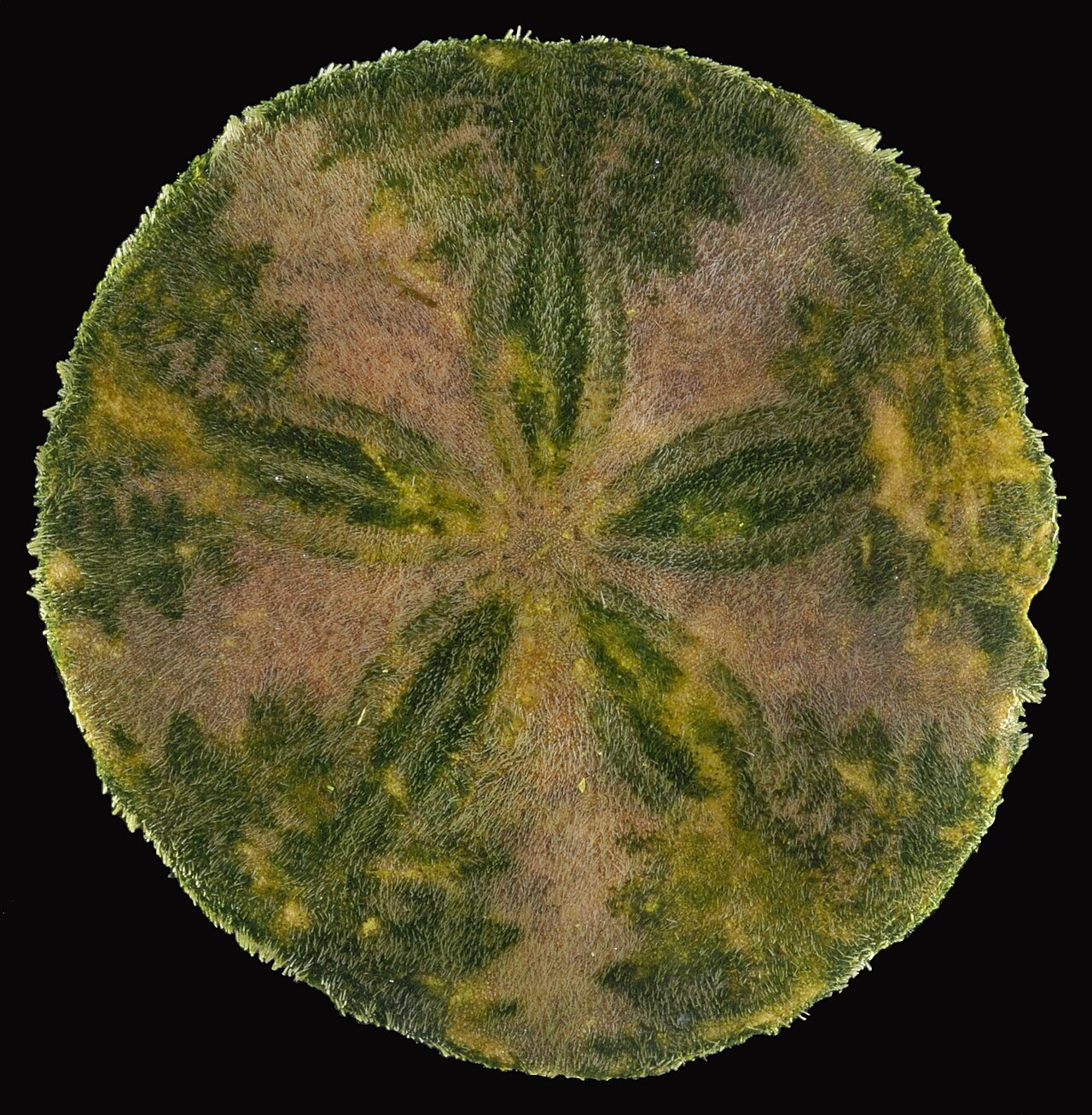
A Northern Hemisphere sand dollar with a purplish brown test.

Smithsonian Environmental Research Center · CC BY 2.0
Echinarachnius parma, the common sand dollar, lives in the Northern Hemisphere. It has three recognized subspecies: *Echinarachnius parma obesus*, *Echinarachnius parma parma*, and *Echinarachnius parma sakkalinensis*.
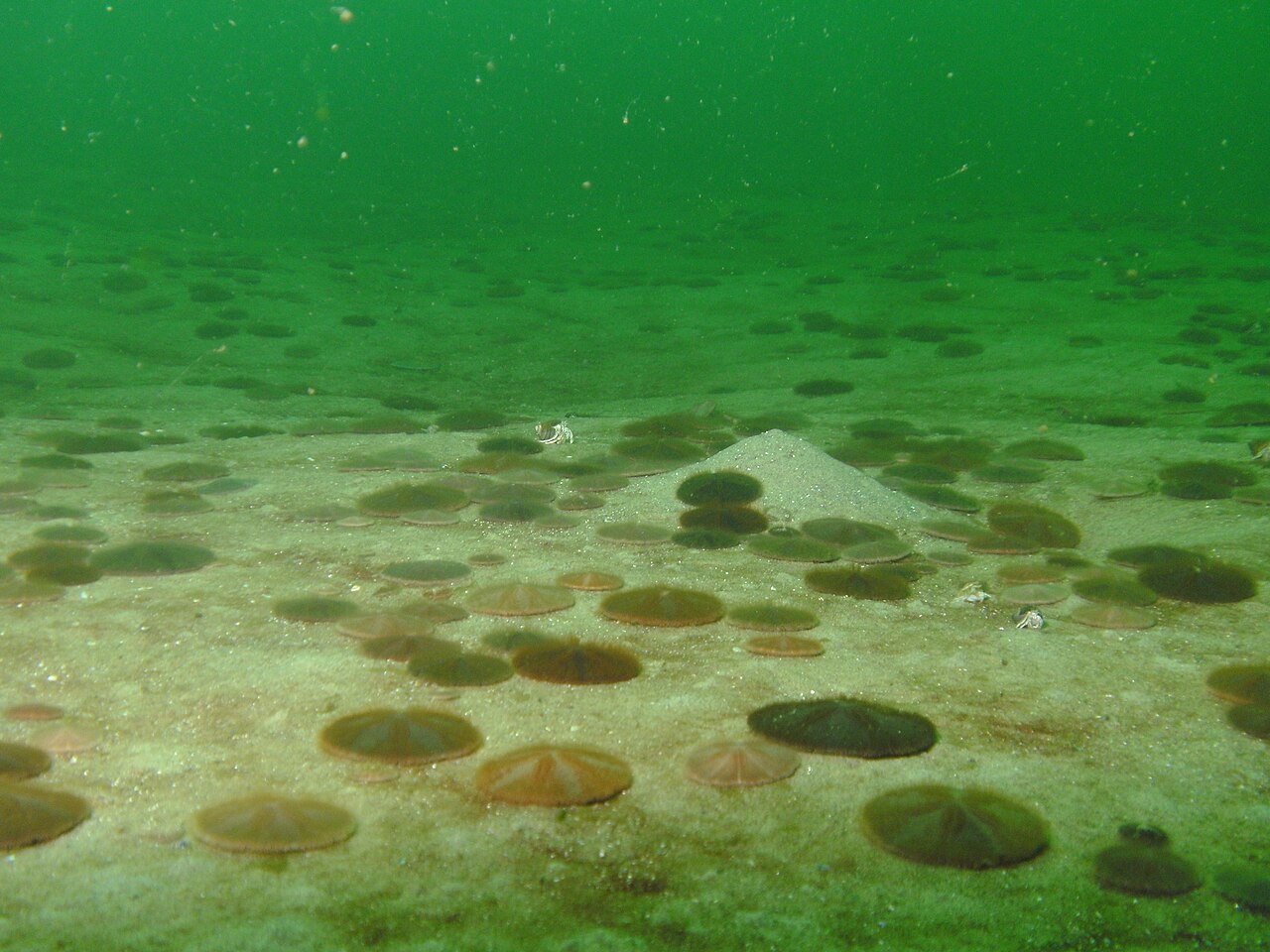
This species is found in the North Pacific and Northwest Atlantic. On North America’s east coast, its range starts at New Jersey and extends northward. It also occurs off Alaska, Siberia, British Columbia, and Japan. The animals inhabit isolated sandy areas below the low-tide line, at depths reaching 1,500 meters (about 5,000 feet).
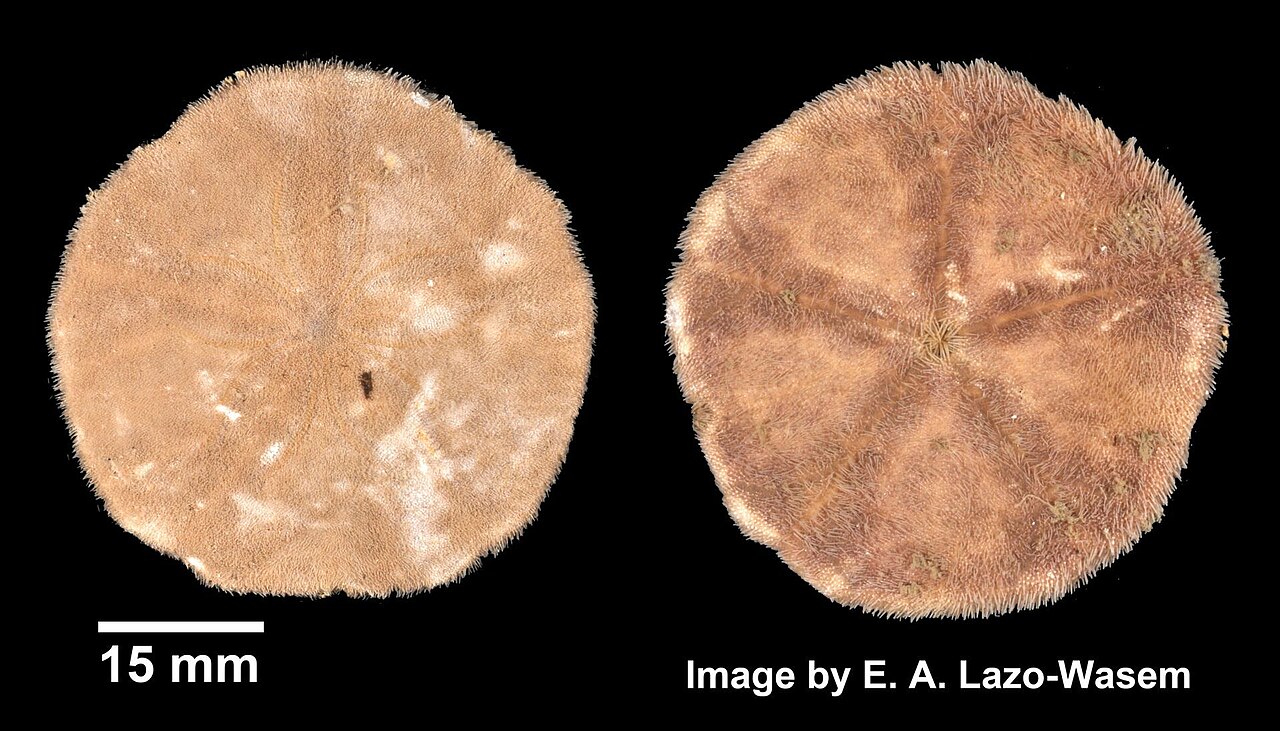
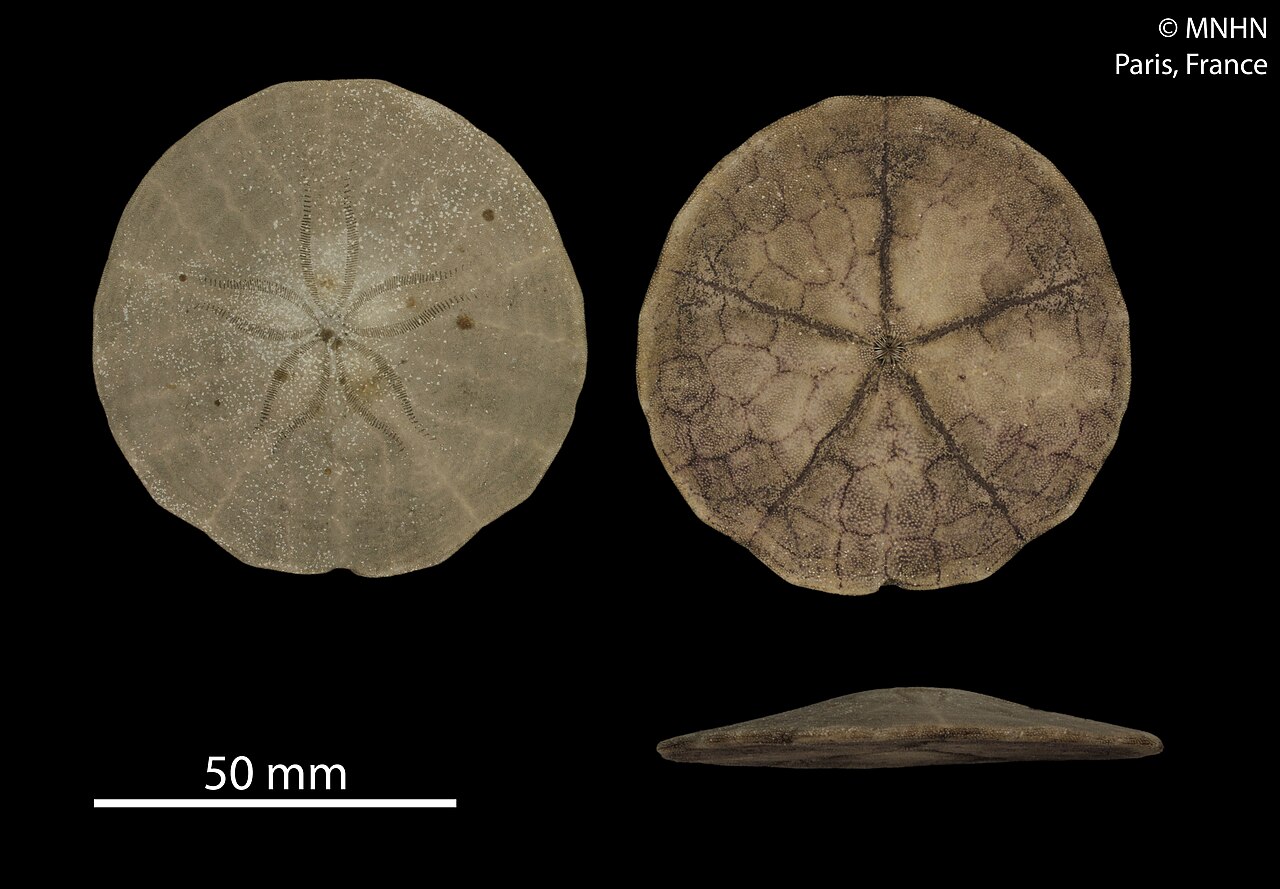
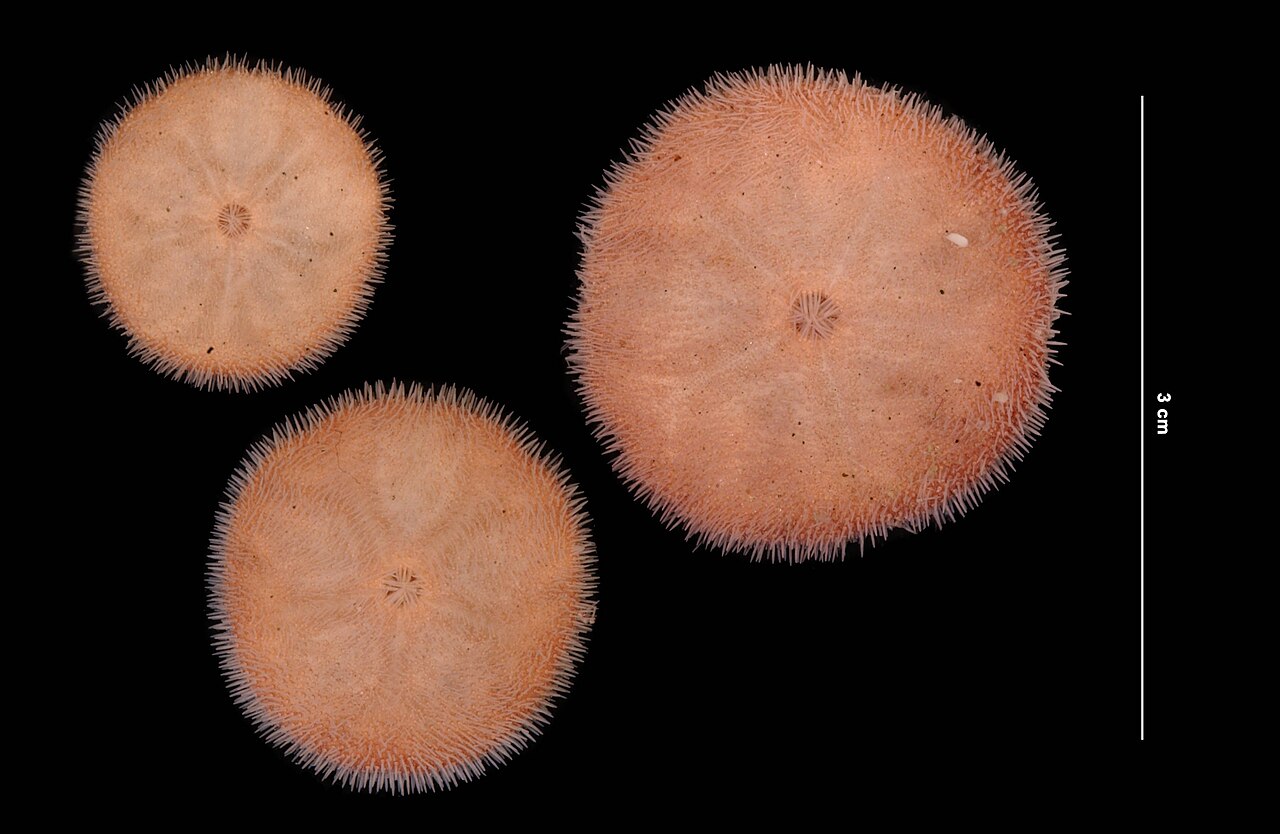
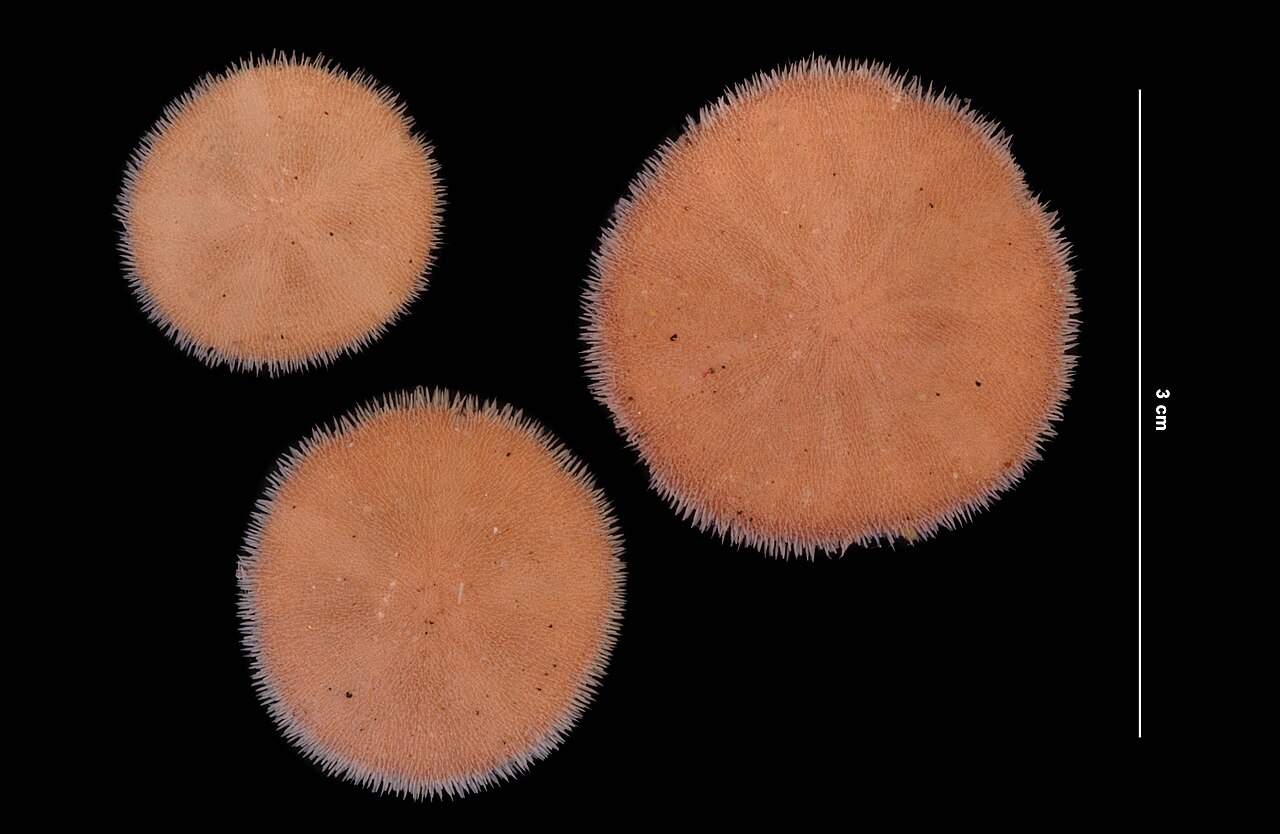
The sand dollar’s test (shell) is round, flat, and disc-shaped, typically about 7.6 centimeters (3 inches) across. Over the last five years of its roughly eight-year lifespan, it grows between 3.5 and 6 millimeters per year. The entire shell is covered in movable, maroon-colored spines. Living animals are a purplish brown; after death, when washed ashore, the shell bleaches white. This happens because only the hard, calcified exoskeleton remains, and sun and saltwater further bleach it. Like other echinoderms, it has five-fold radial symmetry, with a petal-shaped structure (the petalidium) on its upper (aboral) surface. Small, hair-like cilia line the tube feet on this surface. The mouth, food grooves, and anus are on the underside. Fossils of this and other *Echinarachnius* species date back to the Pliocene epoch.
Sand dollars are suspension feeders. They use a specialized structure called Aristotle’s lantern, and their cilia create grooves on the underside that funnel food particles—such as plankton, detritus, and microscopic organisms—toward the central mouth. Interlocking teeth, known as “doves,” grind and process the food. This strategy lets them extract nutrients from sediment and water, and they are opportunistic feeders.
Reproduction involves both sexual and asexual methods. Typically, they reproduce sexually through external fertilization, releasing eggs and sperm into the water. Under certain conditions, especially in the larval stage, they can also reproduce asexually. When facing predation threats, larvae may undergo budding or fission, splitting into smaller clones that are less detectable by predators.
Quick Facts
- Taxon
- Echinarachnius parma
Facts from the source article.
Lore & Background
The common sand dollar has been present since the Pliocene epoch. Its test is round, flat, and disc-like, typically measuring 3 inches in diameter, and is covered with maroon-colored moveable spines. The living animal is purplish brown, but when deceased and washed ashore, the shell becomes bleached white due to the remaining hard, calcified exoskeleton being further bleached by sun and saltwater. Like other echinoderms, it exhibits five-fold radial symmetry, with a petal-shaped structure (petalidium) on the aboral surface; the feet containing small hair-like structures (cilia) are located on this surface, while the mouth, food grooves, and anus are on the bottom side.
The species is found in the North Pacific and Northwest Atlantic, on the North American east coast from New Jersey north, as well as in Alaska, Siberia, British Columbia, and Japan. It inhabits isolated areas on sandy bottoms below the low tide level down to a depth of 5,000 feet. Three subspecies are recognized: Echinarachnius parma obesus, Echinarachnius parma parma, and Echinarachnius parma sakkalinensis.
Reader's Guide
Echinarachnius parma is significant as a representative sand dollar species of the Northern Hemisphere, with a fossil record extending to the Pliocene epoch. Its feeding strategy relies on a specialized structure called Aristotle's Lantern, with cilia creating grooves on the underside that funnel plankton, detritus, and microscopic organisms toward the central mouth; interlocking teeth known as 'doves' grind the food, making it an opportunistic suspension feeder. The species reproduces both sexually through external fertilization and asexually: under predation threats, larvae can reproduce by budding or fission, splitting into smaller clones that are less detectable by predators. This asexual response is considered an evolutionary adaptation to reduce predation pressure on vulnerable larvae. The species has been documented in scientific literature since at least 1826, with references including works by Say, Gosner, Mortensen, and others.
Did You Know?
- The common sand dollar's test typically measures 3 inches (7.6 cm) in diameter.
- Its lifespan is typically around 8 years, with a growth rate of 3.5 to 6 mm/yr in the latter 5 years.
- Sand dollar larvae can reproduce asexually through budding or fission when faced with predation threats.
Naming & Cultural Identity
The common sand dollar, Echinarachnius parma, has accumulated a remarkable collection of vernacular names across the globe, each rooted in what beachcombers see when a bleached specimen washes ashore. The English term "sand dollar" itself is a visual echo of the old Spanish silver coin, whose 38-to-40-millimeter diameter closely mirrors the flattened, coin-like test of a dead individual stripped of its living spines and sun-bleached to white. In New Zealand and Brazil, people call them snapper biscuits or sea cookies; South Africans recognize them as pansy shells because the five-petaled pore pattern evokes a garden flower. Spanish-speaking communities across the Americas most commonly use galleta de mar, a phrase that has bled into English usage. Other regional labels include sand cakes, cake urchins, and simply sand urchins. Each name captures a different facet of the animal's appearance once it has lost its living, velvety exterior and become a pale, disc-shaped relic on the shore.
Anatomy & Physical Design
The body plan of Echinarachnius parma is a study in elegant engineering. Its rigid endoskeleton, the test, is built from calcium carbonate plates arranged with precise fivefold radial symmetry. The iconic petal-like pattern visible on the surface is actually composed of five paired rows of pores—perforations through which tiny podia extend for gas exchange. The mouth sits at the very center of this petal design on the underside of the animal. What makes sand dollars unusual among urchins is their secondary bilateral symmetry running front to back, a trait that evolved as these creatures shifted from living atop the seafloor to burrowing beneath it. The anus, for instance, is positioned at the posterior rather than the top, and several other morphological features reflect this front-to-back axis. In living individuals, the test is draped in a dense coat of velvet-textured spines, each tipped with microscopic cilia. These spines can appear green, blue, violet, or purple depending on the species, and their coordinated movement propels the animal across the seabed.
Evolutionary History & Taxonomic Placement
Sand dollars occupy a distinct branch of the irregular urchin lineage. They split from the cassiduloids during the early Jurassic, but the first genus to qualify as a true sand dollar, Togocyamus, did not appear until the Paleocene. More recognizable, modern-looking groups followed in the Eocene, setting the stage for the diversity we see today. Taxonomically, Echinarachnius parma falls within the family Echinarachniidae, placed under the suborder Scutellina and the infraorder Scutelliformes. The broader order Clypeasteroida is divided into two suborders—Clypeasterina and Scutellina—encompassing numerous families, several of which are now extinct and known only from the fossil record. The family Echinarachniidae was described by Lambert in collaboration with Thiéry in 1914. This deep evolutionary timeline, stretching from the Jurassic through the Paleocene to the present, underscores that sand dollars represent one of the more ancient and continuously evolving lineages within the echinoid radiation.
Behavior, Habitat & the Cloning Discovery
Echinarachnius parma is a remarkably widespread inhabitant of the Northern Hemisphere, ranging from the intertidal zone down to the deep ocean. Like all sand dollars, it dwells below the mean low tide line on sandy or muddy substrates, using its spine-covered body to burrow or creep through sediment in search of shelter and food. Its diet consists primarily of algae and detrital organic matter on the ocean floor, though some sand dollar species will tilt on their side to intercept particles drifting in currents. Reproduction follows the typical echinoid pattern: separate sexes release gametes into the water column for external fertilization, and the resulting planktonic larvae pass through several developmental stages before the test begins to form and the juvenile settles onto the seafloor. In 2008, researchers made a striking discovery: certain sand dollar larvae can asexually clone themselves when they detect dissolved mucus released by a predatory fish. The split takes up to a day and produces offspring two-thirds the original length, effectively doubling the population while making each individual harder to spot.
Gallery
Frequently Asked Questions
What is Echinarachnius parma?
Echinarachnius parma is a Northern Hemisphere sand dollar easily recognized by its round, purplish-brown test. It is a cold-temperate echinoderm that inhabits sandy substrates well below the low-tide line.
Where can Echinarachnius parma be found?
Its range spans the North Pacific and Northwest Atlantic, stretching from New Jersey northward along the U.S. east coast and also occurring off Alaska, British Columbia, Japan, and Siberia. Individuals have been collected from isolated sandy patches at depths reaching roughly 1,500 meters (about 5,000 feet).
How big does Echinarachnius parma grow?
A mature specimen reaches a test diameter of approximately 3 inches (7.6 cm). In the last five years of its life, the animal adds only about 3.5 to 6 millimeters of size per year.
How long does Echinarachnius parma live?
This sand dollar typically survives around eight years, with its growth rate tapering to a few millimeters annually during the final stretch of that lifespan.
What subspecies of Echinarachnius parma are recognized?
Three subspecies are currently acknowledged in the taxonomy: E. p. obesus, E. p. parma, and E. p. sakkalinensis, each associated with different portions of the species' broad Northern Hemisphere distribution.
More in Sea Urchins, Part 2 1-24
Spotted an error? Know more?
Reader corrections go straight into our review queue. Suggest an edit · How this site is sourced