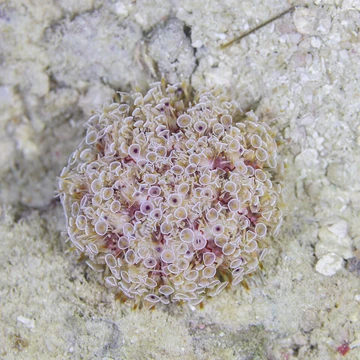
Holasteroida
An order of irregular sea urchins with marked bilateral symmetry.

Holasteroida is an order of irregular sea urchins. It is notable for its marked bilateral symmetry, including a highly elongated apical system, and for the absence of an Aristotle's lantern in the mouth. Some contemporary abyssal groups, such as Pourtalesiidae, include bottle-shaped species.
Quick Facts
- Taxon
- Holasteroida
Facts from the source article.
Lore & Background
Holasteroida is an order of irregular sea urchins characterized by a particularly marked bilateral symmetry, including for the apical system, which is highly elongated. In some contemporary abyssal groups such as Pourtalesiidae, some species are even bottle-shaped. The mouth (peristome) does not contain an Aristotle's lantern, and the anus (periproct) has migrated towards the periphery of the test. The plastron is never amphisternous. This order seems to have appeared at the lower Cretaceous.
Reader's Guide
Holasteroida represents a distinct order of irregular sea urchins whose evolutionary history extends back to the lower Cretaceous. Its defining features—marked bilateral symmetry, an elongated apical system, and the absence of an Aristotle's lantern—set it apart from regular sea urchins. The migration of the anus to the periphery of the test and the non-amphisternous plastron further characterize the group. Among its contemporary members, the abyssal family Pourtalesiidae includes bottle-shaped species, illustrating morphological adaptation to deep-sea environments. The order's classification includes numerous families, both extant and extinct, such as Hemipneustidae, Holasteridae, and Urechinidae, as listed by the World Register of Marine Species. The fossil record, including families like Disasteridae and Cardiasteridae, underscores its long-standing presence. The order's significance lies in its role in understanding echinoid evolution, particularly the transition from regular to irregular forms and the development of bilateral symmetry in response to burrowing lifestyles.
Frequently Asked Questions
Who is Holasteroida?
Holasteroida is an order of irregular sea urchins set apart by a strongly bilateral body plan and a dramatically stretched-out apical system. It occupies a distinctive niche in the urchin family tree, looking quite different from the more radially symmetric groups.
What are Holasteroida's key physical traits?
Members show pronounced bilateral symmetry, with an apical system that is notably elongated compared to other urchin orders. The anus has shifted toward the outer edge of the test, and the plastron is never amphisternous.
Does Holasteroida have an Aristotle's lantern?
No — the mouth region in this order completely lacks an Aristotle's lantern, a major departure from most other sea urchin lineages. That absence is one of the defining features fans and taxonomists use to spot a holasteroid at a glance.
When did Holasteroida first appear in the fossil record?
The order first shows up in the lower Cretaceous, making it a fairly ancient branch within the irregular urchins. Its distinctive bilateral body plan had already taken shape by that point in Earth's history.
What do modern Holasteroida look like?
Some living abyssal families, such as Pourtalesiidae, produce bottle-shaped species that are quite striking in appearance. These deep-sea forms carry forward the order's elongated, bilaterally symmetric body plan into the present day.
More in Sea Urchins, Part 2 1-24
Spotted an error? Know more?
Reader corrections go straight into our review queue. Suggest an edit · How this site is sourced