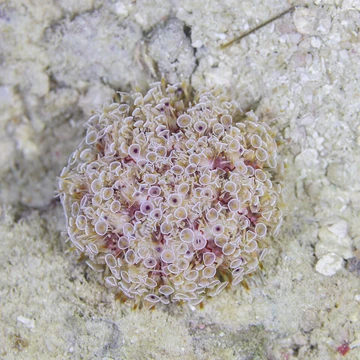
Echinocardium cordatum
A heart-shaped urchin that buries in sand worldwide.

Echinocardium cordatum, commonly known as the common heart urchin or sea potato, is a sea urchin in the family Loveniidae. It is found in subtidal regions in temperate seas throughout the world, living buried in the sandy sea floor. The species is notable for its heart-shaped test, dense mat of yellowish spines, and its ability to trap air to prevent asphyxiation while buried.
Quick Facts
- Taxon
- Echinocardium cordatum
Facts from the source article.
Lore & Background
The sea potato is a heart-shaped urchin clothed in a dense mat of furrowed yellowish spines that grow from tubercles and mostly point backwards. Its upper surface is flattened with an indentation near the front. During life, the spines trap air, which helps prevent asphyxiation for the buried urchin. The ambulacra form a broad furrow in a star shape extending down the sides of the test, with two series each of two rows of tube feet. The test reaches from six to nine centimetres in length. The species was first described as Echinus cordatum in 1777 by Thomas Pennant and has been synonymised with several other names, including Echinocardium sebae, Spatangus arcuarius, and others. A 2016 study revealed that it was a complex of at least five species, with three in Europe, one in Australia, and one in the NW Pacific.
Reader's Guide
Echinocardium cordatum is significant as a widely distributed burrowing sea urchin found in temperate seas worldwide, from the north Atlantic to the west Pacific, around Australia, New Zealand, South Africa, and the Gulf of California, at depths down to 230 metres. It is very common round the coasts of the British Isles in the neritic zone. The sea potato buries itself in sand to a depth of ten to fifteen centimetres, preferring sediments with a grain size of 200 to 300 μm and low mud content. It creates a respiratory channel to the surface and two sanitary channels behind itself, all lined by mucus. Its burrows are marked by a conical depression where detritus collects, which the urchin uses as food, passed down by long tube feet. Reproduction occurs via broadcast spawning, with echinoplutei larvae having four pairs of arms and being laterally flattened; metamorphosis takes place about 39 days after fertilisation. The lifespan is thought to be ten or more years. Ecologically, it is often found with bivalve molluscs such as Tellina fabula, Ensis ensis, and Venus striatula, and the bivalve Tellimya ferruginosa lives commensally in its burrow, with up to fourteen individuals found in one burrow. The amphipod Urothoe marina also uses the burrow. In culture, the test is traditionally referred to as a 'Virgin Mary' shell in West Cork, Ireland, where patterns on the test are thought to resemble an apparition of the Virgin Mary, with associations to May and the Feast of the Assumption.
Did You Know?
- The sea potato traps air in its spines to prevent asphyxiation while buried.
- A 2016 study revealed that Echinocardium cordatum is a complex of at least five species.
- The bivalve Tellimya ferruginosa lives commensally in the sea potato's burrow, with up to fourteen found in one burrow.
- In West Cork, Ireland, the test is traditionally called a 'Virgin Mary' shell.
Frequently Asked Questions
Who is Echinocardium cordatum?
Echinocardium cordatum is a small sea urchin in the family Loveniidae, best known by its nicknames 'common heart urchin' or 'sea potato.' It's instantly recognisable by its heart-shaped test and the dense mat of yellowish spines covering its body.
What are Echinocardium cordatum's survival powers?
Its standout trick is trapping a pocket of air around itself, which prevents suffocation while it lives buried ten to fifteen centimetres deep in sandy sediment. This air-trapping adaptation is what lets it thrive in subtidal sandy habitats without ever breaking the surface.
How does Echinocardium cordatum's life cycle work?
After fertilisation, its free-swimming larvae need roughly 39 days to metamorphose into a tiny juvenile that drops to the sea floor. The juvenile then buries itself in fine sand (grains around 200–300 µm) and grows to a test length of six to nine centimetres over its lifetime.
Where can fans spot Echinocardium cordatum in the wild?
This species has a truly global range, turning up in subtidal sandy bottoms across temperate seas worldwide. It has been recorded at depths up to 230 metres, always in that characteristic buried, sand-dwelling posture.
Why is Echinocardium cordatum important to the urchin community?
It was first formally described in 1777 by Thomas Pennant as Echinus cordatum, making it one of the longer-documented urchin species in the literature. Its heart-shaped test, worldwide distribution, and unique air-trapping behaviour make it a go-to example for studying how benthic invertebrates adapt to life hidden beneath the sea floor.
More in Sea Urchins, Part 2 1-24
Spotted an error? Know more?
Reader corrections go straight into our review queue. Suggest an edit · How this site is sourced