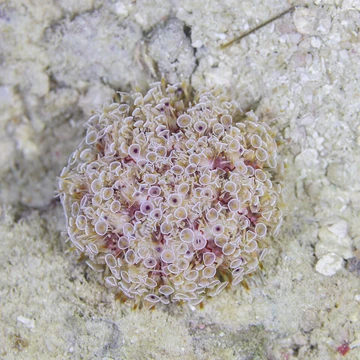
Echinocyamus pusillus
A small sand dollar that buries in gravel and turns green when injured.

Echinocyamus pusillus, commonly known as the pea urchin or green urchin, is a species of sand dollar in the family Fibulariidae. It is native to the northeastern Atlantic Ocean and the Mediterranean Sea, where it buries itself in gravel or coarse sand at depths down to about 1,250 m.
Quick Facts
- Genus
- Echinocyamus
- Species
- pusillus
Facts from the source article.
Lore & Background
Echinocyamus pusillus has a flattened, oval body up to 15 mm long, with a slightly pointed anterior end. Its aboral surface is convex and the oral surface is flat. The ambulacral plates widen into a petal-like pattern on the aboral surface, through which six to nine pairs of tube feet protrude. The test is covered in short dense spines of two types: relatively long, sharply-pointed ones and shorter ones with serrated tips. The mouth is central on the oral surface, and the anus is also on the oral surface but further back. The animal is greenish or yellowish-grey, but turns bright green if injured.
Its range extends from Iceland, Norway, and Denmark south to the Azores, Cape Bojador in Western Sahara, and the Mediterranean Sea. It is common in the North Sea and around the coasts of Britain, occurring from the lower subtidal down to about 1,250 m. It buries itself in gravel or coarse sand.
The spines are covered with fine, hair-like cilia and are used to burrow or creep through sediment while searching for food. It feeds on detritus, Foraminifera, diatoms, and other edible particles, moving these with its tube feet to its mouth, where they are crushed by its jaws. It is often found in association with sea urchins such as Spatangus purpureus and Psammechinus miliaris, the starfish Asterias rubens, and the brittle star Ophiura albida.
Reader's Guide
Echinocyamus pusillus is notable as a small sand dollar species that inhabits the northeastern Atlantic and Mediterranean, burying in gravel and coarse sand at depths up to 1,250 m. Its flattened, oval body and dense spines give it a furry appearance, and its ability to turn bright green when injured is a distinctive characteristic. The species feeds on detritus and small organisms, using its tube feet and jaws to process food. It is often found alongside other echinoderms such as Spatangus purpureus, Psammechinus miliaris, Asterias rubens, and Ophiura albida, indicating its role in benthic communities. The presence of two types of spines—long pointed ones and shorter serrated ones—aids in burrowing and movement through sediment. Its wide distribution from Iceland to the Mediterranean underscores its adaptability to various cold-water and temperate marine environments.
Did You Know?
- Echinocyamus pusillus turns bright green if it gets injured.
- It has two types of spines: long sharply-pointed ones and shorter ones with serrated tips.
- Its range extends from Iceland and Norway to the Azores and the Mediterranean Sea.
Frequently Asked Questions
Who is Echinocyamus pusillus?
Echinocyamus pusillus is a tiny sand dollar in the family Fibulariidae, commonly called the pea urchin or green urchin. It is native to the northeastern Atlantic and the Mediterranean, where it spends its life buried in gravel or coarse sand.
What does Echinocyamus pusillus look like?
Under normal conditions its body is a muted greenish or yellowish-grey, blending into the sediment around it. If the animal is damaged or stressed, however, it flashes a vivid bright green that is impossible to miss.
Where does Echinocyamus pusillus live and how deep can it be found?
It inhabits gravel beds and coarse sandy substrates across the northeastern Atlantic Ocean and the Mediterranean Sea. Individuals have been recorded at depths reaching roughly 1,250 m (about 4,000 ft), well into the deep-sea zone.
How big does Echinocyamus pusillus get?
It is one of the smallest sand dollars you will encounter, capping out at around 15 mm (0.6 in) in maximum length. Its pea-sized stature is exactly why the common name "pea urchin" stuck among collectors and divers.
Why is Echinocyamus pusillus important to the fan community?
Its dramatic color shift from dull grey-green to electric green when injured makes it a favorite subject for time-lapse videos and close-up macro photography. Fans also appreciate that it is a true benthic burrower, spending its whole life hidden in sediment rather than crawling openly like many other echinoderms.
More in Sea Urchins, Part 2 1-24
Spotted an error? Know more?
Reader corrections go straight into our review queue. Suggest an edit · How this site is sourced