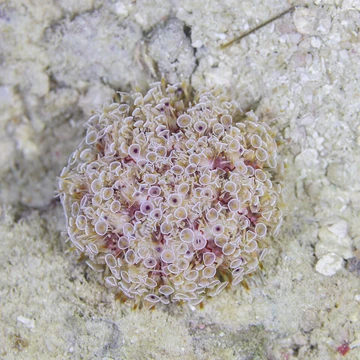
Prionocidaris thomasi
A fuzzy-spined urchin with maroon secondary spines from the Pacific.

Prionocidaris thomasi, called Thomas's urchin, is a sea urchin in the family Cidaridae. Its spines look fuzzy because algae grows on them, and the urchin's bright maroon color comes from the small secondary spines underneath the larger, thicker ones. Including its spines, the largest individuals reach about 5 to 6 inches (130 to 150 mm).
To move across the rocks where it lives, Thomas's urchin uses small tube feet on its underside. It scrapes algae off rocks with five calcareous teeth, a structure known as Aristotle's lantern.
This species can reproduce both sexually and asexually. Like most echinoderms, it releases gametes into the water for fertilization during mass spawning events. After a few months swimming and eating phytoplankton, the larvae find a suitable spot to transform into juveniles that look more like the adults.
Thomas's urchin is native to the central and eastern Pacific Ocean. It lives among the islands of the Papahānaumokuākea Marine National Monument, as well as on Kauaʻi and Oʻahu. It is usually found at depths of 110 to 150 meters (330 to 490 feet), but can also occur in shallower water. It is occasionally seen as shallow as 9 meters (30 feet) in places like Sharks Cove on Oʻahu's North Shore and other protected reefs, such as those around Midway Atoll.
Like many sea urchins, this species faces threats from aquarium collectors and from climate change, which causes coral bleaching and death.
Quick Facts
- Genus
- Prionocidaris
- Species
- thomasi
Facts from the source article.
Lore & Background
Prionocidaris thomasi is characterized by its fuzzy-looking spines, a result of algae growth, and its bright maroon color derived from smaller secondary spines located below the larger, thicker spines. It can reach a maximum size of about 5 to 6 inches (130–150 mm) including its spines.
For mobility, this urchin uses small tube feet underneath its body to move across rocks. It feeds by scraping algae off rocks using five calcareous teeth known as Aristotle's lantern.
Reproduction occurs both sexually and asexually. During mass spawning events, gametes are released into the water for fertilization. Larvae swim and eat phytoplankton for a few months before settling to transform into a juvenile form resembling the adult.
Reader's Guide
Prionocidaris thomasi is significant as a member of the family Cidaridae found in the central and eastern Pacific Ocean. Its distribution includes the Papahānaumokuākea Marine National Monument, Kauaʻi, and Oʻahu, typically at depths of 100–150 meters but occasionally as shallow as 9 meters in protected reefs like Sharks Cove on Oahu's North Shore and around Midway Atoll. The species faces threats from aquarium collectors and climate change, which causes coral bleaching and death. Its notable fuzzy spines, caused by algae, and maroon secondary spines distinguish it visually. The urchin's ability to reproduce both sexually and asexually, along with its use of Aristotle's lantern for scraping algae, highlights its ecological role in reef environments. Conservation concerns mirror those of many sea urchins, emphasizing the impact of human activities and environmental change on its habitat.
Did You Know?
- The fuzzy appearance of its spines is caused by algae growth.
- Its bright maroon color comes from smaller secondary spines beneath the larger ones.
- It uses five calcareous teeth called Aristotle's lantern to scrape algae off rocks.
More in Sea Urchins, Part 2 1-24
Spotted an error? Know more?
Reader corrections go straight into our review queue. Suggest an edit · How this site is sourced