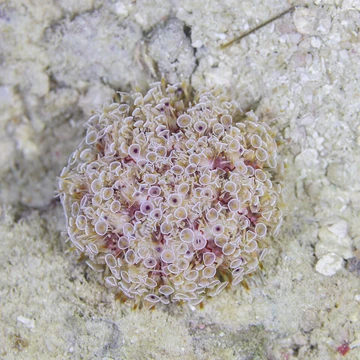
Meoma ventricosa
A large Caribbean urchin with dual symmetry and burrowing habits.

Meoma ventricosa, commonly known as the cake urchin or red heart urchin, is a large species of sea urchin found in shallow Caribbean waters. It is notable for its combination of pentagonal radial symmetry and bilateral symmetry, giving it a sand-dollar appearance, and for its ability to burrow through sediment while feeding on organic films.
Quick Facts
- Genus
- Meoma (echinoderm)
- Species
- ventricosa
Facts from the source article.
Lore & Background
The red heart urchin has a somewhat flattened, heart-shaped test made of closely fitting calcium carbonate plates, covered by short, dense, movable spines on small tubercles. The test is dark reddish-brown and the spines a little paler. Although it has pentagonal radial symmetry, it also has bilateral symmetry because one interambulacral area is undeveloped, leaving only four apparent. The mouth is on the oral surface near the anterior end and the anus at the posterior end.
It inhabits reef flats, turtle grass beds, areas of coral fragments, and deep reefs in the Caribbean Sea, the Bahamas, Florida, and Bermuda. It buries itself in sedimentary areas with sand, silt, or coarse coral rubble. The urchin feeds by swallowing sediment coated with films of algae and bacteria; fifty-six tube feet near the mouth form a disc that uses mucus to adhere sand particles, which are then retracted into the mouth. Growth is slow, limited by organic material and oxygen in the sediment. Adults often emerge onto the seabed at night and reburrow by day, while juveniles remain permanently buried.
Predators include stingrays, other fish, loggerhead turtles, and the sea star Oreaster reticulatus. The urchin can emit a noxious yellow exudate that repels fish. In 1997, an epizootic off Curaçao caused by the bacterium Pseudoalteromonas led to spine loss and death, possibly linked to polluted water. Breeding occurs in Florida between August and February, with planktonic larvae settling on sandy seabeds. Most adults host the parasitic crab Dissodactylus primitivus, usually near the mouth.
Reader's Guide
The red heart urchin is significant for its ecological role in sediment disturbance: during feeding, it increases water content and decreases sediment density, which may boost the growth of algae and bacteria that form its food films. This impact on the microhabitat is considerable. Its slow growth rate is tied to the limited organic material and oxygen in sediment, especially at night, which drives its nocturnal emergence behavior. The 1997 epizootic event off Curaçao highlights its vulnerability to bacterial disease linked to environmental pollution, as the bacterium Pseudoalteromonas caused spine loss and mortality in a localized area down-current from a harbor. The species also serves as a host for the parasitic crab Dissodactylus primitivus, a common relationship among adults. Its dual symmetry—combining pentagonal radial and bilateral features—makes it a notable example of morphological adaptation in echinoids, resembling sand dollars. The urchin's burrowing rate of 3 to 6 centimeters per hour by day, doubling at night, and its ability to leave depressed trails and mounds, further underscore its role as a bioturbator in Caribbean sedimentary environments.
Did You Know?
- The red heart urchin can reach a diameter of 20 centimeters.
- It has both pentagonal radial symmetry and bilateral symmetry, with two of five sections merged more closely.
- It burrows at 3 to 6 centimeters per hour during the day and twice as fast at night.
Frequently Asked Questions
What is Meoma ventricosa?
Meoma ventricosa is a large Caribbean sea urchin that fans usually call the cake urchin or red heart urchin. It's one of the bigger species you'll bump into in shallow tropical waters.
What's special about Meoma ventricosa's body shape?
Instead of looking like a typical spiky globe, it blends pentagonal radial symmetry with bilateral symmetry, giving it a flattened, sand-dollar-like profile. That dual-symmetry combo is what makes it stand out in the urchin lineup.
How does Meoma ventricosa actually feed?
It digs through sandy sediment in search of organic films, covering roughly 3 to 6 centimetres per hour during the day. At night it speeds up to about twice that rate, so it's most active after dark.
How big does Meoma ventricosa get and where does it live?
It can reach up to 20 centimetres across and is found anywhere from the intertidal zone down to around 200 metres in Caribbean waters. That wide depth range makes it one of the more versatile urchin species in the region.
When does Meoma ventricosa reproduce?
Breeding runs from August through February, with the heaviest activity landing between November and January. The species is also split into two recognized subspecies: M. v. grandis and M. v. ventricosa.
More in Sea Urchins, Part 2 1-24
Spotted an error? Know more?
Reader corrections go straight into our review queue. Suggest an edit · How this site is sourced