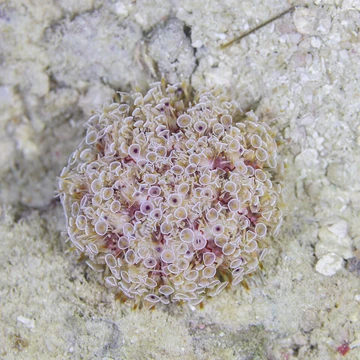
Goniocidaris umbraculum
A brooding sea urchin from southern New Zealand waters.

Goniocidaris umbraculum, or kina taratara in Māori, is a cidaroid sea urchin living on the continental shelf off southern New Zealand. It is especially abundant on a seabed of shell and bryozoan rubble at a depth of 95 meters off Otago. The test reaches 30 mm in diameter. Its main spines are thick, blunt, and usually shorter than the test; those on the upper surface have small flat discs at the tip and thornlike projections near the base. The test is greenish-brown, the spines pale brown and often green-tinged at the base, and they are frequently overgrown by epiphytes like hydroids, sponges, and bryozoa.
This urchin is native to southern New Zealand waters, common in Foveaux Strait, along the eastern coast of South Island up to Cook Strait, and on the Chatham Rise, at depths of 60 to 400 meters on coarse sand or rubble. It feeds on the bryozoan *Filicea elegans*.
Its reproductive strategy is unusual: females brood their eggs on the flared peristome surrounding the mouth. Prior to research on this species, only two other brooding sea urchins had been studied—*Cassidulus caribaearum* and *Abatus cordatus*—though several arctic and subarctic species were known to brood. *G. umbraculum* is gonochoric, with separate sexes. Spawning occurs around July. The large, buoyant eggs emerge from the gonopore on the upper surface and are retained by the female. Tube feet and cilia then move the eggs along channels between the spines to the peristome, a process taking several minutes; the peristome depresses slightly to hold them. The spines around the mouth retain up to sixty eggs for about two months. Once the juveniles develop tube feet, they move to other parts of the test but continue to be brooded for another two months. This strategy may have evolved as the species moved into colder southern waters.
Quick Facts
- Genus
- Goniocidaris
- Species
- umbraculum
Facts from the source article.
Lore & Background
Goniocidaris umbraculum grows to a test diameter of 30 mm. Its main spines are thick, blunt, and usually shorter than the test diameter; those on the aboral surface have small flat discs at the tip and thornlike projections near the base. The test is greenish-brown, and the spines are pale brown, often tinged green near the base. They are frequently overgrown by epiphytes such as hydroids, sponges, and bryozoa.
This species is native to the sea around southern New Zealand, common in Foveaux Strait, on the eastern coast of South Island as far north as Cook Strait, and on the Chatham Rise, at depths between about 60 and 400 m on coarse sand or rubble. It is plentiful on a seabed composed of seashell and bryozoan rubble at a depth of 95 m off Otago.
Goniocidaris umbraculum is gonochoric, with spawning around July. The eggs have large yolks and are buoyant; if detached, they float to the surface. Females retain the eggs as they emerge from the gonopore on the aboral surface, then move them to the peristome via tube feet and cilia along channels between spines. The peristome becomes slightly depressed to hold up to 60 eggs for about two months. After juveniles develop tube feet, they move to other parts of the test but continue to be brooded for another two months. This unusual reproductive strategy may have developed when the species evolved to live in colder waters further south than other members of its genus.
Reader's Guide
Goniocidaris umbraculum is significant primarily for its brooding reproductive biology. Prior to research into its breeding, only two other sea urchins—Cassidulus caribaearum and Abatus cordatus—had been studied for brooding young, though several arctic and subarctic species were known to do so. This makes Goniocidaris umbraculum a key species for understanding the evolution of parental care in echinoderms. Its method of moving eggs from the gonopore to the peristome using tube feet and cilia, and the subsequent two-month brooding period on the peristome followed by another two months on other parts of the test, represents a complex and relatively rare strategy among sea urchins. The species also feeds on the bryozoan Filicea elegans, linking it to specific ecological interactions on the seabed. Its presence on coarse sand or rubble at depths from 60 to 400 m, and its abundance in areas like Foveaux Strait and the Chatham Rise, mark it as a characteristic component of southern New Zealand's benthic communities. The article suggests that this brooding behavior may have evolved as an adaptation to colder waters, providing insight into how environmental pressures shape reproductive strategies.
Did You Know?
- Goniocidaris umbraculum broods its eggs on the flared peristome surrounding its mouth.
- Prior to research on this species, only two other sea urchins had been studied for brooding: Cassidulus caribaearum and Abatus cordatus.
- The eggs are buoyant and will float to the surface if detached from the female.
- This sea urchin feeds on the bryozoan Filicea elegans.
More in Sea Urchins, Part 2 1-24
Spotted an error? Know more?
Reader corrections go straight into our review queue. Suggest an edit · How this site is sourced